
Cyber Threat Hunting in Smart Cities and Critical Infrastructure
Advanced Technical Approaches for Proactive Detection
Abstract
The convergence of heterogeneous IoT devices, operational technology (OT), and IT systems in smart cities and critical infrastructure significantly broadens the threat surface and attack vectors exploited by sophisticated adversaries. Reactive defenses are insufficient for detecting stealthy, multi-stage attacks within these environments. This paper provides an in-depth technical exposition of cyber threat hunting tailored to the complexities of smart city ecosystems and critical infrastructure, detailing advanced telemetry collection, analytics frameworks, behavioral and anomaly detection models, and integrated hunting workflows. We present architectural models optimized for scale, latency, and heterogeneity, supported by recent empirical findings. The goal is to equip advanced cybersecurity professionals with a rigorous blueprint for implementing threat hunting operations in these mission-critical contexts.
1. Smart City Challenges and Risk Landscape
1.1 Complex, Heterogeneous Ecosystems
Smart cities amalgamate a vast array of systems — from legacy OT to modern IT, diverse IoT endpoints, cloud services, and third-party applications — creating a multifaceted environment:
-
Device Diversity: Deployments encompass millions of IoT devices with heterogeneous hardware architectures (ARM, MIPS, x86), OS platforms (RTOS, Linux variants, Windows IoT), and communication protocols (Zigbee, LoRaWAN, 5G, Ethernet). This diversity complicates unified security management and telemetry collection due to disparate firmware, patching cycles, and device capabilities.
-
Interoperability Requirements: Legacy industrial protocols such as Modbus, BACnet, and early versions of OPC UA often lack encryption or authentication, necessitating protocol-aware threat hunting solutions that can operate on plaintext or minimally protected channels.
-
Operational Constraints: Real-time operational demands impose strict latency and availability requirements, limiting options for intrusive scanning or frequent patching. Many OT devices cannot host endpoint detection agents or support advanced cryptographic functions without risking operational integrity.
1.2 Expanded Attack Surface
Smart cities inherently increase attack vectors:
-
Insecure IoT Devices: Default credentials, infrequent firmware updates, and absence of hardware roots of trust render IoT endpoints vulnerable to compromise and botnet formation, a prime vector for lateral movement and distributed denial-of-service attacks.
-
Supply Chain Vulnerabilities: The complexity of multi-tier hardware and software sourcing introduces risks of pre-installed backdoors or malicious firmware variants that evade standard validation.
-
Cloud and Third-Party Dependencies: Cloud-hosted analytics and third-party APIs introduce new risk domains, requiring threat hunting to encompass cloud telemetry and inter-service communication patterns.
-
Wireless Communications: Protocols like LoRaWAN, Zigbee, and proprietary wireless solutions are susceptible to jamming, spoofing, and man-in-the-middle attacks given limited native security features.
1.3 Attack Complexity and Adversary Sophistication
-
Multi-Stage, Stealthy Attacks: Advanced Persistent Threats (APTs) leverage sophisticated tactics including zero-day exploits, lateral movement across segmented networks, and multi-protocol command-and-control to maintain persistence while evading traditional detection.
-
Physical-Cyber Convergence: Exploiting cyber vulnerabilities to effect physical disruptions — e.g., manipulating traffic control signals or water treatment processes — highlights the criticality of synchronized cyber-physical threat hunting.
-
Insider Threats: Privileged insiders can misuse operational access to facilitate compromise or data exfiltration, often bypassing perimeter controls and necessitating robust user behavior analytics.
1.4 Data Privacy and Regulatory Risks
-
Personal Data Exposure: Extensive citizen data collection mandates compliance with regulations such as GDPR and CCPA, elevating risk around data confidentiality and necessitating rigorous access controls and audit trails.
-
Data Integrity and Availability: Cyberattacks targeting sensor data streams or operational databases can cause erroneous decision-making or service disruptions, emphasizing the importance of integrity monitoring and anomaly detection.
1.5 Security Operations Challenges
-
Visibility Gaps: Distributed, heterogeneous environments and proprietary protocols create blind spots that can obscure adversarial activities.
-
Incident Response Complexity: The necessity for uninterrupted critical services complicates incident containment and remediation, requiring integrated, minimally invasive hunting tools.
-
Resource Constraints: Limited cybersecurity staffing in municipalities demands automated, scalable detection and investigation platforms capable of ingesting vast, disparate data sources.
2. Threat Hunting Methodology for Smart Cities and Critical Infrastructure
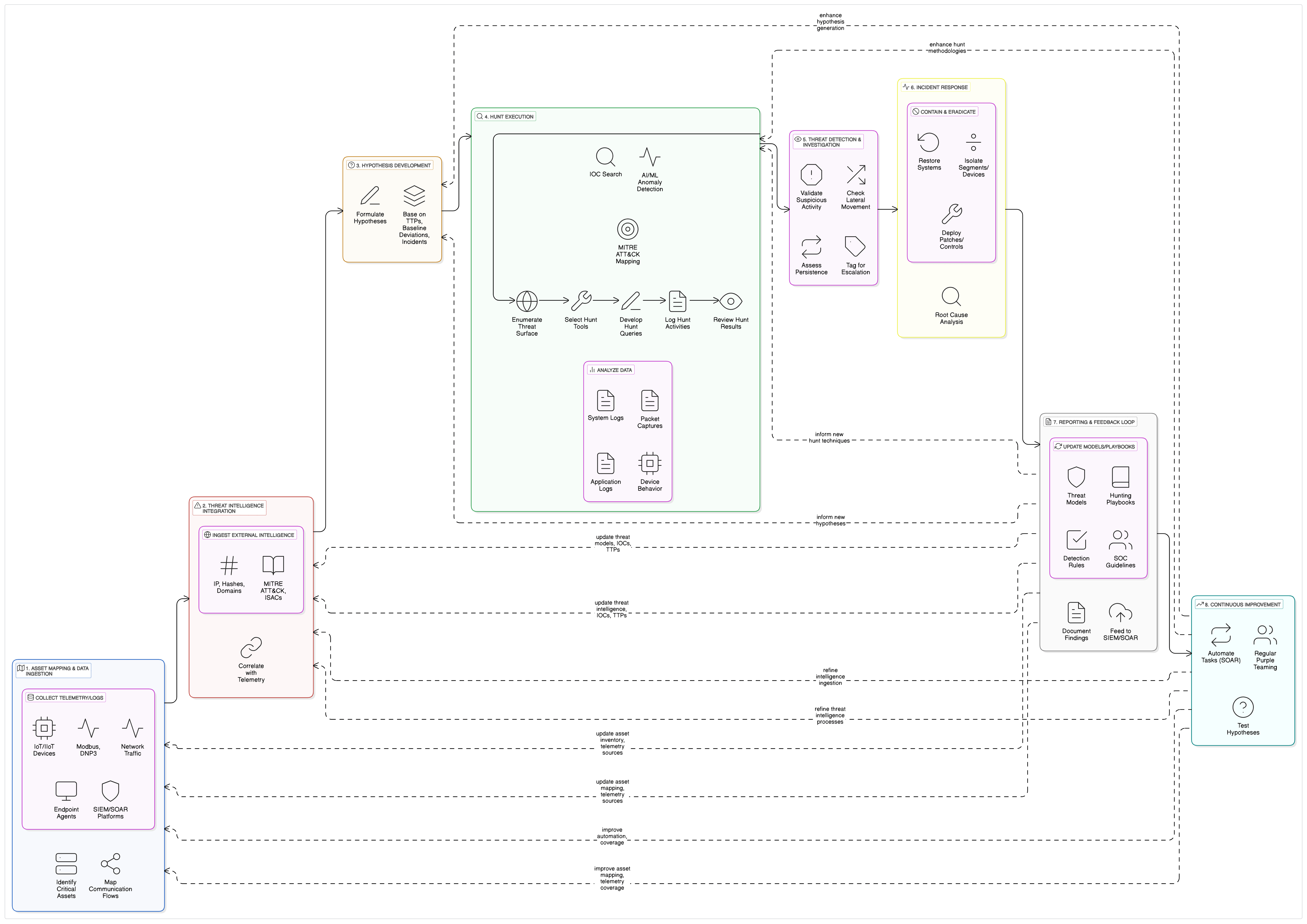
2.1 Hypothesis-Driven Threat Hunting
Threat hunting hypotheses are formulated through a layered approach integrating technical intelligence sources and domain-specific operational knowledge:
-
Technical Intelligence Sources: Real-time threat feeds (e.g., MISP, AlienVault OTX), curated vulnerability databases (NVD, ICS-CERT advisories), and MITRE ATT&CK for ICS and IoT.
-
Domain Operational Context: Understanding protocol behaviors, control logic workflows, and asset criticality within smart city subdomains (e.g., traffic control, water treatment).
Example hypotheses include:
-
Lateral movement via exploitation of unsegmented Modbus/TCP networks, exploiting lack of authentication to inject malicious commands or enumerate PLCs.
-
Firmware manipulation through tampering with Over-The-Air (OTA) update mechanisms by exploiting weak code signing or encrypted channels to introduce backdoors.
2.2 Multi-Modal Data Collection and Correlation
2.2.1 Telemetry Sources and Protocols
-
Network Traffic Capture and Enrichment:
-
Protocols monitored include Modbus/TCP, DNP3, IEC 61850, BACnet, OPC UA, MQTT, CoAP, and proprietary IoT protocols such as Zigbee Green Power and LoRaWAN.
-
Packet captures are enriched with metadata like timestamps, flow identifiers, command types, and payload integrity hashes.
-
Protocol-aware parsing extracts operational commands (e.g., relay settings, sensor queries), facilitating analysis of control behaviors beyond raw network data.
-
-
Endpoint and Device Logs:
-
Logs collected from embedded RTOS (VxWorks, FreeRTOS) and PLC firmware via syslog or vendor-specific APIs.
-
Event sources include device reboots, configuration changes, firmware update attempts, and runtime errors.
-
-
System and Application Logs:
-
Logs from SCADA HMIs, Historian databases (e.g., OSIsoft PI), and asset management platforms.
-
-
Physical Sensor and Actuator Data:
-
Time-series data streams from sensors (traffic cameras, water flow meters, air quality monitors) synchronized with cyber events.
-
2.2.2 Data Normalization and Synchronization
-
Utilization of Common Information Model (CIM) schemas to normalize heterogeneous log formats and telemetry.
-
Precision synchronization using Precision Time Protocol (PTP) or Network Time Protocol (NTP) to align events across distributed systems.
2.3 Advanced Behavioral Analytics and Detection Models
2.3.1 Temporal Sequence Models
-
Deployment of Long Short-Term Memory (LSTM) networks to model sequential control commands sent to PLCs and RTUs.
-
Training datasets capture command sequences under normal operation, including timing gaps, parameter ranges, and order constraints.
-
Anomalies identified by deviations in sequence probabilities or presence of unexpected commands, potentially signaling replay or injection attacks.
2.3.2 Graph-Based Anomaly Detection
-
Construction of dynamic device communication graphs with nodes representing devices/endpoints and edges representing communication flows weighted by frequency and protocol type.
-
Application of community detection algorithms (Louvain, Girvan-Newman) to identify subnetworks or isolate devices.
-
Detection of anomalies such as sudden changes in topology, emergence of high-degree nodes, or unexpected cross-community communications triggers alerts.
2.3.3 Statistical Multivariate Anomaly Detection
-
Utilization of Hotelling’s T² and Mahalanobis distance metrics applied to multidimensional sensor streams for outlier detection indicating spoofing or injection.
-
Complemented by CUSUM (Cumulative Sum Control Chart) techniques for change detection in sensor drift or process anomalies.
2.4 Threat Intelligence Integration
-
IoCs integrated via:
-
YARA rules for identifying malicious firmware patterns during OTA update scans.
-
STIX/TAXII threat intelligence feeds continuously ingested and correlated with observed telemetry.
-
-
Mapping detected adversary tactics to MITRE ATT&CK ICS and MITRE ATT&CK for IoT matrices enhances hunting context and precision.
3. Data Pipeline Architecture for Scalable Threat Hunting
3.1 Distributed Data Ingestion Layer
-
Edge Collectors:
-
Lightweight agents deployed on network gateways or dedicated appliances performing protocol-aware packet inspection, session reassembly, and preliminary anomaly scoring.
-
Examples include Zeek (formerly Bro) extended with ICS protocol parsers and custom parsers for proprietary IoT protocols.
-
-
Message Broker:
-
Apache Kafka cluster provides scalable, durable transport with topic partitioning by device type, protocol, or geography.
-
Kafka Connectors feed data into processing layers for real-time and batch analysis.
-
3.2 Processing Layers
-
Real-Time Streaming:
- Apache Flink or Spark Streaming jobs performing:
- Stateful analytics maintaining device interaction histories.
- Sliding window anomaly detection on telemetry streams.
- Correlation of network and endpoint logs for multi-modal alert enrichment.
-
Batch Processing:
- Spark ML pipelines train and update models on historical data.
- Cross-validation and hyperparameter tuning embedded to optimize detection accuracy.
3.3 Analytical Layer
-
Feature Engineering:
-
Temporal features such as command inter-arrival times and device uptime ratios.
-
Interaction features including frequency and sequence of cross-device commands.
-
Statistical summaries like entropy of command parameters and variance of sensor readings.
-
-
Inference Engines:
-
Containerized microservices perform model inference to produce risk scores.
-
-
Alert Prioritization:
-
Ensemble models combine outputs from multiple anomaly detectors with weighted voting.
-
Analyst feedback is incorporated via active learning loops to reduce false positives.
-
3.4 Visualization and Investigation Layer
-
Integration with enterprise-grade SIEMs (Splunk, IBM QRadar):
-
Custom dashboards display device health, anomaly heatmaps, and interactive graph visualizations of communication patterns.
-
Drill-down capabilities allow event timeline analysis for alert investigation.
-
-
Case management automates triage workflows and documents hunt results.
4. Use Case Deep-Dives
4.1 Multi-Stage Intrusion Detection in Electrical Grid Substations
-
Technology Stack:
-
Monitoring IEC 61850 MMS (Manufacturing Message Specification) traffic using Zeek ICS protocol analyzer enhanced for MMS command decoding.
-
-
Workflow:
-
Real-time decoding of relay control commands.
-
LSTM model applied to relay command sequences to detect abnormal switching patterns.
-
Graph analysis detects lateral movement across substation RTUs and control servers.
-
Correlation of unusual circuit breaker trips with command anomalies validates incidents.
-
4.2 Supply Chain Firmware Compromise in Smart City Sensors
-
Technology Stack:
-
OTA update channels leveraging MQTT over TLS, with firmware images signed using ECDSA.
-
Firmware scanned using YARA rules for known malicious signatures.
-
Dynamic analysis via QEMU emulation of embedded sensor firmware.
-
-
Workflow:
-
Scheduled scans of firmware images upon upload.
-
Cross-referencing telemetry for unexpected device behaviors post-update.
-
Automated rollback initiated via device management platform upon detection of compromise.
-
4.3 Covert Data Exfiltration Detection in Water Treatment Systems
-
Technology Stack:
-
Monitoring DNP3 protocol traffic with deep packet inspection.
-
Statistical timing channel detection implemented as custom Spark Streaming job.
-
-
Workflow:
-
Modeling normal DNP3 request-response intervals.
-
Detecting deviations in inter-packet timing indicative of covert signaling.
-
Cross-correlation with physical sensor readings for anomalies in water chemistry.
-
5. Threat Hunting Challenges and Mitigations
-
Telemetry Integrity and Synchronization:
-
Hardware timestamping and synchronized clocks mitigate event misalignment risks.
-
-
False Positives:
-
Multi-model ensembles and analyst-in-the-loop feedback loops reduce noise.
-
-
Scaling:
-
Horizontal scaling of Kafka and Spark clusters.
-
Use of approximate computing algorithms (HyperLogLog) for large-scale graph analytics.
-
6. Emerging Research Directions
-
Explainable AI approaches for model interpretability (SHAP, LIME).
-
AI-powered automated threat hunting playbooks.
-
Federated learning architectures enabling cross-city collaboration without data sharing.
-
Quantum-resistant cryptographic methods for IoT communications.
The complexity and criticality of smart city and critical infrastructure ecosystems demand a paradigm shift toward proactive, intelligent threat hunting. Integrating multi-modal telemetry, advanced anomaly detection models, and scalable data architectures tailored to heterogeneous protocols and real-time operational constraints is essential. The outlined methodologies and architectures provide a comprehensive framework for cybersecurity professionals to elevate their defense posture, minimizing risk and ensuring continuity of essential services in increasingly connected urban environments.
