Securing the Data Lifecycle: Technical Best Practices from Creation to Destruction

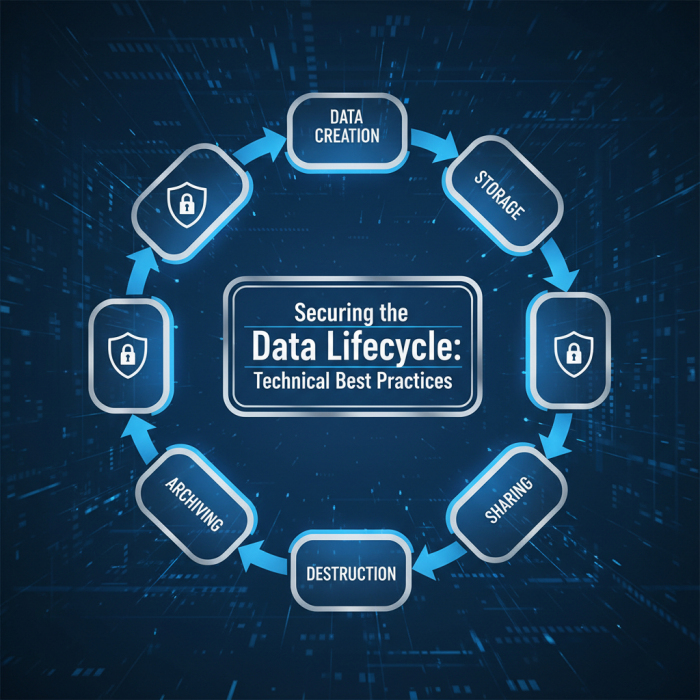
Data is the cornerstone of every modern enterprise architecture, supporting analytics, operations, and critical business functions. Protecting and managing data effectively means understanding its journey throughout the data lifecycle—covering all stages from initial creation, through periods of intense use and sharing, followed by long-term archiving, and ending ultimately in secure destruction. Each phase introduces unique risks and requirements, and securing data demands a granular, context-aware approach tailored to the technical realities of each stage.
This comprehensive analysis systematically examines every phase in the data lifecycle from a security-first perspective. By detailing practical technical recommendations and referencing relevant standards, this guide aims to reinforce holistic data protection postures for organizations operating in highly regulated and complex environments.
Data Creation: Securing Origins and Establishing Metadata
The data lifecycle fundamentally begins at the point of data creation, which may occur through user input, machine or sensor telemetry, application logs, automated systems, or data imports. Security at this initial phase is frequently neglected, yet the decisions made here—on classification, provenance, metadata assignment, and format—greatly impact downstream risk.
It is imperative that any process for data creation enforces strong user authentication and access controls, ensuring only authorized actors are permitted to generate or ingest new data into your environment. Mechanisms should be in place to validate the integrity and trustworthiness of newly created data—for example, cryptographic checksums or signatures applied at source. Automation workflows that create data programmatically (such as IoT sensors or transactional platforms) should implement strong device or service identity management, using certificates, TPM-backed keys, or mutual authentication protocols.
Metadata tagging at birth is a foundational practice, as it provides both semantic context and facilitates policy enforcement downstream. Embedding labels for sensitivity (e.g., “confidential”, “regulated”, “customer PII”), geographic origin, or data owner allows Data Loss Prevention (DLP) systems, encryption gateways, and access control systems to enforce rules based on data type. NIST SP 800-53 and ISO/IEC 27001 provide clear frameworks for data classification and protection from inception, and these controls should be programmatically woven into all data-creation workflows.
Creation processes should also log all relevant events—such as user ID, timestamp, source system, and location—to audit trails secured against tampering. Immutable logs (leveraging append-only tools or blockchain-backed architectures for higher assurance) provide indispensable forensic artifacts for incident investigation or legal compliance.
A final but critical aspect is the sanitation of ingest points. Trusted path enforcement, payload validation (using robust schemas and formats), and threat intelligence-informed filtering can neutralize poisoning attempts, malformed data, or embedded malware at the outset. Data validation and cleaning at point of creation remove a wide category of downstream integrity risks, including fraud and sophisticated business logic attacks.
Storage: Defending Data at Rest and Governing Access
Once created, data typically transitions into storage—whether that be on-premises disks, SAN/NAS arrays, cloud object storage, distributed file systems, or specialized databases. The dominant security risk during this phase is unauthorized access or exfiltration, alongside concerns over data corruption, integrity loss, ransomware, and regulatory compliance for sensitive categories of information.
Encryption is the most fundamental safeguard at this stage, mandated for both primary repositories and backups. Industry-standard algorithms (such as AES-256 or better) and robust key management infrastructure (using HSMs, centralized KMS, and strict key rotation policies) are best practice. Encryption should be enforced at the storage level, but also consider application-level or record-level encryption for especially sensitive or regulated datasets.
Authentication and authorization mechanisms must be least-privilege by design, enforced both at the infrastructure level (IAM users, roles, or rootless containers) and at the application logic layer. Modern approaches recommend use of just-in-time access provisioning, role-based access control (RBAC), and even attribute-based access control (ABAC) for highly dynamic environments. All access to storage should be monitored and logged, and anomalies—such as bulk downloads, outside-business-hours access, or failed authentication attempts—should trigger real-time alerts.
Data integrity checks—such as cryptographically signed hash chains or Merkle tree structures in distributed files systems—guard against unauthorized modification or data corruption attacks. For high-value assets, consider integrating storage with digital ledger technologies or write-once-read-many (WORM) storage, as recognized by financial regulatory regimes.
Physical security of storage media is also paramount, particularly for endpoints, removable media, or on-premises infrastructure. Secure lock-down of data centers, tamper-evident hardware, and strict chain-of-custody controls complement logical safeguards. Within virtualized or cloud-native environments, network-level segmentation (VPCs, subnets, firewalls, microsegmentation) and hardened VM/container images can reduce the risk of lateral movement if storage is compromised at the hypervisor or orchestration layer.
Retention policies must be codified and enforced automatically, as both business and regulatory needs dictate when data can or must be destroyed, redacted, or re-encrypted. Integration with enterprise GRC tools and configuration of retention schedules, legal hold flags, and automatic archival workflows will support compliance (GDPR, CCPA, HIPAA, and more) while reducing operational risk.
Ultimately, storage security is a multilayered affair, blending technical and governance controls. Following best practices from frameworks such as CIS Benchmarks, NIST SP 800-111 (Guide to Storage Encryption Technologies), and ISO/IEC 27040 (Storage Security) is essential for any data-driven organization.
Use: Controlling Data in Processing, Analytics, and Application Workflows
As data leaves storage and enters its use phase—ranging from analytical model training to customer service lookups or transactional processing—the risk landscape expands. Data is at its most vulnerable during processing, as protective wrappers may be removed temporarily, data may be loaded into application memory, or handed off between services, introducing a broader attack surface.
Application security is foundational at this stage. Secure coding practices (aligned with OWASP Top Ten or SANS CWE/SANS Top 25) mitigate threats such as SQL injection, buffer overflows, or memory scraping. Enforcing data minimization—ensuring only required data is loaded or exposed to each process or user context—further limits potential exposure. Endpoint protection and memory inspection controls are recommended for high-risk use cases.
Data should continue to be decrypted only as necessary and immediately re-encrypted or purged from memory upon transaction or session completion. Disk and page file encryption can partially protect against memory scraping or dump attacks, but for more robust protection, confidential computing technologies—such as Trusted Execution Environments (TEEs), Intel SGX, or AMD SEV—can keep data encrypted even during processing.
Audit logging during processing is critical. Every data read, modification, or export event should be captured with sufficient fidelity to support forensics. Anomaly detection via Security Information and Event Management (SIEM) tools, allied with User and Entity Behavior Analytics (UEBA), provide timely identification of potential insider threats or compromised application logic.
Access controls at this stage must be strictly enforced, ideally using context-aware or risk-based adaptive authentication. Zero Trust principles, which assume no implicit trust regardless of location or network, are especially relevant: every process accessing data is authenticated, authorized for that specific activity, and subject to policy checks. Where multi-tenancy or shared processing environments are in play, strong logical partitioning (using namespaces, resource quotas, or dedicated compute pools) must be maintained.
Privacy engineering is now a key part of securing data use. Privacy-enhancing technologies such as differential privacy, homomorphic encryption, or federated learning allow organizations to perform analytics or cross-domain processing with formal privacy guarantees, reducing the risk of re-identification or leakage of data. For use cases involving synthetic data generation, robust technical safeguards must exist to prevent the synthetic outputs from inadvertently exposing attributes of real individuals or confidential source data.
Finally, controls must exist to ensure data is used for its intended and authorized purposes only. Data provenance and usage tracking, policy definition using data governance languages (such as OPA/Gatekeeper or XACML-based policies), and constant reconciliations between declared and actual use reduce the likelihood of privacy violations, regulatory penalties, or reputational harm from misuse.
Sharing: Securing Data in Motion and Controlling Collaborative Risks
When data transits between systems—whether within an organization or to third parties, partners, or customers—an array of new security challenges emerge. Attack techniques such as eavesdropping, man-in-the-middle attacks, improper exposure, and data leakage are most acute during this stage, requiring robust technical countermeasures and finely tuned governance.
The in-transit encryption layer remains non-negotiable. Protocols such as TLS 1.3, mutual TLS (mTLS), and IPsec must be uniformly enforced across all interfaces—whether API endpoints, web portals, or message queues. All keys and certificates should be managed centrally, with automated rotation and revocation in the event of compromise.
Data integrity in transit must be verified, using digital signatures, HMACs, or cryptographic attestations. These can detect and prevent data tampering or injection attacks, especially critical for financial transactions, healthcare interfaces, or critical infrastructure telemetry pipelines.
Strong authentication and granular authorization precede any data-sharing event. OAuth 2.0, OpenID Connect, and SAML are widely deployed for application-to-application interactions, while modern API gateways, service meshes, or cloud-native identity platforms can manage complex federated access requirements across borders or clouds. Attribute- and policy-based access controls (PBAC, ABAC) allow enforcement of sharing constraints (such as “only during business hours”, or “no onward transmission”) aligned to both technical and business policies.
Masking, tokenization, or redaction of data should be applied so only the minimum required data is shared. For highly sensitive or regulated categories (PII, PHI, PCI), even pseudonymized or aggregated data may be required by governing standards. When external sharing is involved, data should be rendered unreadable to the outside world without a specific decryption or unmasking key, and contractual agreements (e.g., Data Processing Agreements or Service Level Agreements) should mirror technical controls.
Data Loss Prevention (DLP) systems serve as the last line of defense, operating at network boundaries, application layers, or cloud storage gateways to detect and block unauthorized transmissions, exfiltration attempts, or suspicious file movements. Real-time DLP with adaptive policy tuning can frustrate even well-resourced attackers or rogue insiders seeking to evade conventional audits.
Technical controls alone are insufficient—governance is equally crucial. Attribute-based data usage policies, automated consent management, legal hold monitoring, and cross-jurisdiction alerting are required to meet sectoral (GDPR, CCPA, HIPAA, GLBA, etc.) and geography-specific requirements. Robust auditing of all data outflows—detailing recipient, nature of data, time, method, and authorizing rationale—supports incident response and legal defense if improper sharing is later alleged.
Technical documentation and API specifications should clearly enumerate which fields and data types are shared in each interface, updated rigorously as schemas or information governance postures evolve. Continuous third-party risk monitoring and regular penetration testing of data exchange points are recommended to maintain the integrity and confidentiality of shared data assets.
Archiving: Achieving Long-Term Storage Security and Regulatory Compliance
Data archiving transitions frequently accessed operational data to low-cost, infrequently accessed repositories, often for regulatory, legal, or analytical retention. This phase is characterized by its extended time horizons and the unique security and availability risks that arise from storing data over years or decades.
The security posture of archival storage is shaped by regulatory requirements (such as Sarbanes-Oxley, FINRA, health data retention laws, or regional data sovereignty statutes), dictating which data must be retained, for how long, and under what security controls. Immutable storage—leveraging Write Once Read Many (WORM) architectures, append-only log files, or cryptographic time-stamping—can be indispensable for ensuring that archived data cannot be maliciously altered or deleted prior to mandated schedules.
Encryption remains essential, with keys secured and rotated according to defined cryptoperiod policies. A particular challenge here is ensuring that cryptographic algorithms and key sizes remain secure against future cryptanalysis—periodic algorithm reviews, NIST guidance updates, and potential migration to post-quantum cryptographic schemes must be considered for archives with exceptionally long lifecycles.
Segregation of archives from primary operational networks, via air-gapped or physically separate storage, reduces attack surface and supports resilience against ransomware, supply chain, or destroyer malware attacks. Multipoint redundancy—storing archives in geographically distributed, independent datacenters or clouds—safeguards data against regional disasters, persistent threats, or loss of a single trusted party.
Access to archived data must be tightly controlled and monitored, with all requests subject to multi-factor authentication, strict reason codes, and managerial approval. All retrievals or restoration events should trigger extensive logging and alerting, especially where archives contain privileged or regulated information.
Data format sustainability is another important technical consideration—proprietary or obsolete file formats may become unreadable over time, risking legal non-compliance or business continuity. Techniques such as preservation in open-standard formats, migration scheduling, and periodic validation checks should be considered as part of the archiving process.
Jennifer, a CISO in a multinational manufacturing enterprise, recently faced an urgent request from regulators recalling archived supplier contracts dating back 15 years. By aligning archival systems with FINRA-compliant, tamper-proof storage and maintaining robust audit trails, her team could retrieve the required data rapidly and demonstrate both technical integrity and legal admissibility.
Finally, regular compliance audits and penetration testing of archival entropy, logical partitioning, and destruction logs support provable adherence to both statutory and sectoral standards. Without ongoing oversight, even the best-designed archival system will succumb to drift, misconfiguration, or exploit development over time.
Destruction: Enforcing Irreversible Data Deletion and Sanitization
The final act in the data lifecycle, secure data destruction, is perhaps the most under-appreciated yet critical. Improper deletion or careless hardware disposal can become a leading source of unintentional data breach, regulatory sanction, or brand erosion. Technical rigor during this phase must match or exceed all preceding lifecycle stages.
Data destruction encompasses both logical wiping—where data is overwritten with random or fixed patterns—and physical destruction, where storage media is rendered inoperable or irretrievably damaged. The method selected should reflect both the sensitivity of the data and environmental policy.
Industry standards such as NIST SP 800-88 (Guidelines for Media Sanitization) define authoritative procedures for digital data destruction across hard disks, SSDs, tape, optical media, and cloud storage. For logical erasure, multiple overwrites, degaussing, or cryptographic erasure (destroying the relevant encryption key), can render data unrecoverable to advanced forensic techniques. In virtualized or cloud-native contexts, provider-side tools (such as AWS KMS-integrated volume destruction or Azure’s customer-managed keys) should be leveraged, with audit logs to confirm destruction events.
Physical destruction—shredding, pulverizing, incineration, or acid-dissolving—should be performed for media containing high-value secrets or requiring absolute assurance, such as defense, critical infrastructure, or top-secret assets. Chain of custody for destroyed media must be enforced, with records maintained to support regulatory or legal review.
In large-scale environments, automating data destruction via policy-driven workflows (triggered by retention schedules, user lifecycle events, or regulatory timeouts) reduces human error and supports defensible documentation. Data subject rights, such as those enshrined in GDPR's “right to be forgotten,” require demonstrable technical erasure upon authenticated user request.
Verification processes are crucial—random audits, forensic recoverability testing, or external certification of destruction procedures can close the loop between intended and actual data destruction outcomes. Legacy data, such as residuals on abandoned legacy systems, “shadow IT” endpoints, or forgotten backups, must be periodically discovered and remediated as part of an ongoing data hygiene campaign.
Jennifer’s incident response plan addresses one such challenge—when decommissioning a factory IoT system, embedded flash memory retained blueprints and calibration files. Only after partnering with device vendors to execute firmware-level erasure routines and physically destroying select chips could her risk management team provide sufficient assurance that no sensitive data might leak as equipment was recycled or resold.
Cross-Cutting Considerations: Data Lifecycle Management in the Era of Advanced Threats
While the compartmental model of the data lifecycle is analytically useful, reality often demands continuous and holistic security postures. Several cross-phase considerations are essential in modern environments.
Data governance frameworks, incorporating automated discovery, classification, and lineage tracking, are now expected to underpin all phases of the lifecycle. Tooling from leading cloud providers, as well as best-in-class third-party solutions, can monitor, classify, and flag policy violations in real time as data traverses boundaries. Integrating governance metadata and labeling with security controls (such as encryption gateways and DLP engines) allows organizations to dynamically enforce rules as data flows.
Identity, credential, and access management must never be static. Adaptive authentication, device fingerprinting, risk scoring, and session validation should all be seen as first-class security features mapped to data as it moves through creation, use, and sharing. PAM (Privileged Access Management) and CIEM (Cloud Infrastructure Entitlement Management) controls are especially relevant as organizations pivot to hybrid or multi-cloud realities.
Automation, API-first design, and Infrastructure as Code (IaC) further enable security as code—embedding checks, enforcement, and logging into every data touchpoint. Integration with SIEM, SOAR, and threat intelligence feeds strengthens adaptive response, allowing teams to detect and mitigate attacks or policy violations as soon as they arise.
Human factors still matter. Continuous staff awareness training, simulated phishing, and incident response drills must be aligned to each phase of the lifecycle—teaching teams not only how to recognize risks, but how their roles impact lifecycle security. Insider threats—whether malicious or accidental—play out across the data lifecycle, and must be considered through robust technical and procedural countermeasures.
Sector-Specific Stresses: Regulatory Demands in Healthcare, Financial, and Critical Infrastructure Domains
While general best practices abound, sectoral variances can dictate technical nuances in lifecycle management.
Healthcare environments, governed by HIPAA, HITECH, and emerging global patient data standards, require every data movement (from EHR creation, to third-party sharing for research, through to clinical archiving and destruction) to be logged, justified, and provably secured. Advanced tokenization, patient consent management, genomic data anonymization, and role-based access are critical for compliance.
Financial systems encounter overlapping pressures from SEC, PCI-DSS, SOX, and regional regulations that elevate encryption, anti-fraud analytics, and non-repudiation. Immutable audit logging, transaction-level encryption, and logical air-gapping of certain archives are frequent.
Critical infrastructure operators—energy grids, water utilities, transportation—face both targeted attacks and strict data retention/destruction mandates under NERC CIP, ISO/IEC 27019, or regional equivalents. Engineering telemetry, networked control systems, and vendor-introduced supply chain patterns demand bespoke controls at every phase, including destruction of digital twins or operational plans.
Data residency and sovereignty, increasingly codified by law (such as EU’s GDPR, Russia’s PDPL, or China’s CSL), dictate where data may be stored, processed, or archived. Technical controls at every lifecycle stage must dynamically enforce these geographical boundaries—using geo-fencing, cloud region locking, or third-party escrow architectures.
Emerging Challenges: The Impact of AI, Machine Learning, and Data Analytics
Modern data environments are marked by rapid acceleration in the adoption of artificial intelligence and advanced analytics. These introduce new lifecycle demands—model training sets, inferencing workloads, federated learning exchanges, and privacy-preserving analytics engines all create new categories of at-risk data.
AI-centric risks (such as data poisoning at creation, theft of machine learning models in storage, leakage during model use, and exposure through shared analytics pipelines) are driving the development of specific security controls referenced in OWASP’s Top Ten for AI, NIST’s AI Risk Management Framework, and sectoral standards such as ISO/IEC 23894 for AI system security.
Similarly, Big Data platforms—distributed across cloud-native architectures, employing data lakes, or using streaming analytics—require that all lifecycle controls are scalable, automated, and tightly integrated with orchestration and monitoring stacks. Encryption, access authorization, logging, and retention/destruction must not be afterthoughts or “bolted-on” features, but intrinsic to data pipelines, stream processors, and service meshes.
The rise of data mesh architectures, decentralized data ownership, and self-service analytics increase complexity—making automated governance, multi-domain labeling, federated access policies, and agile response capabilities essential for secure lifecycle management.
Recommendations and Future Directions in Data Lifecycle Security
Securing every stage of the data lifecycle requires a blend of rigorous technical controls, adaptive governance, and continuous improvement. Based on emerging standards and observed best practice, several recommendations can refine an organization’s approach:
Automate discovery, tagging, and classification at the point of data creation; integrate this with all downstream policy enforcement engines. Apply encryption by default for all resting and in-transit data, leveraging centralized, well-audited key management. Regularly review algorithmic strength and key rotation practices to stay ahead of cryptanalytic advances.
Define and strictly enforce least-privilege, context-aware authentication and authorization—leveraging Zero Trust, PAM, and adaptive risk scoring wherever data is handled, accessed, or transmitted. Continuously monitor (using SIEM, SOAR, and advanced analytics) every touchpoint—storage, processing, sharing, and archiving. Rapid anomaly detection and well-drilled response playbooks can reduce mean time to detect and contain incidents across the lifecycle.
Engineer workflows to ensure that all data egress is justified, audited, and controlled; apply DLP, strong masking, and legal/contractual coverage for shared data. For archiving, implement immutable storage, geo-redundancy, open and sustainable formats, and manage access at the highest security tier. Execute destruction as a formal, auditable operation using best-practice physical and logical wipes, with maneuverability for regulatory-triggered, on-demand, and scheduled data purges.
Cross-train security, engineering, legal, and risk stakeholders on their respective roles and accountabilities in each phase of the data lifecycle. Foster a continuous improvement approach—regular audits, red team exercises, and post-mortem learning must feed back into policies and controls. Align tooling to best-in-class frameworks: NIST SP 800-53, ISO/IEC 27001/27701, CIS Benchmarks, and respected AI/Big Data standards as relevant.
Securing the data lifecycle is never a static task. As organizational perimeters dissolve, data mobility accelerates, and digital transformation intensifies, so too must the rigor and adaptability of technical and governance controls. By addressing every phase—creation, storage, use, sharing, archiving, and destruction—with the requisite detail, context, and oversight, security professionals can meet both the evolving threat landscape and stringent regulatory mandates with confidence.
This systematic, standards-aligned approach not only prevents loss and leakage, but also instills organizational trust, strengthens compliance postures, and protects the complex digital ecosystems on which public, private, and critical infrastructure sectors increasingly depend
