
Covert Data Exfiltration Detection in Water Treatment Systems
Abstract
Water treatment systems, as part of critical infrastructure, are increasingly targeted by cyber adversaries seeking to cause physical disruption or to covertly extract sensitive data. Unlike overt attacks that trigger alarms or service outages, covert data exfiltration remains stealthy and persistent, exploiting insecure protocols, insider threats, and network misconfigurations. This whitepaper provides an in-depth technical exploration of covert exfiltration detection in water treatment systems. It includes a comprehensive survey of current threats, deep dives into communication protocol vulnerabilities, detailed use cases, advanced methodologies including traffic analysis, timing channel detection, machine learning, and persistent threat scenarios. Real-world scenarios are examined with architectural models and detection workflows applicable to industrial control environments.
1. Introduction
Cyber threats against industrial control systems (ICS) in water treatment facilities are not limited to sabotage or ransomware. Stealthy data exfiltration — the unauthorized and covert transmission of sensitive operational or business data — poses a significant risk. Threat actors leverage misconfigured remote access, legitimate communications protocols (e.g., DNP3, Modbus), and unmonitored out-of-band channels to extract data over extended periods without detection. Detecting such threats requires advanced telemetry, protocol-aware analysis, behavioral modeling, and active threat hunting capabilities.
2. Threat Landscape
2.1 Motivations for Exfiltration
-
Espionage of proprietary process control algorithms or chemical treatment recipes.
-
Extraction of user/customer data, system configuration, and asset inventories.
-
Establishing persistent C2 (Command and Control) channels within ICS networks.
-
Reconnaissance for subsequent kinetic or logical attacks.
2.2 Exfiltration Vectors
-
Protocol misuse (e.g., encoding payloads in DNP3 analog values).
-
Timing channels and steganographic exfiltration.
-
Covert tunneling through compromised IoT sensors or HMIs.
-
Exploiting bidirectional SCADA polling mechanisms.
-
DNS tunneling from air-gapped OT networks via relay hosts.
3. Technical Environment of Water Treatment Systems
3.1 Architecture Overview
Typical water treatment architectures involve:
-
PLCs and RTUs connected to sensors and actuators.
-
SCADA systems for monitoring and control.
-
HMI interfaces for operator interaction.
-
Historian databases storing time-series process data.
-
Ethernet/IP or serial-based communications.
-
Firewalled OT-IT segmentation using data diodes or unidirectional gateways.
3.2 Communication Protocols
-
DNP3 (Distributed Network Protocol): Common in North American utilities; supports unsolicited responses, time synchronization, and complex object groups.
-
Modbus/TCP: Lacks encryption/authentication; used for direct device communications.
-
OPC UA: Modern, encrypted protocol with fine-grained access control.
-
MQTT and CoAP: Increasing use in smart sensors and IIoT.
-
Proprietary telemetry links: May include GSM/LTE modems, satellite, or long-range RF.
4. Detection Methodologies
4.1 Protocol-Aware Traffic Inspection
4.1.1 DNP3 Anomaly Detection
-
Baseline Modeling: Capture normal DNP3 operations using object group analysis (e.g., Group 30 for analog inputs).
-
Heuristics: Unusual frequency of unsolicited messages, repeated group/object combinations with minimal operational value.
-
Deep Inspection: Payload comparison against expected SCADA queries, including object variations, function codes (e.g., Control Relay Output Block).
4.1.2 Modbus Analysis
-
Track non-standard function codes (e.g., 43 for diagnostic).
-
Alert on coil/register reads from unused address ranges.
-
Detect large data read responses potentially used for bulk transfer of encoded data.
4.2 Timing Channel and Covert Channel Detection
4.2.1 Traffic Shape Modeling
-
Capture inter-packet delay statistics per session.
-
Use CUSUM (Cumulative Sum) and EWMA (Exponentially Weighted Moving Average) for change detection.
-
Wavelet Transforms to detect bursty or periodic signaling patterns.
4.2.2 Entropy and Variability Analysis
-
Monitor entropy of analog/digital value changes.
-
High entropy over static sensors (e.g., flow rate) may indicate data encoding.
-
Use of Shannon Entropy and Mutual Information for feature correlation analysis.
4.3 Machine Learning and Anomaly Detection
4.3.1 Unsupervised Learning
-
Apply Isolation Forests, DBSCAN, and Autoencoders for clustering behavioral anomalies.
-
Input features: source IP entropy, request size distributions, function code variance, polling intervals.
4.3.2 Sequence Models
-
Use LSTM (Long Short-Term Memory) and Transformer-based models to learn sequential command behavior.
-
Detect anomalous SCADA command chains diverging from known sequences.
-
Use attention mechanisms for highlighting high-impact deviations.
5. Use Case Scenarios
5.1 Use Case: Insider Threat via HMI Terminal
Description:
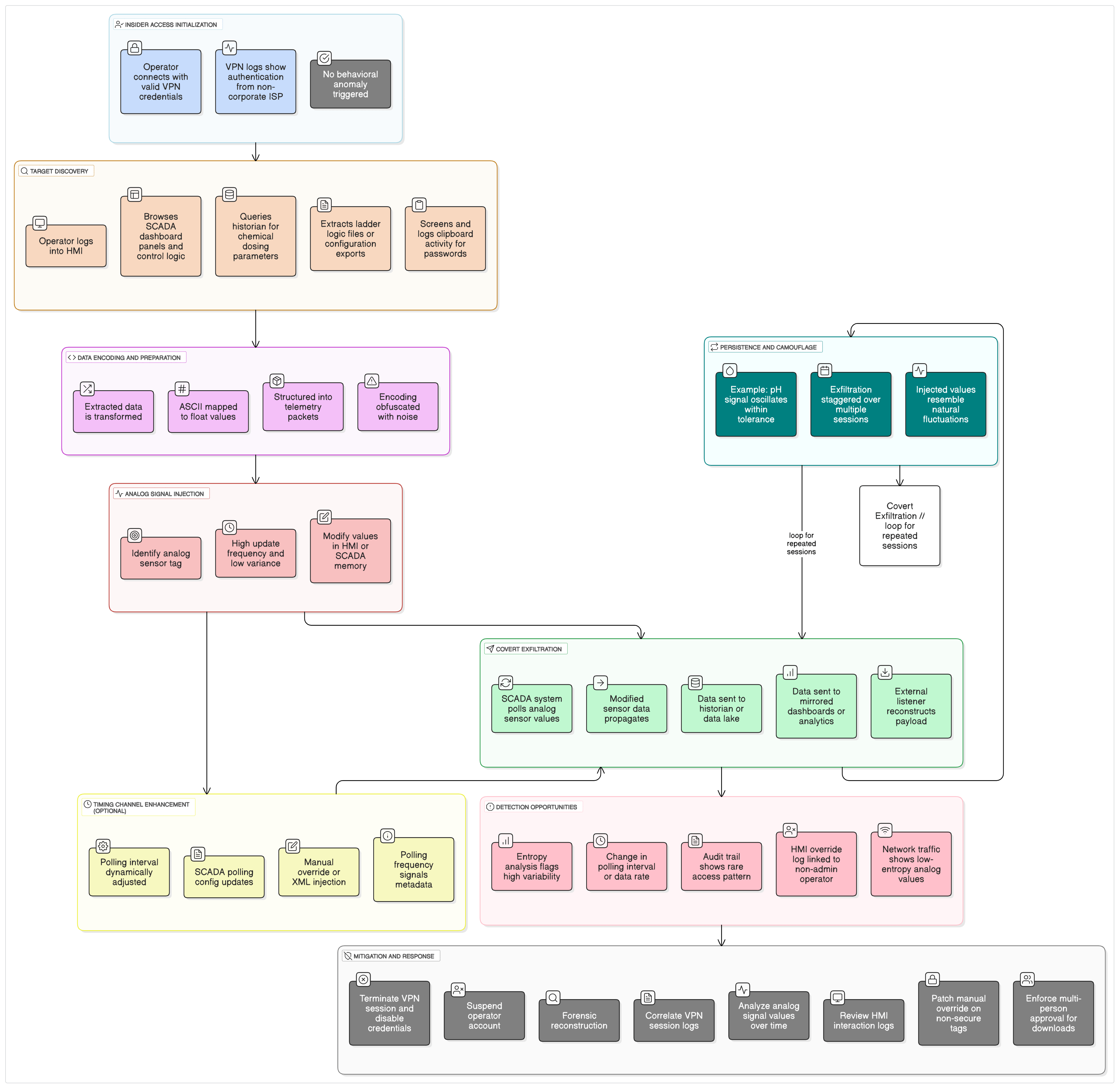
A disgruntled operator with remote VPN access encodes sensitive configuration data (chemical dosing parameters, SCADA credentials) into analog telemetry values, manipulating polling intervals to transmit data to an external listener.
Detection:
-
Baseline analog sensor profiles (e.g., pH, turbidity) over time.
-
Detect high-variance sequences not corresponding to actual sensor input.
-
Timing analysis reveals regular beacon-like transmission.
Response:
-
Trigger alerts and isolate HMI access.
-
Forensic extraction of VPN session logs and payload reconstruction.
5.2 Use Case: Protocol Exploitation over DNP3
Description:
An attacker exploits misconfigured RTU with exposed DNP3 interface. Payloads are crafted to encode base64 data into analog object groups with custom sequence numbers.
Detection:
-
Detection of high-volume unsolicited messages outside of standard polling.
-
Use of unusual object groups (e.g., Group 42 not used in baseline).
-
Outbound data volume exceeds historical baselines for the endpoint.
5.3 Use Case: Exfiltration via Compromised IoT Sensor
Description:
A smart flow meter connected over cellular VPN is compromised. It intermittently establishes outbound HTTPS connections to a C2 server.
Detection:
-
DPI reveals encrypted sessions originating from embedded device.
-
TLS fingerprinting (JA3) flags connection as unknown client signature.
-
Absence of firmware update events or remote commands correlates to anomalous behavior.
6. Advanced Persistent Threat (APT) Scenarios
6.1 APT Scenario: Multi-Stage ICS Recon and Exfiltration
Phase 1: Initial Access
-
Spear-phishing of IT operator yields credentials.
-
Lateral movement through poorly segmented VLANs.
Phase 2: ICS Reconnaissance
-
Enumeration of OPC UA endpoints.
-
Traffic sniffing of Modbus/DNP3 flows.
-
Asset fingerprinting via passive analysis of polling schedules.
Phase 3: Covert Data Collection
-
Installation of ICS-aware toolkit (e.g., Pipedream-like modular implant).
-
Extraction of PLC configuration, ladder logic.
-
Packaging of data into Modbus diagnostics frames.
Phase 4: Exfiltration
-
Use of DNS tunneling via compromised dual-homed engineering workstation.
-
Data encoded into TXT record payloads.
-
Exfiltration throttled to blend with legitimate DNS traffic.
Detection Mechanisms:
-
DNS request frequency anomalies.
-
Payload entropy analysis of TXT records.
-
Detection of redundant configuration requests to engineering stations.
7. Infrastructure for Detection
7.1 Data Pipeline
-
Edge Collectors: Use Zeek and Suricata with ICS protocol parsers.
-
Message Broker: Apache Kafka transports normalized logs.
-
Time-Series Analysis: InfluxDB/Grafana for process data visualization.
-
ML Models: Deployed via TensorFlow or PyTorch in Kubernetes.
7.2 Forensics and Logging
-
PCAP captures of all SCADA channels.
-
Full syslog from RTUs and PLCs.
-
Audit logs from VPN gateways and HMIs.
-
Immutable logs using blockchain-based tamper-evident logging solutions.
8. Challenges and Future Work
8.1 False Positives
-
Use domain-specific baselines to minimize noise.
-
Integrate analyst feedback loops.
-
Employ ensemble models combining statistical, rules-based, and ML detectors.
8.2 Data Privacy and Integrity
-
Encrypt logs at rest.
-
Sign firmware and configuration backups.
-
Secure boot and chain-of-trust for edge telemetry devices.
8.3 Future Research
-
Real-time detection using eBPF in industrial gateways.
-
Adversarial ML defenses for evasion-resistant models.
-
Development of cross-layer attack detection frameworks integrating physical process invariants.
Covert data exfiltration in water treatment systems represents a serious and insidious cyber threat. By leveraging in-depth protocol analysis, behavioral baselines, machine learning, and understanding persistent threats, defenders can elevate their detection capabilities. Continued advancements in telemetry collection, real-time processing, and intelligent alerting are crucial for securing critical infrastructure against increasingly stealthy adversaries.
