
Mastering Industrial Control System Risk Assessment: A Comprehensive Methodology for Critical Infrastructure Protection

The Evolving Landscape of ICS Security
Industrial Control Systems (ICS) form the operational backbone of critical infrastructure worldwide, from power generation and water treatment to manufacturing and transportation. As these systems become increasingly connected to enterprise networks and the internet, they face unprecedented cybersecurity challenges that traditional IT security approaches cannot adequately address. The convergence of operational technology (OT) with information technology (IT) has created a complex risk landscape where cyber threats can have physical consequences, potentially impacting safety, environmental integrity, and essential services.
Recent incidents, such as the Colonial Pipeline ransomware attack and the Oldsmar water treatment facility breach, underscore the real-world implications of ICS security vulnerabilities. Organizations operating critical infrastructure must implement robust risk assessment methodologies to identify, evaluate, and mitigate these unique threats before they can be exploited.
This article provides a comprehensive framework for conducting effective ICS risk assessments, detailing the processes, methodologies, tools, and best practices for translating findings into actionable security improvements.
Understanding the ICS Risk Assessment Landscape
The Unique Nature of ICS Environments
Industrial control systems differ fundamentally from traditional IT systems in several key aspects:
- Operational priorities focus on availability and safety rather than confidentiality
- Extended lifecycles of components (often 15-20 years versus 3-5 years for IT)
- Limited computing resources and proprietary protocols
- Real-time processing requirements with minimal tolerance for latency
- Direct physical impact capabilities affecting critical processes
- Legacy systems designed without security considerations
These characteristics necessitate specialized risk assessment approaches that balance cybersecurity requirements with operational imperatives. Unlike IT risk assessments that primarily focus on data protection, ICS risk assessments must consider potential physical consequences, including safety incidents, environmental damage, and service disruptions.
Regulatory and Standards Framework
Several industry standards and frameworks guide ICS risk assessment practices:
- ISA/IEC 62443: The most comprehensive standard for industrial automation and control systems security
- NIST SP 800-82: Guide to Industrial Control Systems Security
- NERC CIP: Critical Infrastructure Protection standards for the power industry
- AWWA cybersecurity guidance for water utilities
- API 1164 for pipeline SCADA security
- ISO 27001 with ICS-specific controls
These frameworks provide structured approaches to identifying, analyzing, and mitigating risks in industrial environments, though they must be adapted to specific operational contexts.
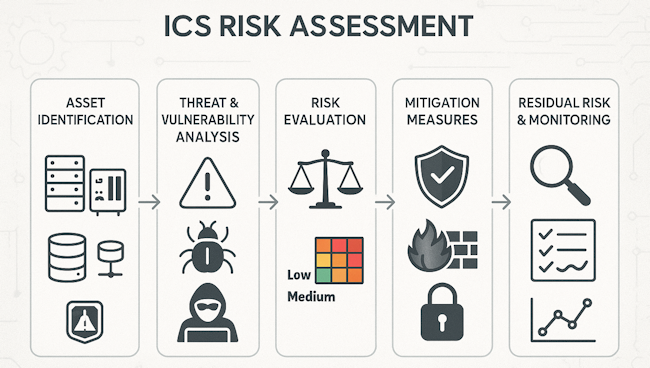
The ICS Risk Assessment Process: A Systematic Approach
Phase 1: Preparation and Scoping
Effective ICS risk assessment begins with thorough preparation and clear scoping:
-
Define Assessment Objectives: Establish clear goals for the assessment, whether regulatory compliance, security improvement, or incident response.
-
Determine Assessment Scope: Identify which systems, networks, and processes will be included. This typically involves:
- Critical operational processes
- Control systems (DCS, SCADA, PLCs)
- Communication networks
- Human-machine interfaces
- Engineering workstations
- Historian servers
- Integration points with IT networks
-
Assemble the Assessment Team: Form a multidisciplinary team including:
- OT engineers and operators
- IT security specialists
- Process safety experts
- Compliance officers
- External specialists (when needed)
-
Gather Documentation: Collect relevant documentation including:
- Network architecture diagrams
- System inventories
- Process flow diagrams
- Previous assessment reports
- Incident records
- Standard operating procedures
-
Establish Assessment Methodology: Select appropriate assessment frameworks and tools based on industry requirements and organizational needs.
Phase 2: Asset Identification and Characterization
Comprehensive asset identification forms the foundation of effective risk assessment:
-
Asset Inventory Development: Create or update a detailed inventory of all ICS assets, including:
- Hardware components (controllers, RTUs, PLCs, HMIs)
- Software systems (SCADA, DCS, historians)
- Communication infrastructure
- Support systems (power, HVAC)
-
Asset Categorization: Classify assets based on:
- Criticality to operations
- Safety implications
- Environmental impact potential
- Regulatory requirements
- Connectivity to other systems
-
System Mapping: Develop detailed system architecture diagrams showing:
- Network segmentation
- Communication flows
- Trust boundaries
- Integration points with IT systems
- Remote access paths
-
Process Dependency Analysis: Document how control systems support critical operational processes and identify single points of failure.
Phase 3: Threat and Vulnerability Assessment
This phase identifies potential threats and vulnerabilities specific to the ICS environment:
-
Threat Identification: Analyze potential threat sources including:
- Nation-state actors targeting critical infrastructure
- Cybercriminal groups deploying ransomware
- Hacktivists with environmental or political motivations
- Malicious insiders with system knowledge
- Unintentional insider actions
- Supply chain compromises
-
Vulnerability Assessment: Identify technical and procedural vulnerabilities through:
- Documentation review
- Configuration analysis
- Network architecture evaluation
- Limited passive scanning (avoiding operational disruption)
- Interviews with operators and engineers
- Review of vendor advisories
-
Attack Vector Analysis: Map potential attack paths through the environment, considering:
- Network perimeter access points
- Remote access systems
- Vendor connections
- Removable media
- Mobile devices
- Physical access vulnerabilities
Phase 4: Risk Analysis and Evaluation
This critical phase determines the actual risk levels by analyzing the likelihood and potential impact of identified threats:
-
Impact Assessment: Evaluate potential consequences of security breaches, including:
- Safety incidents and potential harm to personnel
- Environmental damage
- Production losses and downtime
- Equipment damage
- Regulatory penalties
- Reputational damage
-
Likelihood Assessment: Determine the probability of successful attacks based on:
- Threat actor capabilities and motivations
- Vulnerability exploitability
- Existing security controls
- Historical incident data
- Industry threat intelligence
-
Risk Calculation: Apply appropriate risk calculation methodologies:
- Qualitative approaches (risk matrices)
- Semi-quantitative scoring (CVSS with ICS modifications)
- Quantitative methods (FAIR for ICS)
- Consequence-based analysis for critical systems
-
Risk Prioritization: Rank identified risks based on:
- Overall risk scores
- Potential impact on critical operations
- Regulatory compliance implications
- Remediation feasibility
Risk Assessment Methodologies and Tools
Leading ICS Risk Assessment Methodologies
Several methodologies have been developed specifically for ICS environments:
-
ISA/IEC 62443-3-2 Methodology: This standard provides a structured approach to:
- Identifying and documenting system under consideration (SUC)
- Performing initial cybersecurity risk assessment
- Partitioning the SUC into zones and conduits
- Conducting detailed risk assessments for each zone
- Establishing security level targets
- Identifying security requirements
-
NIST Cybersecurity Framework for ICS: Adapts the NIST CSF to industrial environments with:
- ICS-specific subcategories and implementation guidance
- Integration with NIST SP 800-82 controls
- Alignment with risk management processes in NIST SP 800-30
-
Consequence-Driven Cyber-Informed Engineering (CCE): Focuses on:
- Identifying critical functions with severe consequences if compromised
- Analyzing attack paths to these functions
- Implementing engineering solutions to eliminate or mitigate attack vectors
- Prioritizing protection of crown jewel processes
-
MITRE ATT&CK for ICS: Provides a framework for:
- Understanding adversary tactics and techniques specific to ICS
- Mapping potential attack scenarios
- Evaluating security control coverage
- Identifying detection capabilities
Specialized Assessment Tools
Several tools support the ICS risk assessment process:
-
CISA's Cyber Security Evaluation Tool (CSET): A free desktop application that:
- Guides users through systematic evaluation of ICS security practices
- Provides assessment templates based on multiple standards
- Generates detailed reports with prioritized recommendations
- Supports both IT and OT security assessments
-
ICS-CERT Assessment Tools: Specialized tools including:
- Design Architecture Review (DAR)
- Network Architecture Verification and Validation (NAVV)
- Network Security Monitoring (NSM)
-
Commercial ICS Security Assessment Platforms: Solutions from vendors like:
- Claroty
- Dragos
- Nozomi Networks
- Verve Industrial
- Tenable OT Security
-
Vulnerability Scoring and Prioritization Tools:
- CVSS with ICS-specific modifications
- ICS-CERT's ICS Impact Indicators
- Consequence-based scoring systems
- FAIR (Factor Analysis of Information Risk) for ICS
Conducting the Assessment: Field Techniques and Best Practices
Data Collection Approaches
Effective data collection is critical but must be conducted safely in operational environments:
-
Documentation Review: Analyze existing documentation including:
- Network diagrams and asset inventories
- Security policies and procedures
- Incident response plans
- Change management records
- Previous assessment reports
-
Interviews and Workshops: Engage with key stakeholders through:
- Structured interviews with operators and engineers
- Technical workshops with system administrators
- Tabletop exercises with response teams
- Management discussions on risk tolerance
-
Technical Assessment Methods: Employ appropriate technical approaches:
- Passive network monitoring (avoiding active scanning)
- Configuration reviews of control systems
- Log analysis from security systems
- Limited vulnerability scanning (with operational approval)
- Physical security assessments
-
Operational Impact Considerations: Implement safeguards including:
- Test procedures in lab environments first
- Schedule assessments during maintenance windows
- Have rollback procedures ready
- Ensure operator oversight during technical testing
- Avoid active testing on critical production systems
Assessment Execution Process
A structured execution process ensures comprehensive coverage:
-
Kickoff and Planning: Begin with:
- Stakeholder briefing on assessment scope and methods
- Scheduling of assessment activities
- Establishment of communication protocols
- Review of safety procedures
-
Phased Assessment Approach:
- Start with low-risk, non-intrusive activities
- Progress to more detailed analysis as understanding improves
- Validate findings throughout the process
- Adjust scope as new information emerges
-
Continuous Stakeholder Engagement:
- Daily briefings with operational teams
- Immediate notification of critical findings
- Regular status updates to management
- Technical validation with system experts
-
Documentation and Evidence Collection:
- Maintain detailed assessment notes
- Capture screenshots and configuration data
- Record interview responses
- Document observed security practices
Processing and Analyzing Assessment Findings
Risk Analysis Frameworks
Several frameworks help analyze and contextualize findings:
-
Risk Scoring Methodologies:
- Traditional likelihood × impact calculations
- CVSS scoring adapted for ICS environments
- Consequence-based analysis for critical systems
- Multi-factor risk models incorporating detection and response capabilities
-
Contextual Analysis Approaches:
- Attack path mapping to identify critical vulnerabilities
- Defense-in-depth evaluation
- Control system resilience assessment
- Recovery capability analysis
-
Compliance Mapping:
- Alignment with regulatory requirements
- Gap analysis against industry standards
- Benchmarking against industry peers
- Maturity model assessments
Finding Categorization and Prioritization
Effective categorization supports remediation planning:
-
Finding Classification:
- Technical vulnerabilities (software, hardware, configuration)
- Architectural weaknesses (segmentation, access control)
- Procedural gaps (policies, training, awareness)
- Governance issues (oversight, resource allocation)
-
Risk-Based Prioritization Factors:
- Potential impact on safety and operations
- Exploitation likelihood and complexity
- Exposure to threat actors
- Remediation complexity and cost
- Regulatory compliance implications
-
Prioritization Frameworks:
- Critical/High/Medium/Low classification
- Numerical scoring systems (1-10 scale)
- Time-based remediation targets
- Resource allocation models
Developing Effective Remediation Strategies
Remediation Planning Process
Translating findings into action requires a structured approach:
-
Control Selection Methodology:
- Apply defense-in-depth principles
- Consider both technical and procedural controls
- Evaluate compensating controls when primary options aren't feasible
- Balance security improvements with operational requirements
-
Remediation Roadmap Development:
- Group related findings for efficient remediation
- Establish phased implementation approach
- Define clear milestones and success criteria
- Allocate resources and responsibilities
-
Implementation Planning Considerations:
- Change management requirements
- Testing procedures before deployment
- Operational impact assessment
- Fallback procedures
- Validation methods
Remediation Approaches for Common ICS Vulnerabilities
Specific strategies address common ICS security challenges:
-
Network Segmentation Issues:
- Implement zones and conduits architecture (ISA/IEC 62443)
- Deploy industrial firewalls and data diodes
- Establish demilitarized zones (DMZs) for shared services
- Implement unidirectional security gateways where appropriate
-
Authentication and Access Control Weaknesses:
- Implement role-based access control
- Deploy multi-factor authentication where feasible
- Establish secure remote access solutions
- Implement least privilege principles
-
Patch Management Challenges:
- Develop ICS-specific patch management procedures
- Establish testing environments for patches
- Implement compensating controls for unpatchable systems
- Utilize vendor validation for critical patches
-
Monitoring and Detection Gaps:
- Deploy ICS-aware monitoring solutions
- Establish baseline normal behavior
- Implement anomaly detection
- Develop ICS-specific incident response procedures
Reporting and Communication
Effective Report Development
Comprehensive reporting ensures findings drive action:
-
Report Structure and Components:
- Executive summary for leadership
- Detailed technical findings for implementation teams
- Risk-based prioritization of issues
- Clear remediation recommendations
- Supporting evidence and methodology description
-
Audience-Specific Communication:
- Board-level risk summaries
- Management briefings on resource requirements
- Technical details for implementation teams
- Compliance-focused reporting for regulators
-
Visual Communication Elements:
- Risk heat maps
- Vulnerability trend analysis
- Security architecture diagrams
- Remediation roadmaps
- Maturity model assessments
Continuous Improvement Process
Risk assessment should initiate ongoing security improvement:
-
Establishing Metrics and KPIs:
- Remediation completion rates
- Risk reduction measurements
- Security incident trends
- Maturity improvement tracking
-
Periodic Reassessment Planning:
- Annual comprehensive assessments
- Quarterly focused reviews
- Post-incident reassessments
- Change-triggered evaluations
-
Integration with Security Programs:
- Alignment with overall security strategy
- Coordination with IT security initiatives
- Integration with safety management systems
- Support for business continuity planning
Case Study: Implementing a Comprehensive ICS Risk Assessment Program
A large utility company implemented a structured ICS risk assessment program across its operations:
-
Initial Approach:
- Developed customized methodology based on ISA/IEC 62443 and NIST guidance
- Established cross-functional team with IT security, OT engineering, and safety specialists
- Created asset inventory and criticality classification
-
Assessment Execution:
- Conducted phased assessments starting with most critical systems
- Used CSET tool for baseline evaluations
- Supplemented with specialized technical assessments
- Engaged vendors for proprietary system evaluations
-
Finding Analysis and Remediation:
- Applied consequence-based prioritization
- Developed three-year remediation roadmap
- Implemented quick wins while planning architectural improvements
- Established quarterly progress reviews
-
Outcomes and Benefits:
- 85% reduction in critical vulnerabilities within 18 months
- Improved detection capabilities for abnormal activities
- Enhanced recovery capabilities for critical systems
- Streamlined compliance reporting process
Building a Sustainable ICS Risk Management Program
Industrial control system risk assessment is not a one-time activity but the foundation of an ongoing security program. Effective assessments combine methodical processes, appropriate tools, and domain expertise to identify and prioritize risks in these unique environments. By following the structured approach outlined in this article, organizations can develop comprehensive understanding of their ICS security posture and implement targeted improvements that enhance protection while supporting operational requirements.
As industrial systems continue to evolve with increased connectivity and integration of new technologies, risk assessment methodologies must also adapt. Organizations should establish regular assessment cycles, continuously monitor the threat landscape, and maintain close collaboration between IT security, OT engineering, and business leadership to ensure security measures remain effective and aligned with operational priorities.
By investing in robust ICS risk assessment capabilities, organizations not only protect critical infrastructure from evolving threats but also build the foundation for secure digital transformation of their industrial operations.
Final Thoughts
- ICS risk assessments require specialized methodologies that address the unique characteristics of industrial environments
- Effective assessments combine documentation review, stakeholder engagement, and appropriate technical evaluation
- Risk prioritization should consider safety implications, operational impact, and remediation feasibility
- Remediation planning must balance security improvements with operational requirements
- Continuous improvement through regular reassessment and metrics tracking is essential for sustainable security
Meta Description: Discover a comprehensive methodology for conducting effective industrial control system (ICS) risk assessments, including processes, tools, and strategies for prioritizing and remediating security vulnerabilities in critical infrastructure environments.
Keywords: industrial control system security, ICS risk assessment, critical infrastructure protection, ISA/IEC 62443, NIST SP 800-82, CSET tool, OT security, vulnerability prioritization, ICS remediation strategies, cybersecurity for industrial systems
