Architecting Robust Electric Grid Security: A Comprehensive Framework for Critical Infrastructure Protection

The electric grid stands as one of our most critical infrastructure components, powering everything from essential healthcare services to financial systems and transportation networks. As digital transformation accelerates across the energy sector, the attack surface for potential cyber threats expands exponentially. This evolution demands a sophisticated, multi-layered security architecture that can protect against increasingly sophisticated threat actors targeting our power infrastructure. This article explores the comprehensive approach needed to architect effective electric grid security in today's complex threat landscape.
The Evolving Threat Landscape for Electric Grid Infrastructure
The threat landscape facing electric grid operators has transformed dramatically in recent years. No longer are physical threats the primary concern; instead, sophisticated cyber attacks from nation-state actors, ransomware groups, and hacktivists pose significant risks to grid stability and reliability. According to recent intelligence, energy firms are facing escalating cyber threats particularly from actors linked to geopolitical conflicts.
In 2024-2025, we've witnessed several concerning trends:
- Increased targeting of operational technology (OT) environments that directly control physical grid components
- Supply chain compromises affecting both hardware and software components
- Sophisticated ransomware campaigns specifically designed to impact critical infrastructure
- Advanced persistent threats (APTs) establishing long-term footholds in energy networks
- Exploitation of firewall vulnerabilities with potentially life-threatening consequences
The World Economic Forum has recently warned of growing cyber threats to energy infrastructure, highlighting that the frequency and severity of attacks on critical infrastructure are escalating. This reality necessitates a comprehensive security architecture that addresses both IT and OT environments while maintaining operational reliability.
Foundational Principles for Electric Grid Security Architecture
Defense-in-Depth Strategy
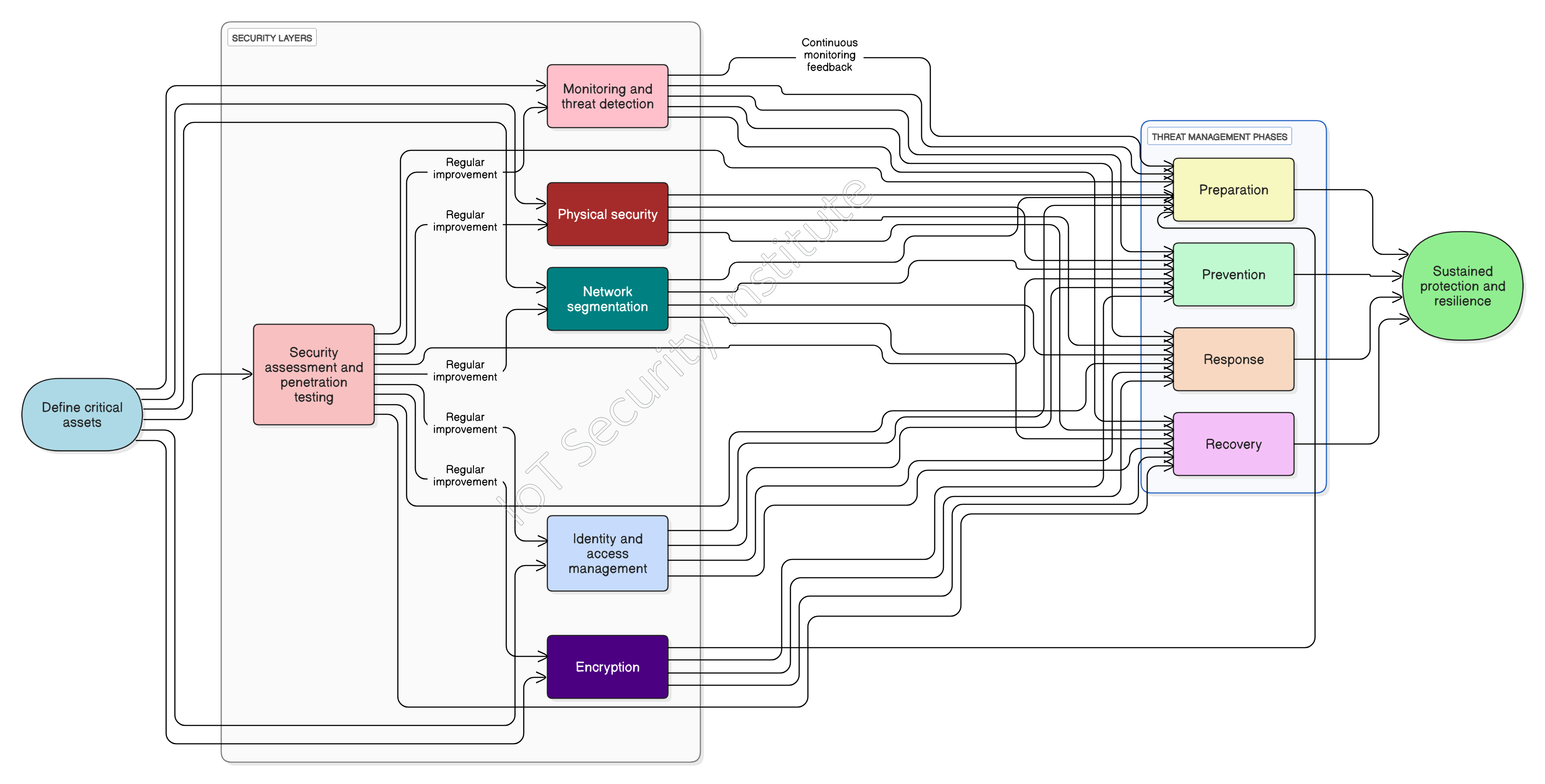
A robust electric grid security architecture must be built on the principle of defense-in-depth. This approach implements multiple layers of security controls throughout the infrastructure, ensuring that if one layer fails, others remain to protect critical assets. The electric power industry employs this strategy with a focus on preparation, prevention, response, and recovery for all potential threats.
Key components of a defense-in-depth strategy include:
- Physical security measures for substations, control centers, and generation facilities
- Network segmentation with clear demarcation between IT and OT environments
- Robust identity and access management systems
- Continuous monitoring and threat detection capabilities
- Encryption for data at rest and in transit
- Regular security assessments and penetration testing
Zero Trust Architecture
Traditional perimeter-based security models are increasingly inadequate for protecting modern electric grid infrastructure. Zero Trust architecture represents a paradigm shift, operating on the principle of "never trust, always verify." This approach is particularly valuable for electric utilities managing complex networks spanning IT and OT environments.
Implementing Zero Trust for electric grid security involves:
- Micro-segmentation of networks to limit lateral movement
- Continuous verification of all access attempts regardless of source
- Least privilege access controls for all users and systems
- Multi-factor authentication for critical systems
- Continuous monitoring and validation of security posture
Zero Trust Network Access (ZTNA) solutions can provide multiple collectives and air-gap IT from OT within the same solution, reducing complexity while enhancing security. This approach is particularly valuable as utilities increasingly adopt cloud services and remote access capabilities.
Regulatory Frameworks and Standards
NERC CIP Standards
The North American Electric Reliability Corporation Critical Infrastructure Protection (NERC CIP) standards establish mandatory requirements for securing the bulk electric system. These standards continue to evolve to address emerging threats, with recent updates focusing on supply chain security, remote access, and security monitoring.
Key NERC CIP standards that influence security architecture include:
- CIP-003: Security Management Controls
- CIP-005: Electronic Security Perimeter
- CIP-007: Systems Security Management
- CIP-010: Configuration Change Management and Vulnerability Assessments
- CIP-013: Supply Chain Risk Management
Recent enhancements to these standards (CIP-003-9, CIP-005-7, CIP-010-4, CIP-013-2) address challenges like transient asset management and supply chain security. Compliance with these standards forms the baseline for electric grid security architecture but should be viewed as a starting point rather than a comprehensive security solution.
NIST Cybersecurity Framework
The NIST Cybersecurity Framework provides a flexible, risk-based approach to managing cybersecurity risk. The framework's core functions—Identify, Protect, Detect, Respond, and Recover—align well with the needs of electric grid operators. The recently released NIST CSF 2.0 further enhances this framework with updated guidance relevant to critical infrastructure protection.
For electric utilities, the NIST framework can be implemented alongside NERC CIP requirements to create a more comprehensive security program. NIST has also developed a Smart Grid Profile that applies risk management strategies specifically to smart grid environments.
IEC Standards
International Electrotechnical Commission (IEC) standards provide important guidance for electric grid security architecture:
- IEC 62351: Focuses specifically on security for power system communication protocols and provides detailed security requirements for various communication layers.
- IEC 62443: Addresses industrial automation and control systems security more broadly, offering a comprehensive framework for securing operational technology environments.
While IEC 62351 focuses on communication security within energy and power systems, IEC 62443 provides a broader framework for industrial automation and control systems cybersecurity. Together, these standards help utilities implement secure communication protocols and establish robust security practices for operational technology environments.
Architectural Components for Comprehensive Grid Security
Secure Substation Architecture
Substations represent critical nodes in the electric grid and require specialized security controls. A secure substation architecture should include:
- Physical security measures including access controls and surveillance
- Network segmentation with clear separation between operational and non-operational systems
- Secure remote access solutions with strong authentication
- Encrypted communications for SCADA and other control systems
- Intrusion detection systems monitoring for unauthorized access or anomalous behavior
Leading vendors now offer Secure Substation Blueprints that meet the strict standards of IEC 62443-2-4 and -3-3 for cybersecurity. These blueprints provide reference architectures that utilities can adapt to their specific environments.
Control Center Security
Control centers serve as the operational nerve centers for electric utilities and require the highest levels of protection. Security architecture for control centers should include:
- Robust physical security with multiple access control layers
- Isolated operational networks with controlled interfaces to corporate IT
- Comprehensive monitoring and logging of all system activities
- Backup control capabilities in case of compromise or failure
- Regular security assessments and penetration testing
Many utilities are implementing Security Operations Centers (SOCs) that provide continuous monitoring of both IT and OT environments, enabling rapid detection and response to potential security incidents.
Field Device Security
The proliferation of intelligent electronic devices (IEDs) and other field equipment creates new security challenges for grid operators. Securing these devices requires:
- Secure-by-design hardware with tamper-resistant features
- Firmware validation and secure update mechanisms
- Strong authentication for all device communications
- Encryption for sensitive data and commands
- Regular vulnerability assessments and patching
As utilities deploy more distributed energy resources (DERs) and smart grid technologies, the security of field devices becomes increasingly critical to overall grid security.
Implementing a Resilient Security Architecture
IT/OT Convergence Challenges
The convergence of information technology (IT) and operational technology (OT) presents significant challenges for electric grid security. Traditional IT security approaches may not be appropriate for OT environments where availability and reliability are paramount. A successful security architecture must address these challenges through:
- Clear demarcation between IT and OT networks with controlled interfaces
- Security controls designed specifically for OT environments
- Unified security monitoring across both domains
- Governance structures that address both IT and OT security requirements
Leading utilities are implementing unified IT/OT security programs that recognize the unique requirements of each domain while ensuring consistent security practices across the organization.
Supply Chain Security
Recent attacks have highlighted the importance of supply chain security for electric grid operators. A comprehensive security architecture must address supply chain risks through:
- Vendor risk assessment and management processes
- Secure procurement practices for hardware and software
- Verification of component integrity before deployment
- Ongoing monitoring for supply chain compromises
NERC CIP-013 provides specific requirements for supply chain risk management, but utilities should go beyond compliance to implement robust supply chain security practices.
Incident Response and Recovery
Even the most robust security architecture cannot prevent all attacks. Effective incident response and recovery capabilities are essential components of electric grid security. Key elements include:
- Comprehensive incident response plans specifically addressing cyber attacks
- Regular exercises and simulations to test response capabilities
- Established communication channels with government agencies and industry partners
- Backup and recovery systems for critical operational technology
- Post-incident analysis to improve security architecture
The electric power industry's "defense-in-depth" philosophy emphasizes preparation, prevention, response, and recovery for all potential threats, recognizing that resilience requires both preventive controls and effective response capabilities.
Future Directions in Electric Grid Security Architecture
AI and Machine Learning Applications
Artificial intelligence and machine learning technologies are increasingly being applied to electric grid security. These technologies can enhance security architecture through:
- Advanced anomaly detection in network traffic and system behavior
- Automated threat hunting and response
- Predictive analytics for identifying potential vulnerabilities
- Enhanced monitoring of increasingly complex grid operations
While AI offers significant benefits, it also introduces new security considerations that must be addressed in the overall security architecture.
Quantum-Resistant Cryptography
The development of quantum computing poses a significant threat to current cryptographic systems. Forward-thinking electric grid security architectures should begin planning for post-quantum cryptography through:
- Assessment of cryptographic vulnerabilities to quantum attacks
- Implementation of crypto-agility to facilitate future algorithm changes
- Monitoring of NIST's post-quantum cryptography standardization efforts
- Pilot implementations of quantum-resistant algorithms for critical systems
While large-scale quantum computers capable of breaking current cryptographic systems may be years away, the long lifespan of electric grid infrastructure necessitates early planning for this threat.
Building a Sustainable Security Architecture
Architecting electric grid security requires a comprehensive approach that addresses both current threats and emerging challenges. By implementing defense-in-depth strategies, adopting zero trust principles, and aligning with established standards and frameworks, utilities can develop security architectures that protect critical infrastructure while enabling operational excellence.
The most effective security architectures will be those that balance security requirements with operational needs, recognize the unique characteristics of OT environments, and provide flexibility to adapt to evolving threats. As the electric grid continues to evolve with increased digitalization and distributed resources, security architecture must evolve as well, incorporating new technologies and approaches while maintaining core security principles.
For electric utilities, the journey toward robust security architecture is continuous, requiring ongoing assessment, improvement, and adaptation. By embracing this challenge and investing in comprehensive security programs, the industry can ensure the reliability and resilience of one of our most critical infrastructure systems.
