Implementing Zero Trust Architecture for Resilient Enterprise Security

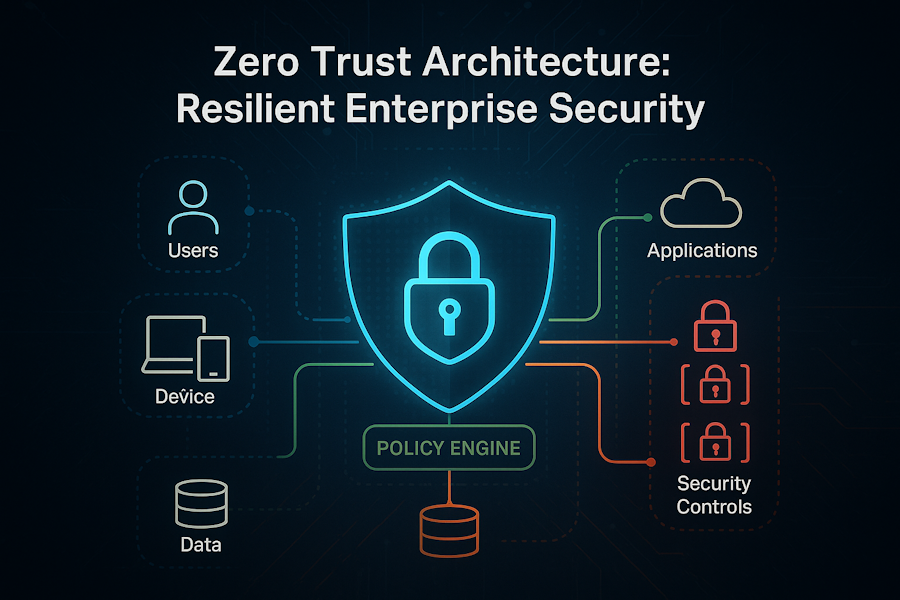
In today's rapidly evolving digital landscape, traditional perimeter-based security models are increasingly inadequate to protect enterprise assets and data. The expansion of cloud services, remote work, IoT devices, and sophisticated cyber threats has rendered the conventional "castle-and-moat" approach obsolete. Organizations can no longer rely on network location as a primary security control, as the traditional network perimeter has dissolved.
Zero Trust Architecture (ZTA) has emerged as a strategic approach to address these challenges. Rather than assuming everything inside the corporate network is safe, Zero Trust operates on the principle of "never trust, always verify." This whitepaper explores the comprehensive framework of Zero Trust Architecture, its core principles, implementation methodologies, and practical considerations for organizations seeking to enhance their security posture.
Understanding Zero Trust Architecture
Zero Trust Architecture is not a single technology or product but rather a strategic approach to cybersecurity that eliminates implicit trust and continuously validates every stage of digital interactions. The concept was initially coined by John Kindervag while at Forrester Research and has since evolved into a comprehensive security framework adopted by organizations worldwide.
Definition and Core Principles
According to NIST Special Publication 800-207, Zero Trust can be defined as "a cybersecurity paradigm focused on resource protection and the premise that trust is never granted implicitly but must be continually evaluated." Zero Trust Architecture is "an enterprise's cybersecurity plan that utilizes zero trust concepts and encompasses component relationships, workflow planning, and access policies."
The core tenets of Zero Trust Architecture include:
-
All data sources and computing services are considered resources - Every network component, regardless of type or location, is treated as a resource requiring protection.
-
All communication is secured regardless of network location - Network location alone does not imply trust. Communications must be secured with the strongest available methods, protecting confidentiality and integrity while providing source authentication.
-
Access to individual enterprise resources is granted on a per-session basis - Trust in the requester is evaluated before access is granted, with least privilege principles applied. Authentication to one resource does not automatically grant access to others.
-
Access to resources is determined by dynamic policy - Decisions are based on observable client identity, application/service state, requesting asset, and other behavioral and environmental attributes.
-
The enterprise monitors and measures the integrity and security posture of all owned and associated assets - No asset is inherently trusted, and the security posture of each asset is evaluated when processing resource requests.
-
All resource authentication and authorization are dynamic and strictly enforced before access is allowed - This creates a continuous cycle of obtaining access, scanning for threats, adapting, and reevaluating trust in ongoing communications.
-
The enterprise collects as much information as possible about assets, network infrastructure, and communications - This data is used to improve security posture, policy creation, and enforcement.
Zero Trust vs. Conventional Security Models
Understanding the fundamental differences between Zero Trust and traditional perimeter-based security models is essential for organizations considering a transition to ZTA.
Traditional Perimeter-Based Security
Conventional security models operate on the principle of establishing a secure perimeter around an organization's network. This approach:
- Relies heavily on firewalls, VPNs, and network segmentation to create a boundary between "trusted" internal networks and "untrusted" external networks
- Assumes that users and systems within the perimeter can be trusted
- Focuses security controls primarily at the network edge
- Provides minimal internal monitoring once access is granted
- Struggles to address modern threats like lateral movement after initial compromise
- Cannot effectively secure remote workers, cloud resources, and IoT devices
Zero Trust Architecture Approach
In contrast, Zero Trust Architecture:
- Assumes no user or device can be trusted by default, regardless of location
- Requires continuous verification of identity and security posture for every access request
- Implements micro-segmentation to limit lateral movement
- Applies least privilege access principles to minimize exposure
- Enforces strong authentication and authorization for all resources
- Continuously monitors and logs all activities for anomaly detection
- Secures all communications regardless of network location
- Provides consistent security controls across on-premises and cloud environments
Key Differences in Implementation
The practical implementation differences between these models are significant:
-
Trust Model: Traditional security establishes trust based on network location, while Zero Trust never assumes trust and requires continuous verification.
-
Access Control: Perimeter models grant broad access once inside the network, while Zero Trust implements fine-grained, least-privilege access controls for each resource.
-
Authentication: Traditional models often rely on single-factor authentication at the perimeter, whereas Zero Trust requires strong, multi-factor authentication for all resource access.
-
Visibility: Conventional approaches have limited visibility into internal network traffic, while Zero Trust monitors and analyzes all traffic regardless of source or destination.
-
Adaptability: Perimeter security struggles with remote work and cloud resources, while Zero Trust is designed for distributed, hybrid environments.
Core Components of Zero Trust Architecture
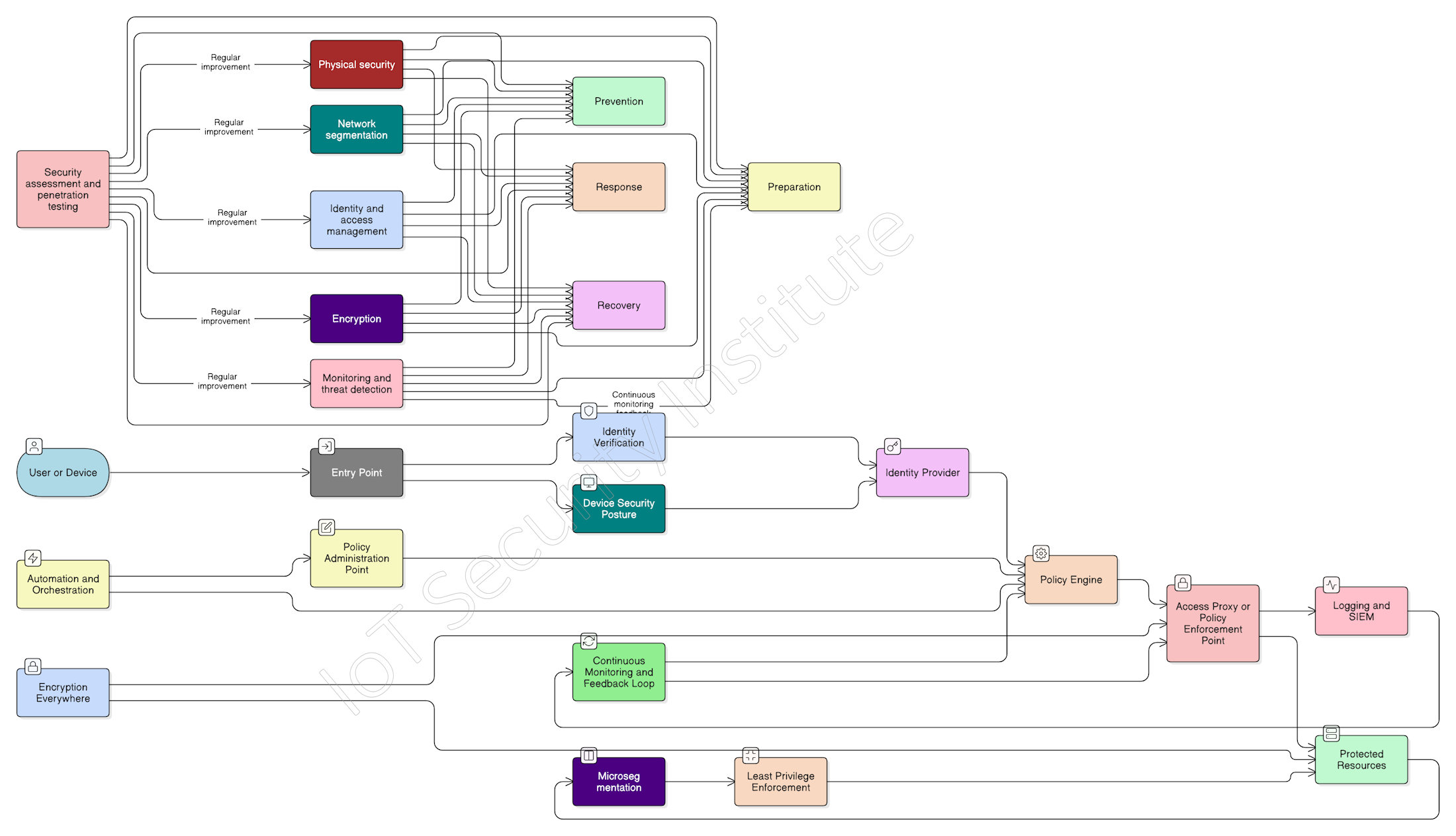
A comprehensive Zero Trust Architecture consists of several logical components that work together to enforce security policies and protect resources. Understanding these components is crucial for effective implementation.
Policy Engine (PE)
The Policy Engine is the brain of the Zero Trust Architecture, responsible for making the ultimate decision to grant access to a resource. It:
- Evaluates access requests against enterprise policies
- Processes input from various data sources
- Applies trust algorithms to determine access decisions
- Logs decisions for auditing and improvement
- Communicates with the Policy Administrator to enforce decisions
Policy Administrator (PA)
The Policy Administrator acts as the executor of policy decisions by:
- Establishing or terminating communication paths between subjects and resources
- Generating session-specific authentication tokens or credentials
- Configuring Policy Enforcement Points based on Policy Engine decisions
- Managing the control plane for security configuration
- Monitoring ongoing sessions for policy compliance
Policy Enforcement Point (PEP)
The Policy Enforcement Point serves as the gateway that:
- Enables, monitors, and terminates connections between subjects and resources
- Forwards access requests to the Policy Administrator
- Implements policy decisions from the Policy Administrator
- Acts as the security gateway protecting enterprise resources
- May exist as a client-side agent, resource-side gateway, or combined component
Data Sources
Zero Trust Architecture relies on multiple data sources to inform access decisions:
- Continuous Diagnostics and Mitigation (CDM) systems - Provide information about asset state, patch levels, and vulnerabilities
- Industry compliance systems - Ensure adherence to regulatory requirements
- Threat intelligence feeds - Supply information about emerging threats and vulnerabilities
- Network and system activity logs - Provide real-time feedback on security posture
- Data access policies - Define rules for resource access based on identity and context
- Enterprise PKI - Manages certificates for authentication
- ID management systems - Store and manage user identities and attributes
- Security Information and Event Management (SIEM) - Collects and analyzes security events
Trust Algorithm
The Trust Algorithm is the process used by the Policy Engine to evaluate access requests and make authorization decisions. It can be:
- Criteria-based - Uses a set of qualified attributes that must be met before access is granted
- Score-based - Computes a confidence level based on multiple factors with enterprise-configured weights
- Singular - Treats each request individually without considering history
- Contextual - Takes the subject's recent behavior into account when evaluating requests
Zero Trust Architecture Deployment Models
Organizations can implement Zero Trust Architecture through various deployment models, each with distinct characteristics and use cases.
Device Agent/Gateway Model
In this model:
- Each enterprise asset has an installed device agent
- Each resource has a gateway component acting as a proxy
- The agent directs traffic to appropriate PEPs for evaluation
- The gateway communicates with the Policy Administrator
- The Policy Administrator configures secure communication channels
- Best suited for enterprises with robust device management programs
Enclave-Based Model
This variation:
- Places gateway components at the boundary of resource enclaves
- Protects groups of resources serving a single business function
- Works well for legacy systems that cannot communicate directly with gateways
- Suitable for cloud-based microservices for single business processes
- May operate as a hybrid with the device agent/gateway model
Resource Portal Model
This approach:
- Uses a single PEP component acting as a gateway for subject requests
- Can protect individual resources or secure enclaves
- Does not require software installation on client devices
- Offers flexibility for BYOD policies and inter-organizational collaboration
- Provides limited visibility into client devices between sessions
Application Sandboxing
This model:
- Runs vetted applications in compartmentalized environments on assets
- Protects applications from potentially compromised hosts
- Allows applications to communicate with PEPs for resource access
- Prevents requests from unauthorized applications
- Requires maintenance of sandboxed applications for all assets
Implementation Methodologies
Implementing Zero Trust Architecture requires a structured approach that addresses identity, network, and application security aspects.
Enhanced Identity Governance Approach
This methodology:
- Uses identity as the primary component of policy creation
- Bases access policies on identity and assigned attributes
- Considers device status and environmental factors as secondary elements
- Works well with resource portal models and cloud-based applications
- Suitable for enterprises with open network models or frequent non-enterprise devices
Micro-Segmentation Approach
This strategy:
- Places resources on unique network segments protected by gateway components
- Uses intelligent switches, next-generation firewalls, or specialized gateways as PEPs
- May implement host-based micro-segmentation using software agents
- Requires an identity governance program to function effectively
- Relies on managed gateway components that can reconfigure as needed
Network-Based Segmentation
This approach:
- Uses network infrastructure to implement Zero Trust
- May employ overlay networks at layer 7 or lower in the OSI stack
- Often incorporates Software Defined Perimeter (SDP) concepts
- Integrates with Software Defined Networks (SDN) and intent-based networking
- Configures the network based on Policy Engine decisions
Implementation Steps
A structured implementation methodology includes:
-
Identify actors on the enterprise - Map all users, service accounts, and non-person entities
-
Identify assets owned by the enterprise - Catalog hardware, software, and digital artifacts
-
Identify key processes and evaluate risks - Rank business processes and data flows by importance
-
Formulate policies - Develop access criteria based on identity, device state, and context
-
Identify candidate solutions - Select appropriate technologies based on use cases
-
Deploy and monitor - Implement in observation mode initially to refine policies
-
Expand incrementally - Gradually extend Zero Trust controls to additional workflows
Use Cases for Zero Trust Architecture
Zero Trust Architecture can be applied to various enterprise scenarios, each with unique requirements and benefits.
Remote Workforce Security
For organizations with remote employees:
- ZTA enables secure access to resources without VPN dependencies
- Authentication and authorization occur regardless of user location
- Cloud-hosted Policy Engines provide superior availability
- Device posture is verified before granting access
- Resources remain protected even when accessed from untrusted networks
Multi-Cloud/Cloud-to-Cloud Environments
For enterprises using multiple cloud providers:
- ZTA facilitates direct communication between resources in different clouds
- Eliminates the need to route traffic through enterprise networks
- Places PEPs at access points of each application and data source
- Maintains consistent security controls across cloud environments
- Enables centralized policy management for distributed resources
IoT and OT Security
For industrial and IoT environments:
- ZTA secures communication between operational technology devices
- Prevents unauthorized access to critical infrastructure
- Implements micro-segmentation to isolate industrial control systems
- Verifies device identity and integrity before allowing connections
- Monitors for anomalous behavior in industrial networks
Third-Party Access Management
For contractors and non-employee access:
- ZTA provides limited, controlled access to specific resources
- Obscures enterprise resources from unauthorized discovery
- Differentiates between employee and visitor access rights
- Enables internet access while protecting internal resources
- Simplifies management of temporary access requirements
Cross-Enterprise Collaboration
For partnerships between organizations:
- ZTA facilitates secure resource sharing without complex firewall rules
- Enables federated identity for streamlined access
- Eliminates the need for enterprise-wide ACLs
- Provides granular control over shared resources
- Supports cloud-based collaboration without VPN requirements
Design Considerations and Challenges
Implementing Zero Trust Architecture presents several challenges that organizations must address through careful design and planning.
Technical Challenges
-
Legacy System Integration - Older systems may lack modern authentication capabilities or API support
-
Performance Impact - Additional verification steps may introduce latency in resource access
-
Encrypted Traffic Inspection - Balancing security needs with privacy and performance considerations
-
Component Interoperability - Ensuring different vendors' solutions work together effectively
-
Scalability - Designing systems that can handle increased authentication and authorization loads
Operational Challenges
-
User Experience - Managing additional authentication requirements without causing security fatigue
-
Policy Management - Developing and maintaining complex, dynamic access policies
-
Incident Response - Adapting security operations to Zero Trust environments
-
Skills Gap - Training staff on new technologies and approaches
-
Business Continuity - Ensuring availability during component failures or network disruptions
Security Considerations
-
Policy Engine Protection - Securing the critical decision-making components
-
Denial-of-Service Resilience - Preventing attacks that target authentication infrastructure
-
Credential Theft Mitigation - Implementing strong MFA and continuous verification
-
Visibility and Monitoring - Ensuring comprehensive logging and analysis capabilities
-
Data Protection - Securing sensitive information used in access decisions
Design Best Practices
To address these challenges, organizations should:
-
Start with critical assets - Identify and protect the most valuable resources first
-
Implement strong identity management - Deploy robust authentication and authorization systems
-
Adopt micro-segmentation - Limit lateral movement through network segmentation
-
Encrypt all communications - Protect data in transit regardless of network location
-
Implement continuous monitoring - Deploy comprehensive logging and analytics
-
Develop clear policies - Create well-defined access rules based on business needs
-
Plan for resilience - Design for component failures and network disruptions
-
Consider user experience - Balance security requirements with usability
Migration Strategy
Transitioning to Zero Trust Architecture requires a phased approach that minimizes disruption while progressively enhancing security.
Assessment and Planning
Begin with a comprehensive assessment:
- Inventory all assets, users, and resources
- Map data flows and dependencies
- Identify critical business processes
- Evaluate current security controls
- Develop a phased migration roadmap
Pilot Implementation
Start with a limited deployment:
- Select a non-critical business process
- Implement Zero Trust controls for specific resources
- Operate in monitoring mode initially
- Gather metrics and user feedback
- Refine policies and procedures
Incremental Expansion
Gradually extend Zero Trust controls:
- Prioritize resources based on sensitivity and risk
- Implement stronger authentication mechanisms
- Deploy micro-segmentation incrementally
- Enhance monitoring and analytics capabilities
- Maintain hybrid operations during transition
Continuous Improvement
Establish ongoing optimization processes:
- Regularly review and update policies
- Monitor for security events and policy violations
- Gather user feedback and address usability issues
- Adapt to changing business requirements
- Incorporate new technologies and approaches
Zero Trust Architecture represents a fundamental shift in cybersecurity strategy, moving from perimeter-based defenses to a model that assumes breach and verifies every access request. By implementing the principles, components, and methodologies outlined organizations can significantly enhance their security posture and better protect their critical assets in today's complex threat landscape.
The journey to Zero Trust is not a destination but a continuous process of improvement. Organizations should approach implementation incrementally, focusing on critical assets and gradually expanding protection across the enterprise. By embracing Zero Trust principles, organizations can build resilient security architectures capable of addressing current and future cybersecurity challenges.
As cyber threats continue to evolve, Zero Trust Architecture provides a framework that adapts to changing conditions while maintaining strong protection for enterprise resources. By eliminating implicit trust and implementing continuous verification, organizations can reduce their attack surface, limit the impact of breaches, and enable secure digital transformation initiatives.
