The Silent Disruptors: How Zero-Day Exploits Are Crippling Global Supply Chains

The Invisible Threat to Global Commerce
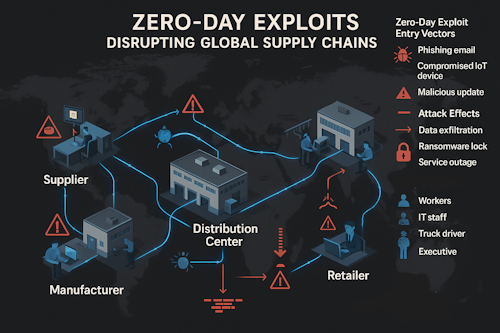
In today's interconnected world, global supply chains represent the backbone of international commerce, connecting manufacturers, distributors, retailers, and consumers across continents. Yet these complex networks face an increasingly sophisticated threat: zero-day exploits. These previously unknown software vulnerabilities, weaponized before developers can patch them, have emerged as powerful tools for disrupting critical infrastructure and supply chain operations worldwide.
The impact of these attacks extends far beyond immediate technical disruptions. When supply chains falter, the consequences cascade through global markets—delaying shipments, halting production lines, compromising sensitive data, and ultimately costing billions in economic damage. Recent years have witnessed several devastating zero-day attacks that have exposed the fragility of our interconnected systems and the far-reaching consequences when they fail.
Understanding Zero-Day Exploits in Supply Chain Contexts
Zero-day vulnerabilities represent the most dangerous class of security flaws—software weaknesses unknown to the vendor and for which no patch exists. The term "zero-day" refers to the fact that developers have had zero days to address the vulnerability before it's exploited. When these vulnerabilities target software or systems integral to supply chain operations, the results can be catastrophic.
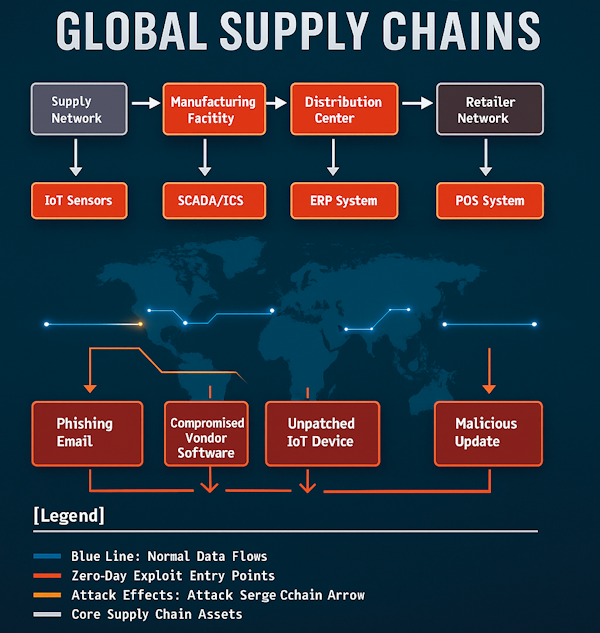
Supply chain attacks leveraging zero-days are particularly effective because they:
- Target trusted relationships between organizations and their technology providers
- Exploit the implicit trust in software update mechanisms
- Allow attackers to compromise multiple victims through a single point of entry
- Often remain undetected for extended periods, maximizing damage
- Create cascading failures across interconnected systems
The sophistication of these attacks has grown substantially, with nation-state actors and advanced criminal groups developing specialized capabilities to identify and weaponize zero-day vulnerabilities specifically targeting supply chain infrastructure.
Case Study: The MOVEit Transfer Attack (2023)
One of the most significant supply chain attacks in recent history began in May 2023 when the Cl0p ransomware group exploited a previously unknown SQL injection vulnerability (CVE-2023-34362) in Progress Software's MOVEit Transfer application—a widely used secure file transfer solution.
Attack Methodology
The attack followed a sophisticated pattern:
- Initial exploitation of the zero-day SQL injection vulnerability in internet-facing MOVEit Transfer servers
- Deployment of web shells to maintain persistent access
- Exfiltration of sensitive data from compromised systems
- Extortion of victims through threats to publish stolen data
What made this attack particularly devastating was its ripple effect through the digital supply chain. Organizations that directly used MOVEit were compromised, but the damage extended to their customers and partners who had entrusted data to these systems.
Scale and Impact
The MOVEit breach represents one of the most extensive supply chain compromises in history:
- Over 2,000 organizations affected across multiple sectors
- Approximately 60 million individuals' data compromised
- Financial services, healthcare, government agencies, and educational institutions all impacted
- Estimated economic damage exceeding $10 billion globally
IBM's Cost of a Data Breach Report noted that supply chain compromises like MOVEit cost 11.8% more than typical breaches and took 12.8% longer to remediate, highlighting the amplified impact of these attacks.
Exploitation Demands
The Cl0p ransomware group, known for its sophisticated operations, demanded ransom payments ranging from hundreds of thousands to millions of dollars from affected organizations. Their approach involved:
- Initial contact through encrypted channels
- Proof of data exfiltration to establish credibility
- Ransom demands with specific payment instructions in cryptocurrency
- Threats to publish stolen data on their leak site if demands weren't met
Many organizations faced impossible choices: pay substantial ransoms or risk exposure of sensitive customer and business data.
Case Study: Ivanti Connect Secure Zero-Days (2024-2025)
In early 2024, security researchers discovered multiple zero-day vulnerabilities in Ivanti's Connect Secure VPN appliances, widely used by organizations to provide secure remote access to corporate networks. These vulnerabilities were actively exploited by suspected nation-state actors.
Attack Methodology
The Ivanti attacks demonstrated sophisticated chaining of multiple zero-day vulnerabilities:
- Initial exploitation of authentication bypass vulnerability (CVE-2023-46805)
- Command injection vulnerability (CVE-2024-21887) to achieve remote code execution
- Privilege escalation vulnerability (CVE-2024-21888) to gain administrative access
- Web component vulnerability (CVE-2024-21893) for persistent access
This attack chain allowed threat actors to completely compromise affected VPN appliances, creating backdoors and establishing persistent access to corporate networks.
Supply Chain Implications
The Ivanti vulnerabilities had severe implications for global supply chains:
- Compromised remote access infrastructure for thousands of organizations
- Unauthorized access to internal networks of critical infrastructure providers
- Potential for lateral movement to operational technology (OT) environments
- Disruption of secure communication channels essential for supply chain operations
According to Ivanti's 2025 State of Cybersecurity Report, only one in three organizations felt prepared to protect themselves from software supply chain threats, highlighting the widespread vulnerability to these types of attacks.
Attack Sources
Security researchers attributed these attacks to advanced persistent threat (APT) groups with likely ties to China. The targeting patterns and sophisticated exploitation techniques indicated state-sponsored activity focused on intelligence gathering and establishing persistent access to high-value networks.
Case Study: The XZ Utils Backdoor (2024)
In March 2024, security researchers discovered a sophisticated backdoor in XZ Utils, a fundamental compression library used in numerous Linux distributions. This supply chain attack represented one of the most concerning software compromises since the Log4j vulnerability.
Attack Methodology
The XZ Utils attack demonstrated extraordinary sophistication:
- The attacker (identified as Jia Tan) gained the trust of the open-source community over time
- Introduced subtle, malicious code into versions 5.6.0 and 5.6.1 of XZ Utils
- The backdoor specifically targeted SSH (Secure Shell) authentication processes
- The malicious code was designed to steal SSH authentication keys and provide unauthorized access
- The code was obfuscated to avoid detection during code reviews
What made this attack particularly concerning was its targeting of a fundamental library used across countless Linux systems, potentially affecting millions of servers worldwide.
Supply Chain Implications
The XZ Utils backdoor highlighted critical vulnerabilities in the open-source supply chain:
- Demonstrated how compromising a single, widely-used component could affect countless downstream systems
- Exposed weaknesses in open-source project governance and security review processes
- Created potential for widespread unauthorized access to critical infrastructure
- Required emergency patching across numerous Linux distributions and dependent systems
The attack specifically targeted SSH—a protocol fundamental to secure remote administration of servers and network devices that form the backbone of global supply chains.
Attack Attribution
While definitive attribution remains challenging, security researchers noted several indicators suggesting a sophisticated, state-sponsored attack:
- The extensive patience and planning required to establish trust within the open-source community
- The highly targeted nature of the backdoor, specifically focusing on SSH authentication
- The sophisticated obfuscation techniques used to hide the malicious code
- The strategic value of the target for intelligence gathering operations
The incident highlighted how nation-state actors are increasingly targeting fundamental software components that underpin global digital infrastructure.
The CrowdStrike Incident: When Security Solutions Become Single Points of Failure (2024)
While not a zero-day exploit in the traditional sense, the July 2024 CrowdStrike incident demonstrated how security solutions themselves can become critical points of failure in global supply chains.
Incident Overview
On July 19, 2024, CrowdStrike, a leading cybersecurity provider, released a faulty update to its Falcon Sensor security software. This update caused Windows systems worldwide to crash with the "Blue Screen of Death," affecting millions of devices across industries.
Global Supply Chain Impact
The incident had unprecedented effects on global supply chains:
- Airlines grounded flights worldwide, disrupting passenger travel and air freight
- Shipping ports experienced significant delays in processing cargo
- Retail point-of-sale systems failed, halting transactions
- Healthcare systems faced disruptions affecting patient care
- Manufacturing facilities experienced production stoppages
The economic impact was staggering, with Fortune 500 companies alone suffering an estimated $5.4 billion in damages. The semiconductor industry, which relies heavily on air freight for transporting finished products, faced particularly severe disruptions.
Key Lessons
The CrowdStrike incident highlighted several critical vulnerabilities in modern supply chains:
- Over-reliance on single vendors creating dangerous points of failure
- Insufficient testing of security updates before deployment
- Inadequate business continuity planning for widespread IT failures
- The interconnected nature of global supply chains amplifying localized failures
This case demonstrated how even security solutions designed to protect supply chains can themselves become vectors for massive disruption when they fail.
Attack Sources and Motivations
Zero-day exploits targeting supply chains originate from several distinct threat actors, each with different motivations and capabilities:
Nation-State Actors
Government-sponsored threat groups represent the most sophisticated attackers targeting supply chains:
- China-linked APT groups: Frequently target intellectual property and strategic intelligence through supply chain compromises
- Russia-associated actors: Focus on critical infrastructure disruption and intelligence gathering
- North Korean state-sponsored groups: Often motivated by financial gain to circumvent sanctions
- Western intelligence agencies: Develop sophisticated capabilities for targeted intelligence operations
These actors typically possess substantial resources, including dedicated research teams searching for zero-day vulnerabilities and developing sophisticated exploitation techniques.
Financially Motivated Criminal Groups
Ransomware gangs and other cybercriminal organizations have increasingly targeted supply chains:
- Cl0p Ransomware Group: Responsible for the MOVEit attacks and numerous other supply chain compromises
- LockBit: Targets logistics and manufacturing organizations with ransomware
- BlackCat/ALPHV: Specializes in double-extortion ransomware targeting critical infrastructure
These groups are primarily motivated by financial gain, with ransom demands frequently reaching millions of dollars for large organizations.
Hacktivists and Disruptive Actors
Some attacks target supply chains specifically to cause disruption:
- Anonymous and affiliated groups: Target organizations for ideological reasons
- Chaos-focused actors: Seek to cause maximum disruption without clear financial motives
- Insider threats: Disgruntled employees with privileged access can cause significant damage
These actors may be less sophisticated but can still cause substantial disruption by targeting vulnerable points in supply chain systems.
Exploitation Demands and Objectives
The demands and objectives of supply chain attackers vary significantly based on their motivations:
Financial Extortion
Ransomware groups typically make explicit demands:
- Ransom payments in cryptocurrency (usually Bitcoin or Monero)
- Amounts ranging from hundreds of thousands to tens of millions of dollars
- Threats to publish exfiltrated data if demands aren't met (double extortion)
- Offers of decryption tools upon payment (though these aren't always reliable)
Intelligence Gathering
Nation-state actors often focus on espionage objectives:
- Exfiltration of intellectual property and trade secrets
- Access to strategic information about competitors or adversaries
- Mapping of critical infrastructure for potential future operations
- Establishing persistent access for long-term intelligence gathering
These attacks typically don't involve explicit demands, as the objective is covert information collection rather than immediate financial gain.
Strategic Disruption
Some attacks aim specifically to disrupt operations:
- Targeting critical infrastructure to cause economic damage
- Disrupting supply chains during geopolitical tensions
- Creating public panic or undermining confidence in systems
- Demonstrating capabilities as a form of geopolitical signaling
These attacks may be accompanied by public statements or may remain unclaimed, depending on the strategic objectives of the attackers.
Defensive Strategies: Protecting Supply Chains from Zero-Day Threats
Organizations can implement several strategies to mitigate the risk of zero-day exploits disrupting their supply chains:
Supply Chain Risk Management
- Implement comprehensive vendor security assessment processes
- Develop and maintain software bills of materials (SBOMs) for all critical systems
- Establish clear security requirements in vendor contracts
- Regularly audit third-party access and permissions
- Implement zero trust architecture principles across supply chain systems
Technical Mitigations
- Deploy advanced endpoint protection with behavioral analysis capabilities
- Implement network segmentation to limit lateral movement
- Utilize application allowlisting to prevent unauthorized code execution
- Employ runtime application self-protection (RASP) technologies
- Implement robust patch management processes with emergency procedures for zero-day vulnerabilities
Resilience Planning
- Develop and regularly test business continuity plans specifically for supply chain disruptions
- Implement redundancy for critical systems and suppliers
- Establish incident response procedures specifically for supply chain compromises
- Conduct regular tabletop exercises simulating zero-day attacks
- Maintain offline backups of critical data and systems
Collaborative Defense
- Participate in industry information sharing groups
- Engage with government cybersecurity agencies for threat intelligence
- Contribute to responsible vulnerability disclosure programs
- Support open-source security initiatives
- Share lessons learned from incidents to improve collective defense
The Evolving Threat Landscape
Zero-day exploits targeting global supply chains represent one of the most significant cybersecurity challenges facing organizations today. The cases examined—from MOVEit and Ivanti to XZ Utils and CrowdStrike—demonstrate the far-reaching consequences when these attacks succeed.
As supply chains become increasingly digitized and interconnected, the potential impact of zero-day exploits will only grow. Organizations must recognize that traditional security approaches focused solely on perimeter defense are insufficient against these sophisticated threats.
The future of supply chain security lies in adopting a comprehensive approach that combines technical controls, organizational processes, and collaborative defense mechanisms. By understanding the methodologies, sources, and motivations behind zero-day attacks, organizations can better prepare for and respond to these inevitable challenges.
In an era where a single vulnerability can disrupt global commerce, resilience must become the cornerstone of supply chain security strategy. The question is no longer if a zero-day exploit will target your supply chain, but when—and how prepared you'll be to respond.
