IEC 62443 in Action: Cybersecurity for Smart Manufacturing

The Convergence of Cybersecurity and Smart Manufacturing
The rapid evolution of Industry 4.0 technologies has fundamentally transformed traditional manufacturing environments into interconnected ecosystems of smart devices, sensors, and control systems. While this digital transformation delivers unprecedented operational efficiency, productivity gains, and data-driven insights, it simultaneously expands the attack surface for cyber threats. As manufacturing facilities integrate more connected technologies, the potential impact of security breaches extends beyond data loss to include production disruptions, equipment damage, safety incidents, and even environmental hazards.
The IEC 62443 series of standards has emerged as the definitive framework for securing Industrial Automation and Control Systems (IACS) in this new paradigm. This comprehensive set of standards provides a structured approach to cybersecurity that addresses the unique challenges of operational technology (OT) environments while accommodating the integration of IT systems and cloud technologies that characterize smart manufacturing.
This article explores how IEC 62443 is being implemented in smart manufacturing environments, examining real-world applications, implementation challenges, and best practices for establishing robust cybersecurity postures in increasingly complex industrial ecosystems.
Understanding the IEC 62443 Framework
The IEC 62443 (formerly ISA-99) standards were developed through collaboration between the International Society of Automation (ISA) and the International Electrotechnical Commission (IEC). Unlike IT-focused frameworks, IEC 62443 was specifically designed to address the unique requirements and constraints of industrial control systems, where availability and integrity often take precedence over confidentiality.
Structure of the IEC 62443 Standards
The IEC 62443 framework is organized into four main categories, each addressing different aspects of industrial cybersecurity:
-
General (62443-1-X): Establishes core concepts, terminology, and metrics for industrial automation security.
-
Policies and Procedures (62443-2-X): Focuses on organizational security policies and procedures, including requirements for security management systems.
-
System Requirements (62443-3-X): Defines technical requirements for system design and integration, including security architecture and system security requirements.
-
Component Requirements (62443-4-X): Specifies requirements for the development and testing of secure components and products.
The Seven Foundational Requirements
At the core of IEC 62443 are seven foundational requirements (FRs) that form the basis for evaluating and implementing security controls:
-
Identification and Authentication Control (IAC): Ensuring that all users and systems are properly identified and authenticated before granting access.
-
Use Control (UC): Managing and enforcing the permissions assigned to authenticated users and systems.
-
System Integrity (SI): Protecting the integrity of the industrial control system against unauthorized data or command manipulation.
-
Data Confidentiality (DC): Protecting sensitive information from unauthorized disclosure.
-
Restricted Data Flow (RDF): Segmenting networks and controlling communication between zones and conduits.
-
Timely Response to Events (TRE): Ensuring that security events are detected, logged, analyzed, and addressed promptly.
-
Resource Availability (RA): Ensuring the availability of critical system resources and services.
Security Levels: A Risk-Based Approach
IEC 62443 defines four security levels (SLs) that correlate required security measures with the potential impact of security breaches:
-
SL1: Protection against casual or coincidental violations. Includes 37 base requirements focused on fundamental security controls.
-
SL2: Protection against intentional violations using simple means with low resources, generic skills, and low motivation. Builds on SL1 with 43 additional requirements (22 new base requirements and 21 enhancements).
-
SL3: Protection against intentional violations using sophisticated means with moderate resources, IACS-specific skills, and moderate motivation. Requires hardware-based security mechanisms and more rigorous controls.
-
SL4: Protection against intentional violations using sophisticated means with extended resources, IACS-specific skills, and high motivation. Designed for critical infrastructure and systems where breaches could have catastrophic consequences.
This graduated approach allows organizations to implement security controls proportionate to their risk profile and operational requirements, making the framework adaptable to various manufacturing environments.
IEC 62443 Implementation in Smart Manufacturing
Smart manufacturing environments present unique challenges for cybersecurity implementation due to their complex integration of legacy systems, modern IoT devices, and cloud services. The IEC 62443 framework provides a structured approach to addressing these challenges.
Zone and Conduit Model: Securing the Smart Factory
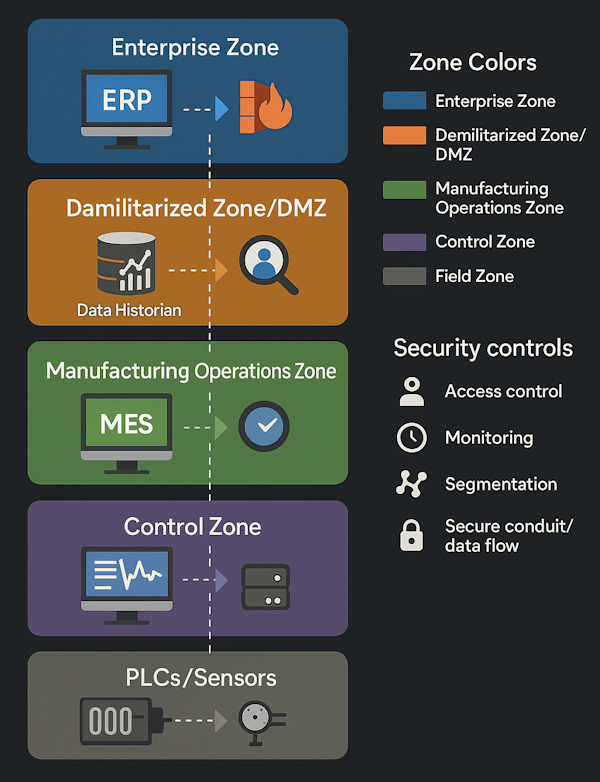
One of the most powerful concepts in IEC 62443 is the zone and conduit model, which is particularly relevant for smart manufacturing environments. This approach involves:
-
Segmentation: Dividing the manufacturing network into logical zones based on security requirements, criticality, and functional relationships.
-
Controlled Communication: Establishing secure conduits between zones with appropriate security controls to monitor and restrict data flows.
-
Defense in Depth: Implementing multiple layers of security controls to protect critical assets.
In a smart manufacturing context, this might involve creating separate zones for:
- Enterprise IT systems
- Manufacturing execution systems (MES)
- Supervisory control systems
- Control systems and PLCs
- Field devices and sensors
- Cloud-based analytics platforms
- Remote access systems
Each zone would have security controls appropriate to its security level requirements, with conduits between zones implementing strict access controls, data validation, and monitoring.
Security Level Implementation in Practice
The implementation of security levels in smart manufacturing typically follows a risk-based approach:
- Critical production systems that could cause safety incidents or significant production losses if compromised might require SL3 protection.
- Supporting production systems with moderate impact potential might be assigned SL2 requirements.
- Non-critical systems with minimal impact might operate at SL1.
For example, a pharmaceutical manufacturer might implement:
- SL3 controls for systems controlling critical production processes and formulations
- SL2 controls for inventory management and quality testing systems
- SL1 controls for environmental monitoring and non-critical data collection
This tiered approach allows organizations to focus security investments where they deliver the greatest risk reduction.
Case Studies: IEC 62443 in Smart Manufacturing Environments
Case Study 1: Automotive Manufacturing Plant
A leading automotive manufacturer implemented IEC 62443 as part of its digital transformation initiative. The company faced challenges integrating legacy production equipment with new IoT sensors and cloud-based analytics platforms while maintaining security.
Implementation Approach:
- Conducted comprehensive risk assessment to identify critical assets and potential threats
- Developed a zone and conduit architecture with five distinct security zones
- Implemented SL3 controls for robotic assembly systems and safety-critical equipment
- Applied SL2 controls for production monitoring and quality control systems
- Deployed industrial firewalls and secure remote access solutions at zone boundaries
- Established a continuous monitoring program for security events
Results:
- 60% reduction in security incidents affecting production
- Improved visibility into potential security issues
- Enhanced ability to integrate new technologies securely
- Streamlined compliance with customer security requirements
Case Study 2: Pharmaceutical Manufacturing
A pharmaceutical manufacturer implemented IEC 62443 to protect sensitive intellectual property and ensure regulatory compliance while adopting Industry 4.0 technologies.
Implementation Approach:
- Conducted detailed asset inventory and classification
- Implemented strict network segmentation with industrial demilitarized zones (DMZs)
- Deployed SL3 controls for formulation and critical production systems
- Implemented secure-by-design principles for new equipment procurement
- Established comprehensive security policies and procedures
- Conducted regular security assessments and penetration testing
Results:
- Successfully maintained compliance with FDA and other regulatory requirements
- Protected valuable intellectual property from targeted attacks
- Reduced unplanned downtime due to security incidents
- Established secure foundation for ongoing digital transformation
Implementation Challenges and Best Practices
Common Implementation Challenges
Organizations implementing IEC 62443 in smart manufacturing environments typically face several challenges:
-
Legacy System Integration: Many manufacturing environments contain legacy systems that were not designed with security in mind and may lack basic security capabilities.
-
Operational Constraints: Security controls must be implemented without disrupting production processes or introducing unacceptable latency.
-
Skills Gap: There is often a shortage of personnel with expertise in both manufacturing operations and cybersecurity.
-
Vendor Management: Manufacturing environments typically include equipment and software from multiple vendors with varying security capabilities.
-
Continuous Evolution: Smart manufacturing technologies continue to evolve rapidly, requiring security architectures that can adapt to new capabilities and threats.
Best Practices for Successful Implementation
Based on successful implementations, several best practices have emerged for applying IEC 62443 in smart manufacturing:
-
Start with Risk Assessment: Conduct a thorough assessment to identify critical assets, potential threats, and vulnerabilities specific to your manufacturing environment.
-
Adopt a Phased Approach: Implement security controls incrementally, starting with the most critical systems and highest-risk vulnerabilities.
-
Establish Clear Security Policies: Develop comprehensive security policies and procedures aligned with IEC 62443-2-1 requirements.
-
Implement Defense in Depth: Deploy multiple layers of security controls to protect critical assets, rather than relying on a single security boundary.
-
Secure the Supply Chain: Establish security requirements for vendors and integrate security into the procurement process for new equipment and systems.
-
Conduct Regular Assessments: Perform periodic security assessments to identify new vulnerabilities and verify the effectiveness of existing controls.
-
Develop Incident Response Capabilities: Establish procedures for detecting, responding to, and recovering from security incidents.
-
Provide Ongoing Training: Ensure that personnel have the knowledge and skills needed to implement and maintain security controls.
Future Trends: IEC 62443 and Emerging Technologies
As smart manufacturing continues to evolve, several trends are shaping the future of IEC 62443 implementation:
Integration with AI and Machine Learning
Artificial intelligence and machine learning are increasingly being integrated into security solutions for smart manufacturing, enabling:
- Anomaly detection in industrial control system communications
- Predictive maintenance with security considerations
- Automated threat hunting and response
- Risk-based authentication for industrial systems
These technologies can enhance the implementation of IEC 62443 by providing more sophisticated detection and response capabilities.
Cloud Security for Manufacturing
As manufacturing operations increasingly leverage cloud services for data analytics, remote monitoring, and supply chain integration, IEC 62443 implementations must address cloud security considerations:
- Secure integration between on-premises control systems and cloud platforms
- Data protection for manufacturing intellectual property in cloud environments
- Identity and access management across hybrid environments
- Compliance verification for cloud service providers
Security for Digital Twins and Virtual Commissioning
Digital twins and virtual commissioning are transforming manufacturing design and operations, introducing new security considerations:
- Protection of digital twin data and models
- Secure synchronization between physical systems and digital representations
- Authentication and integrity verification for simulation inputs and outputs
- Secure development environments for virtual commissioning
Building Resilient Smart Manufacturing with IEC 62443
The IEC 62443 framework provides a comprehensive approach to securing smart manufacturing environments, addressing the unique challenges of operational technology while accommodating the integration of new technologies. By implementing the standards with a risk-based approach, manufacturing organizations can protect critical assets, ensure operational continuity, and enable secure digital transformation.
Successful implementation requires a combination of technical controls, organizational processes, and security awareness, applied within the context of specific manufacturing operations and business requirements. As smart manufacturing continues to evolve, the IEC 62443 framework will remain a critical foundation for industrial cybersecurity, adapting to address new technologies and emerging threats.
For manufacturing organizations embarking on digital transformation initiatives, IEC 62443 offers not just a compliance framework but a practical roadmap for building security into the foundation of smart manufacturing operations. By following the principles and practices outlined in these standards, organizations can realize the benefits of Industry 4.0 while maintaining the security, reliability, and safety of their manufacturing operations.
Key Takeaways
- IEC 62443 provides a comprehensive framework specifically designed for industrial automation and control systems security.
- The zone and conduit model offers an effective approach for securing complex smart manufacturing environments.
- Security levels should be assigned based on risk assessment, with the most critical systems receiving the highest level of protection.
- Successful implementation requires addressing both technical and organizational aspects of security.
- As smart manufacturing evolves, IEC 62443 implementation must adapt to incorporate new technologies and address emerging threats.
