Zero Trust in Practice: Reference Models for Hybrid Environments

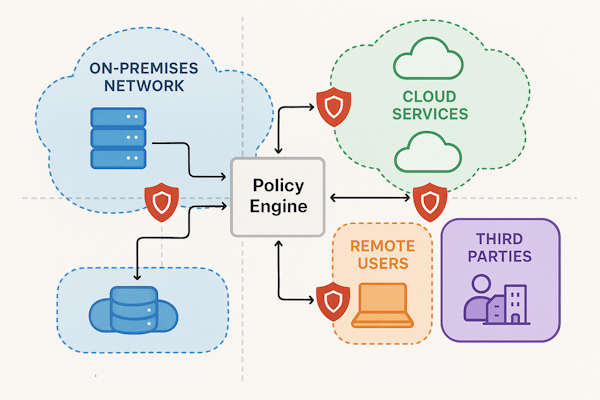
In today's complex digital landscape, organizations face unprecedented cybersecurity challenges. The traditional perimeter-based security model—often described as a "castle and moat" approach—has proven inadequate against sophisticated threat actors who can breach network boundaries and move laterally once inside. This reality, coupled with the rapid adoption of cloud services, remote work, and IoT devices, has accelerated the need for a more robust security framework: Zero Trust Architecture (ZTA).
Zero Trust is not a single product or technology but a strategic approach to cybersecurity that eliminates implicit trust and continuously validates every stage of digital interactions. This article explores how organizations can implement Zero Trust reference models in hybrid environments that span on-premises infrastructure, cloud resources, and remote access scenarios.
Understanding Zero Trust Architecture Fundamentals
Before diving into reference models for hybrid environments, it's essential to understand the core principles that underpin Zero Trust Architecture.
Core Tenets of Zero Trust
The National Institute of Standards and Technology (NIST) Special Publication 800-207 defines Zero Trust as "an evolving set of cybersecurity paradigms that move defenses from static, network-based perimeters to focus on users, assets, and resources." The Department of Defense (DoD) Zero Trust Reference Architecture identifies five fundamental tenets:
- Assume a Hostile Environment: Treat all users, devices, applications, and environments as potentially compromised, regardless of location or ownership.
- Presume Breach: Operate and defend resources with the assumption that an adversary already has presence within your environment.
- Never Trust, Always Verify: Deny access by default and require explicit verification for every access request using multiple attributes.
- Scrutinize Explicitly: Access all resources securely using multiple attributes to derive confidence levels for contextual access decisions.
- Apply Unified Analytics: Monitor and log each transaction, applying analytics across data, applications, assets, and services.
These tenets form the foundation for implementing Zero Trust across any environment, but they become particularly critical in hybrid scenarios where resources span multiple domains and security boundaries.
The Seven Pillars of Zero Trust Architecture
To operationalize Zero Trust principles in hybrid environments, organizations should focus on seven key pillars that provide a comprehensive framework for implementation:
- User: Securing and enforcing person and non-person entity access through continuous authentication and authorization.
- Device: Ensuring all endpoints are continuously authenticated, inspected, and assessed before granting access to resources.
- Network/Environment: Segmenting and isolating networks with granular access controls to prevent lateral movement.
- Applications and Workloads: Securing the complete application stack from application layer to hypervisor, regardless of hosting location.
- Data: Categorizing, encrypting, and protecting data based on sensitivity and criticality.
- Visibility and Analytics: Monitoring all activity to detect anomalous behavior and enable dynamic security policy adjustments.
- Automation and Orchestration: Implementing policy-based actions across the enterprise to respond to security events at scale.
These pillars are not isolated components but interconnected elements that work together to create a comprehensive security posture. In hybrid environments, each pillar must extend across on-premises infrastructure, cloud services, and remote access scenarios.
Reference Models for Hybrid Zero Trust Implementation
Implementing Zero Trust in hybrid environments requires a structured approach based on proven reference models. The following models provide frameworks that organizations can adapt to their specific needs.
NIST Zero Trust Reference Architecture
The NIST SP 800-207 defines a logical architecture for Zero Trust that consists of three primary components:
- Policy Engine (PE): Makes access decisions based on enterprise policy and external inputs.
- Policy Administrator (PA): Establishes and manages communication between subjects and resources.
- Policy Enforcement Point (PEP): Enables, monitors, and terminates connections between subjects and enterprise resources.
In hybrid environments, these components must operate consistently across on-premises and cloud resources. The NIST model also incorporates supporting components that provide data for policy decisions, including:
- Identity management systems
- Endpoint security solutions
- Security analytics platforms
- Data security controls
- Threat intelligence feeds
The NIST model emphasizes that Zero Trust is not a single architecture but a set of guiding principles that can be implemented in various ways depending on an organization's specific requirements and existing technologies.
DoD Zero Trust Reference Architecture
The Department of Defense has developed a comprehensive Zero Trust Reference Architecture that provides valuable insights for organizations implementing Zero Trust in hybrid environments. The DoD model emphasizes a data-centric approach with the following key components:
- Control Plane: Consisting of ZT policy controllers, automation, and orchestration capabilities.
- Policy Enforcement Points: Distributed throughout the architecture to enforce access decisions.
- Authentication and Authorization: Integrating with enterprise identity services and device management.
- Micro-segmentation: Implemented at the network level to control east-west traffic.
- Data Protection: Using DLP and DRM to control data access and prevent exfiltration.
- Analytics: Providing continuous monitoring and confidence scoring for access decisions.
The DoD architecture also defines several implementation patterns that are particularly relevant for hybrid environments:
- Domain Policy Enforcement for Resource Access: Using parallel domain orchestration to enforce policies across different security domains.
- Software Defined Perimeter: Creating secure access pathways that are invisible to unauthorized users.
- Zero Trust Broker Integration: Using intermediary services to facilitate secure connections between users and resources.
- Micro-segmentation: Breaking down networks into smaller components with enhanced control of traffic.
- Macro-segmentation: Implementing broader segmentation across hybrid environments.
Enhanced Identity Governance (EIG) Model
For organizations beginning their Zero Trust journey, the Enhanced Identity Governance (EIG) model provides a practical starting point. This model focuses on identity as the foundation of Zero Trust and includes:
- Continuous Authentication: Verifying user and device identity throughout sessions.
- Conditional Authorization: Making access decisions based on multiple factors including identity, device health, and behavior.
- Device Compliance: Ensuring endpoints meet security requirements before granting access.
- Policy-Based Access Control: Implementing fine-grained policies based on least privilege principles.
The EIG model can be implemented in phases, starting with on-premises resources (crawl phase) and extending to cloud environments (run phase). This phased approach allows organizations to build Zero Trust capabilities incrementally while maintaining operational continuity.
Implementation Patterns for Hybrid Environments
Implementing Zero Trust in hybrid environments requires specific architectural patterns that address the unique challenges of securing resources across different domains. The following patterns provide proven approaches for Zero Trust implementation.
Software-Defined Perimeter (SDP)
The Software-Defined Perimeter pattern creates a dynamic, identity-centric security perimeter around applications and services, regardless of their location. Key components include:
- SDP Controller: Authenticates users and devices and determines access rights.
- SDP Gateway: Provides secure access to protected resources.
- SDP Client: Installed on user devices to establish secure connections.
In hybrid environments, SDP offers several advantages:
- Resources are invisible to unauthorized users, reducing the attack surface.
- Access is based on identity and device posture, not network location.
- Connections can be established directly to cloud resources without "hairpinning" through corporate networks.
- Traffic can be inspected for malicious content before reaching protected resources.
SDP is particularly effective for providing secure remote access to applications hosted in both on-premises data centers and cloud environments.
Micro-segmentation
Micro-segmentation divides networks into small, isolated segments with granular security controls. In hybrid environments, micro-segmentation can be implemented at different levels:
- Network-level Micro-segmentation: Using next-generation firewalls (NGFWs) to control traffic between segments.
- Hypervisor-level Micro-segmentation: Implementing controls at the virtualization layer.
- Host-based Micro-segmentation: Using agents on endpoints to control traffic at the process level.
- Application-level Micro-segmentation: Controlling API calls and process-to-process communication.
Micro-segmentation helps prevent lateral movement by ensuring that even if attackers breach one segment, they cannot easily access other parts of the network. This is particularly important in hybrid environments where traditional network boundaries are blurred.
Secure Access Service Edge (SASE)
SASE combines network security functions with WAN capabilities to support the dynamic, secure access needs of hybrid environments. Key components include:
- Cloud Access Security Broker (CASB): Provides visibility and control over cloud applications.
- Secure Web Gateway (SWG): Protects users from web-based threats.
- Zero Trust Network Access (ZTNA): Provides secure, identity-based access to applications.
- Software-Defined WAN (SD-WAN): Optimizes network connectivity across hybrid environments.
SASE is particularly well-suited for hybrid environments because it:
- Provides consistent security policies regardless of user location.
- Reduces latency by bringing security services closer to users.
- Simplifies management by consolidating multiple security functions.
- Scales easily to accommodate changing business needs.
Organizations can implement SASE incrementally, starting with specific use cases and expanding coverage over time.
Technical Components for Zero Trust in Hybrid Environments
Implementing Zero Trust in hybrid environments requires a combination of technical components that work together to enforce security policies consistently across different domains.
Identity and Access Management
Identity is the foundation of Zero Trust, particularly in hybrid environments where traditional network boundaries are ineffective. Key components include:
- Enterprise Identity Provider: Centralizes identity management across on-premises and cloud resources.
- Multi-factor Authentication (MFA): Requires multiple forms of verification before granting access.
- Privileged Access Management (PAM): Controls and monitors access to privileged accounts.
- Just-in-Time Access: Provides temporary access rights when needed and revokes them when no longer required.
- Continuous Authentication: Verifies user identity throughout sessions, not just at login.
In hybrid environments, identity services must extend across all resources and integrate with both on-premises and cloud-based applications.
Device Security and Compliance
Zero Trust requires continuous verification of device health and compliance before granting access to resources. Key components include:
- Endpoint Detection and Response (EDR): Monitors endpoints for suspicious activity.
- Mobile Device Management (MDM): Enforces security policies on mobile devices.
- Unified Endpoint Management (UEM): Provides comprehensive management of all endpoints.
- Comply-to-Connect: Ensures devices meet security requirements before connecting to networks.
- Device Health Attestation: Verifies the integrity of device hardware and software.
In hybrid environments, device security solutions must work consistently across different networks and provide real-time information to policy decision points.
Network Security
While Zero Trust focuses on protecting resources rather than networks, network security remains an important component, particularly in hybrid environments. Key technologies include:
- Next-Generation Firewalls (NGFWs): Provide advanced traffic filtering and inspection.
- Software-Defined Networking (SDN): Enables programmatic control of network resources.
- Network Segmentation: Divides networks into isolated zones with controlled access between them.
- Encrypted Traffic Inspection: Examines encrypted communications for threats without compromising privacy.
- Network Traffic Analysis: Identifies suspicious patterns in network traffic.
In hybrid environments, network security must extend across on-premises infrastructure, cloud networks, and remote access scenarios.
Data Security
Protecting data is the ultimate goal of Zero Trust, particularly in hybrid environments where data moves between different domains. Key components include:
- Data Loss Prevention (DLP): Prevents unauthorized data exfiltration.
- Data Rights Management (DRM): Controls how data can be used after access is granted.
- Encryption: Protects data both at rest and in transit.
- Data Classification and Tagging: Identifies sensitive data and applies appropriate controls.
- Dynamic Data Masking: Hides sensitive data from unauthorized users.
In hybrid environments, data security must be consistent regardless of where data is stored or processed, requiring integration between on-premises and cloud-based security controls.
Analytics and Orchestration
Zero Trust requires continuous monitoring and automated response to security events, particularly in complex hybrid environments. Key components include:
- Security Information and Event Management (SIEM): Collects and analyzes security data from multiple sources.
- User and Entity Behavior Analytics (UEBA): Identifies anomalous behavior that may indicate threats.
- Security Orchestration, Automation, and Response (SOAR): Automates security workflows and incident response.
- Artificial Intelligence and Machine Learning: Enhances threat detection and response capabilities.
- Policy Engines: Makes access decisions based on multiple factors and enterprise policies.
In hybrid environments, analytics and orchestration systems must have visibility across all domains and the ability to enforce policies consistently.
Implementation Challenges in Hybrid Environments
Implementing Zero Trust in hybrid environments presents several challenges that organizations must address:
Integration Complexity
Hybrid environments typically include a mix of legacy systems, on-premises infrastructure, and cloud services from multiple providers. Integrating these diverse components into a cohesive Zero Trust architecture requires careful planning and may involve:
- Developing APIs and connectors to enable communication between systems
- Implementing identity federation across different domains
- Establishing consistent policy enforcement mechanisms
- Creating unified monitoring and analytics capabilities
Organizations should prioritize solutions that offer out-of-the-box integrations with existing systems and follow standards-based approaches to reduce complexity.
Policy Management
In hybrid environments, security policies must be consistent across different domains while accounting for the unique requirements of each environment. Challenges include:
- Maintaining consistent access controls across on-premises and cloud resources
- Adapting policies to different technical implementations
- Ensuring policies are updated consistently across all systems
- Balancing security requirements with operational needs
Centralized policy management with distributed enforcement is essential for addressing these challenges. Policy orchestration tools can help translate high-level security requirements into specific configurations for different systems.
Visibility and Monitoring
Zero Trust requires comprehensive visibility across all resources, which can be difficult to achieve in hybrid environments. Challenges include:
- Collecting and correlating data from diverse sources
- Maintaining visibility as resources move between environments
- Detecting anomalies across different systems
- Creating a unified view of security posture
Organizations should implement monitoring solutions that can collect data from all environments and provide normalized, actionable information to security teams.
Performance and User Experience
Zero Trust controls can impact performance and user experience if not implemented carefully. Challenges include:
- Minimizing latency introduced by security checks
- Balancing security with usability
- Managing authentication and authorization processes efficiently
- Ensuring consistent performance across different environments
Organizations should implement Zero Trust controls incrementally, starting with critical resources and expanding coverage as they optimize performance and user experience.
Zero Trust Maturity Model for Hybrid Environments
Implementing Zero Trust in hybrid environments is a journey that requires a phased approach. The following maturity model provides a framework for organizations to assess their current state and plan their Zero Trust implementation:
Phase 1: Prepare for Zero Trust
In this initial phase, organizations lay the groundwork for Zero Trust implementation by:
- Identifying critical data, applications, assets, and services
- Mapping transaction flows and access patterns
- Assessing current security capabilities and gaps
- Developing a Zero Trust strategy and roadmap
- Establishing governance structures and policies
This phase is crucial for understanding the environment and setting clear objectives for Zero Trust implementation.
Phase 2: Implement Core Zero Trust Capabilities
In this phase, organizations implement the foundational components of Zero Trust:
- Enhancing identity and access management
- Implementing device health verification
- Establishing basic network segmentation
- Deploying initial monitoring and analytics capabilities
- Implementing data protection controls
These capabilities provide the essential building blocks for Zero Trust and can be implemented incrementally, starting with critical resources.
Phase 3: Extend Zero Trust Across Hybrid Environments
In this phase, organizations extend Zero Trust controls to all resources across hybrid environments:
- Implementing micro-segmentation
- Deploying software-defined perimeter
- Enhancing data security with DLP and DRM
- Implementing advanced analytics and automation
- Integrating cloud security controls
This phase focuses on creating a consistent security posture across all environments and resources.
Phase 4: Optimize and Mature Zero Trust
In the final phase, organizations optimize their Zero Trust implementation and address advanced use cases:
- Implementing dynamic policy enforcement
- Enhancing threat detection and response
- Optimizing performance and user experience
- Implementing advanced analytics with AI/ML
- Continuously improving security posture
This phase represents a mature Zero Trust implementation that provides comprehensive protection across hybrid environments.
Best Practices for Zero Trust Implementation in Hybrid Environments
Based on the experiences of organizations that have successfully implemented Zero Trust in hybrid environments, the following best practices can guide your implementation:
Start with a Clear Strategy
Develop a comprehensive Zero Trust strategy that aligns with your organization's business objectives and risk tolerance. The strategy should:
- Define clear goals and success criteria
- Identify priority use cases and resources
- Establish a phased implementation approach
- Align with regulatory requirements and industry standards
- Gain executive sponsorship and stakeholder buy-in
A well-defined strategy provides direction and ensures that Zero Trust implementation supports business needs.
Focus on Identity First
Identity is the foundation of Zero Trust, particularly in hybrid environments. Prioritize:
- Implementing strong authentication mechanisms
- Establishing a unified identity service across all environments
- Implementing least privilege access controls
- Developing attribute-based access policies
- Implementing continuous authentication and authorization
A robust identity foundation enables more effective implementation of other Zero Trust controls.
Implement Incremental Changes
Zero Trust is a journey, not a destination. Implement changes incrementally to minimize disruption and allow for adjustment based on feedback:
- Start with specific use cases or resources
- Implement controls in monitoring mode before enforcement
- Gradually expand coverage to additional resources
- Continuously evaluate and refine policies
- Balance security improvements with operational impact
An incremental approach allows organizations to learn and adapt as they implement Zero Trust.
Leverage Existing Investments
Most organizations already have security technologies that can support Zero Trust. Identify and leverage these existing investments:
- Assess current capabilities against Zero Trust requirements
- Identify gaps and prioritize new investments
- Integrate existing technologies into the Zero Trust architecture
- Optimize configurations to support Zero Trust principles
- Plan for technology evolution and replacement
Leveraging existing investments reduces costs and accelerates implementation.
Automate and Orchestrate
Zero Trust requires continuous monitoring and enforcement, which is only practical with automation and orchestration:
- Implement automated policy enforcement
- Develop orchestration workflows for security operations
- Automate threat detection and response
- Implement continuous compliance monitoring
- Use analytics to drive policy refinement
Automation and orchestration enable Zero Trust at scale and ensure consistent enforcement across hybrid environments.
Monitor, Measure, and Improve
Zero Trust implementation should be continuously evaluated and improved:
- Define metrics to measure effectiveness
- Continuously monitor security posture
- Conduct regular assessments and testing
- Gather feedback from users and stakeholders
- Refine policies and controls based on results
Continuous improvement ensures that Zero Trust controls remain effective as threats and business requirements evolve.
Case Study: Implementing Zero Trust in a Hybrid Financial Services Environment
A global financial services organization with 50,000 employees and operations in 30 countries implemented Zero Trust across its hybrid environment. The organization had a mix of legacy on-premises systems, private cloud infrastructure, and public cloud services from multiple providers.
Challenges
The organization faced several challenges:
- Protecting sensitive financial and customer data across diverse environments
- Supporting a remote workforce with secure access to critical applications
- Meeting regulatory requirements in multiple jurisdictions
- Integrating security controls across legacy and modern systems
- Maintaining performance and user experience while enhancing security
Approach
The organization adopted a phased approach to Zero Trust implementation:
- Phase 1: Foundation
- Implemented a unified identity service with MFA across all environments
- Deployed endpoint security with health attestation
- Established initial network segmentation
- Implemented basic monitoring and analytics
- Phase 2: Enhanced Protection
- Implemented software-defined perimeter for remote access
- Deployed micro-segmentation in data centers
- Enhanced data protection with DLP and encryption
- Implemented CASB for cloud application security
- Phase 3: Advanced Capabilities
- Implemented SASE for branch offices and remote workers
- Deployed advanced analytics with UEBA
- Implemented automated policy enforcement
- Enhanced threat detection and response capabilities
Results
The Zero Trust implementation delivered significant benefits:
- 80% reduction in successful phishing attacks
- 65% reduction in time to detect and respond to security incidents
- 90% improvement in visibility across hybrid environments
- Simplified compliance with regulatory requirements
- Enhanced ability to support remote work securely
- Improved user experience through consistent security controls
The organization continues to refine its Zero Trust implementation, focusing on advanced analytics and automation to further enhance security posture.
Implementing Zero Trust in hybrid environments is a complex but essential undertaking for organizations facing today's cybersecurity challenges. By adopting proven reference models and implementation patterns, organizations can create a comprehensive security architecture that protects resources regardless of their location.
The journey to Zero Trust requires a strategic approach that balances security improvements with operational needs. By starting with a clear strategy, focusing on identity, implementing changes incrementally, leveraging existing investments, automating and orchestrating security controls, and continuously monitoring and improving, organizations can successfully implement Zero Trust across hybrid environments.
As threats continue to evolve and environments become more complex, Zero Trust provides a flexible, adaptable framework for security that can grow and change with the organization. By embracing Zero Trust principles and implementing them consistently across all environments, organizations can significantly enhance their security posture and better protect their critical assets in today's dynamic threat landscape.
Remember that Zero Trust is not a destination but a journey of continuous improvement. Each step toward Zero Trust enhances security and builds the foundation for further advancements. By starting today and proceeding methodically, organizations can achieve meaningful security improvements while supporting their business objectives in an increasingly complex digital world.
