Identity Federation: Architecting Secure Cross-Domain Authentication for Modern Enterprises

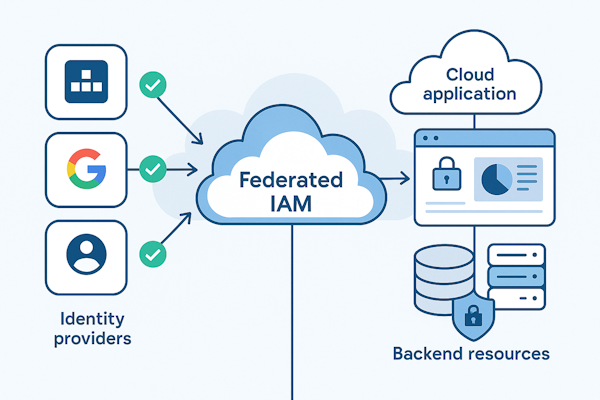
In today's interconnected digital landscape, organizations face increasing challenges managing user identities across multiple applications, platforms, and domains. The proliferation of cloud services, remote work environments, and third-party integrations has created complex identity ecosystems that traditional authentication methods struggle to address effectively. Identity federation has emerged as a critical architectural pattern that enables secure, streamlined authentication across organizational boundaries while maintaining robust security controls. This article explores the technical foundations, implementation considerations, and strategic benefits of identity federation for enterprise environments.
Understanding Identity Federation: Core Concepts
Identity federation represents an architectural approach to authentication and authorization that allows users to access resources across multiple domains using a single set of credentials. Unlike traditional siloed identity systems, federation establishes trust relationships between identity providers (IdPs) and service providers (SPs), enabling seamless authentication experiences while maintaining security boundaries.
At its core, federation separates the authentication process (verifying who a user is) from the authorization process (determining what they can access). This separation creates a more flexible, scalable identity architecture that can adapt to complex organizational requirements while reducing administrative overhead and enhancing security posture.
Key Components of Identity Federation
A federated identity architecture consists of several critical components working in concert:
- Identity Provider (IdP): The authoritative source for user authentication that verifies user credentials and issues security tokens or assertions.
- Service Provider (SP): The application or service that relies on the IdP to authenticate users before granting access to protected resources.
- Trust Relationship: The configured connection between IdP and SP that defines how authentication assertions are exchanged and validated.
- Federation Protocols: Standardized methods for exchanging authentication and authorization data (e.g., SAML, OAuth, OIDC).
- Claims/Assertions: Statements about the user (attributes, group memberships, etc.) that are passed from the IdP to the SP.
Federation Protocols: Technical Implementation Approaches
The implementation of identity federation relies on established protocols that facilitate secure communication between identity providers and service providers. Each protocol offers distinct capabilities and is suited to different use cases.
SAML 2.0 (Security Assertion Markup Language)
SAML 2.0 remains one of the most widely deployed federation protocols, particularly in enterprise environments. It uses XML-based assertions to communicate authentication and authorization data between parties.
A typical SAML authentication flow involves:
- User attempts to access a protected resource at the service provider
- SP generates a SAML authentication request and redirects the user to the IdP
- User authenticates at the IdP
- IdP generates a signed SAML assertion containing user identity information
- User is redirected back to the SP with the SAML assertion
- SP validates the assertion and grants access to the protected resource
SAML excels in enterprise scenarios requiring strong security guarantees and is commonly used for web-based single sign-on implementations. Its XML structure provides extensive flexibility for conveying complex identity attributes but can be more resource-intensive than newer protocols.
OAuth 2.0
While not strictly an authentication protocol, OAuth 2.0 provides a framework for authorization that has become a foundation for modern identity federation. OAuth 2.0 focuses on delegated authorization, allowing a third-party application to access resources on behalf of a user without exposing credentials.
OAuth 2.0 defines several grant types to accommodate different scenarios:
- Authorization Code Grant: Optimized for server-side applications
- Implicit Grant: Designed for browser-based applications (though now deprecated in favor of PKCE-enhanced flows)
- Client Credentials Grant: Used for service-to-service authentication
- Resource Owner Password Credentials Grant: Allows direct exchange of credentials for tokens (used sparingly due to security considerations)
OAuth 2.0 is particularly well-suited for API access management and mobile application scenarios where lightweight token exchange is preferable to verbose XML assertions.
OpenID Connect (OIDC)
OpenID Connect extends OAuth 2.0 to provide a standardized authentication layer. OIDC has gained significant traction as a modern federation protocol that combines the authorization capabilities of OAuth 2.0 with identity verification.
OIDC introduces several key components:
- ID Token: A JWT (JSON Web Token) containing authenticated user identity information
- UserInfo Endpoint: An API that provides additional user attributes
- Discovery: A mechanism for clients to dynamically discover OIDC provider capabilities
The lightweight nature of OIDC, combined with its comprehensive feature set, has made it increasingly popular for modern applications, particularly in cloud-native and microservices architectures.
Common IAM Federation Implementation Patterns
Organizations implement identity federation in various patterns depending on their specific requirements, existing infrastructure, and security posture. Several common implementation models have emerged:
Enterprise-to-Cloud Federation
This pattern enables employees to access cloud services using their existing corporate credentials. The enterprise IdP (typically Active Directory or another corporate directory) serves as the authoritative identity source, while cloud services act as service providers.
Example: A multinational corporation using Microsoft Entra ID (formerly Azure AD) to federate access to AWS, Google Cloud, and various SaaS applications. Users authenticate once against their corporate directory and gain seamless access to all federated cloud resources without additional login prompts.
Multi-Cloud Federation
As organizations adopt multi-cloud strategies, federation between cloud providers becomes essential. This pattern establishes trust relationships between different cloud environments, allowing consistent identity management across heterogeneous infrastructure.
Example: An organization using AWS IAM Identity Center as a central identity hub that federates authentication to resources across AWS, Azure, and GCP. This approach enables unified access control and audit capabilities spanning multiple cloud providers.
B2B Federation
Business-to-business federation enables partner organizations to access shared resources without creating and managing separate accounts for external users. Each organization maintains control over their user identities while establishing trust relationships with partners.
Example: A manufacturing company establishing federation with suppliers and distributors, allowing partner employees to access shared supply chain applications using their existing corporate credentials. This eliminates the need to provision and manage separate accounts for hundreds or thousands of partner users.
Consumer Identity Federation
This pattern allows users to authenticate to services using existing social or consumer identities (e.g., Google, Facebook, Apple). It's commonly used in B2C scenarios to reduce friction in the user registration and authentication process.
Example: An e-commerce platform allowing customers to sign in using their Google, Facebook, or Apple accounts rather than creating yet another username and password. The platform federates with these consumer IdPs while maintaining its own authorization logic.
Technical Benefits of Identity Federation
Identity federation delivers numerous technical advantages that address common challenges in enterprise identity management:
Enhanced Security Posture
Federation significantly improves security by:
- Reducing credential proliferation: With fewer sets of credentials to manage, the attack surface associated with password reuse and weak authentication is diminished.
- Centralizing authentication controls: Security policies, including MFA requirements, password complexity, and account lockout, can be enforced at the IdP level and automatically applied across all federated services.
- Enabling rapid response to security incidents: When a user's access needs to be revoked, a single change at the IdP immediately propagates across all federated services.
- Supporting strong authentication methods: Modern federation protocols can convey rich authentication context, enabling risk-based authentication decisions across organizational boundaries.
Operational Efficiency
Federation streamlines identity operations through:
- Centralized user lifecycle management: User provisioning, deprovisioning, and attribute updates can be managed at a single point rather than across multiple systems.
- Reduced administrative overhead: IT teams no longer need to manage separate identity stores for each application or service.
- Automated provisioning workflows: When combined with SCIM (System for Cross-domain Identity Management), federation enables automated user provisioning and deprovisioning across federated services.
- Simplified compliance reporting: Centralized authentication provides a single source of truth for access audit trails and compliance reporting.
Enhanced User Experience
Users benefit from federation through:
- Single sign-on capabilities: Once authenticated to the IdP, users can access multiple applications without re-entering credentials.
- Consistent authentication experience: Users encounter familiar login interfaces regardless of which application they're accessing.
- Reduced password fatigue: With fewer credentials to remember, users are less likely to resort to insecure practices like password reuse or writing down credentials.
- Seamless access across organizational boundaries: B2B federation enables collaboration without requiring users to maintain separate identities for partner systems.
Technical Challenges and Considerations
While identity federation offers substantial benefits, implementing it effectively requires addressing several technical challenges:
Protocol Selection and Interoperability
Organizations must carefully select federation protocols based on their specific requirements and the capabilities of their target systems. Many environments require supporting multiple protocols simultaneously:
- SAML 2.0 for traditional enterprise applications
- OAuth 2.0/OIDC for modern APIs and mobile applications
- WS-Federation for legacy Microsoft environments
Ensuring interoperability between these protocols often requires additional middleware or identity proxying capabilities to translate between different authentication mechanisms.
Certificate Management
Federation security relies heavily on cryptographic trust anchors, typically X.509 certificates. Organizations must implement robust certificate lifecycle management processes to:
- Rotate certificates before expiration to prevent authentication outages
- Securely distribute and update certificates across federation partners
- Maintain appropriate key lengths and algorithms as cryptographic standards evolve
- Protect private keys from unauthorized access
Attribute Mapping and Transformation
Different systems often have divergent expectations regarding user attributes and their formats. Federation implementations must address:
- Mapping between different attribute schemas and naming conventions
- Transforming attribute values to meet target system requirements
- Filtering sensitive attributes that shouldn't be shared with certain service providers
- Enriching identity assertions with additional attributes from authoritative sources
Session Management Complexity
Federated authentication introduces complex session management considerations:
- Coordinating session lifetimes between IdPs and multiple SPs
- Implementing secure single logout across federated services
- Balancing security (shorter sessions) with user experience (fewer authentication prompts)
- Managing session revocation when access needs to be terminated immediately
Identity Provider Availability
In federated architectures, the IdP becomes a critical authentication dependency. Organizations must consider:
- Implementing high-availability IdP infrastructure to prevent authentication outages
- Developing contingency authentication mechanisms for critical systems
- Monitoring IdP performance and availability as part of overall security operations
- Establishing appropriate SLAs for authentication services
Implementation Best Practices
Successful identity federation implementations incorporate several key best practices:
Security-First Design
- Implement defense-in-depth: Don't rely solely on federation for security; maintain additional authorization controls at each service provider.
- Enforce strong authentication: Require multi-factor authentication for sensitive applications and high-risk scenarios.
- Secure token exchange: Use TLS for all federation traffic and validate digital signatures on all assertions and tokens.
- Implement proper token validation: Service providers should thoroughly validate all aspects of security tokens, including signatures, audience restrictions, and expiration times.
- Apply least privilege: Federation assertions should convey only the minimum attributes necessary for the target application to function.
Scalable Architecture
- Design for growth: Implement federation infrastructure that can scale to accommodate increasing numbers of users, applications, and federation partners.
- Automate federation establishment: Develop standardized processes and templates for onboarding new federation partners.
- Implement metadata management: Establish automated processes for exchanging and updating federation metadata to maintain trust relationships.
- Consider federation proxies: For complex environments, identity proxying can simplify management by centralizing protocol translation and attribute mapping.
Operational Readiness
- Implement comprehensive monitoring: Monitor federation components for availability, performance, and security anomalies.
- Develop incident response procedures: Establish clear processes for responding to federation-related security incidents.
- Create federation-aware support processes: Train support staff to troubleshoot federation issues and understand the interdependencies between systems.
- Document trust relationships: Maintain clear documentation of all federation partners, including technical contacts, certificate information, and attribute mappings.
Governance and Compliance
- Establish federation policies: Define clear policies governing which external identity providers are trusted and under what circumstances.
- Implement regular reviews: Periodically review federation relationships to ensure they remain necessary and properly configured.
- Maintain audit trails: Capture comprehensive logs of federation activities for security analysis and compliance reporting.
- Consider regulatory requirements: Ensure federation implementations comply with relevant regulations regarding data protection and privacy.
Real-World Federation Scenarios
To illustrate practical applications of identity federation, consider these common implementation scenarios:
AWS Multi-Account Federation
Large enterprises typically manage multiple AWS accounts for different departments, environments, or workloads. Rather than creating and managing IAM users in each account, organizations implement federation from their corporate identity provider to AWS.
In this scenario:
- The corporate IdP (e.g., Microsoft Entra ID) serves as the authentication authority
- AWS IAM Identity Center acts as a federation hub, establishing trust with the corporate IdP
- IAM roles in each AWS account define permissions for federated users
- Users authenticate to their corporate IdP and receive SAML assertions
- These assertions are exchanged for temporary AWS security credentials
- Users access AWS resources based on the permissions defined in IAM roles
This approach provides centralized authentication while maintaining distributed authorization through IAM roles, enabling fine-grained access control across the AWS organization.
Healthcare Provider Federation
Healthcare environments often involve complex collaboration between multiple organizations. A regional healthcare network might implement federation to enable secure information sharing while maintaining organizational boundaries.
In this scenario:
- Each healthcare provider maintains its own identity provider for staff authentication
- A federation hub establishes trust relationships between participating organizations
- Shared clinical applications accept federated authentication from any trusted provider
- Attribute-based access control (ABAC) determines what information each user can access based on their role, organization, and patient relationships
- Federation assertions include privacy and consent attributes that influence authorization decisions
This federation model enables critical information sharing while maintaining appropriate security boundaries and regulatory compliance.
SaaS Application Integration
Modern enterprises typically use dozens or hundreds of SaaS applications. Rather than managing separate user accounts for each service, organizations implement federation from their corporate directory.
In this scenario:
- The corporate IdP establishes federation relationships with each SaaS provider
- User provisioning may be automated through SCIM or similar protocols
- Users access a corporate application portal that provides single sign-on to all federated applications
- Authentication events and access logs are centralized for security monitoring
- When employees leave the organization, disabling their corporate account automatically revokes access to all federated services
This approach significantly reduces administrative overhead while improving security through centralized access control and monitoring.
Future Trends in Identity Federation
As digital ecosystems continue to evolve, several emerging trends are shaping the future of identity federation:
Decentralized Identity
Blockchain-based decentralized identity systems are introducing new federation models that reduce reliance on centralized identity providers. These systems enable users to control their own identity information and selectively share verified attributes with service providers, potentially transforming traditional federation architectures.
Zero Trust Integration
Federation is increasingly being integrated with zero trust security frameworks, where authentication alone is insufficient for access. Modern federation implementations are incorporating continuous authentication, device posture assessment, and behavioral analytics to make more nuanced access decisions.
Passwordless Federation
The industry is moving toward passwordless authentication methods, including biometrics, security keys, and mobile authenticators. Federation protocols are evolving to support these methods, enabling passwordless experiences across organizational boundaries.
API-Driven Federation
As applications become more API-centric, federation is shifting from traditional web-based flows to API-oriented patterns. OAuth 2.0 and OIDC are becoming dominant in these scenarios, with extensions for machine-to-machine authentication and fine-grained API access control.
Identity federation represents a fundamental architectural pattern for modern enterprise security, enabling secure authentication across organizational boundaries while reducing administrative overhead and improving user experience. By separating authentication from authorization and establishing standardized trust relationships between identity providers and service providers, federation addresses many of the challenges associated with traditional identity management approaches.
Successful implementation requires careful consideration of protocol selection, security controls, operational processes, and governance frameworks. Organizations must balance security requirements with usability considerations while designing federation architectures that can scale to accommodate growing digital ecosystems.
As technology continues to evolve, identity federation will remain a critical component of enterprise security architecture, adapting to support new authentication methods, integration patterns, and trust models. Organizations that implement federation effectively will be well-positioned to manage complex identity relationships while maintaining robust security controls in an increasingly interconnected digital landscape.
