The Evolving Threat Landscape of Software-Defined Networks: Attack Vectors, Exploitation Methods, and Impact Scenarios 
The Double-Edged Sword of SDN Architecture
Software-Defined Networking (SDN) has revolutionized network infrastructure management by decoupling the control plane from the data plane, enabling centralized management, programmability, and unprecedented flexibility. As organizations increasingly adopt SDN to enhance operational efficiency and reduce costs, this architectural paradigm shift introduces novel security challenges that traditional network security approaches fail to address adequately. The programmable nature of SDN, while offering tremendous benefits, simultaneously expands the attack surface and creates new vectors for exploitation that cybersecurity professionals must understand and mitigate.
The centralization of network intelligence within the SDN controller creates a single point of failure that, if compromised, could lead to catastrophic network-wide impacts. This architectural vulnerability, combined with the complex interaction between the control plane, data plane, and application layer, presents sophisticated adversaries with multiple entry points for attacks. Understanding these attack vectors, exploitation methods, and potential impact scenarios is crucial for organizations implementing SDN technologies, particularly in critical infrastructure environments where network disruptions can have severe consequences.
SDN Architecture: Understanding the Attack Surface
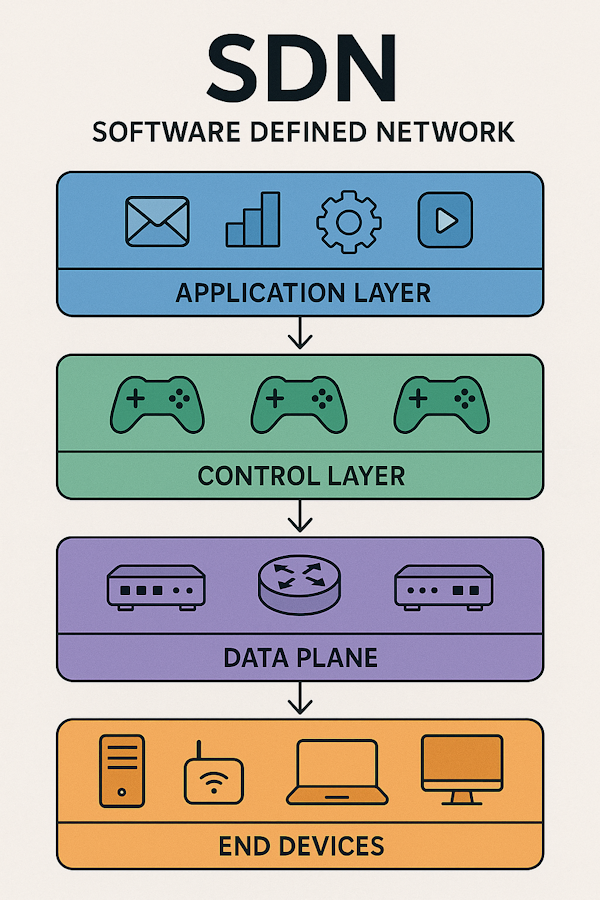
Before delving into specific attack vectors, it's essential to understand the fundamental SDN architecture that creates these security challenges. SDN consists of three primary layers, each presenting unique security concerns:
The data plane comprises network devices such as switches and routers that forward traffic based on flow rules received from the controller. These devices, while simplified in functionality compared to traditional networking equipment, remain vulnerable to various attacks targeting their resources and communication channels.
The control plane, centered around the SDN controller, serves as the network's "brain," making decisions about traffic routing and policy enforcement. As the central point of network intelligence, the controller represents a high-value target for attackers seeking to gain control over the entire network infrastructure.
The application plane hosts network applications that interact with the controller through northbound APIs to implement specific network functions and services. These applications, if compromised or maliciously designed, can manipulate network behavior through their privileged access to the controller.
The communication interfaces between these layers—southbound APIs connecting the controller to network devices and northbound APIs linking applications to the controller—create additional attack surfaces that adversaries can exploit. This layered architecture, while providing unprecedented flexibility and programmability, simultaneously introduces complexity that can be weaponized by sophisticated threat actors.
Critical Attack Vectors in SDN Environments
Controller-Focused Attacks: Targeting the Network Brain
The SDN controller represents the most critical component of the architecture and, consequently, the most attractive target for attackers. Several sophisticated attack vectors specifically target the controller:
Distributed Denial of Service (DDoS) attacks against the controller can overwhelm its processing capabilities by flooding it with a high volume of packet-in messages or connection requests. Research conducted in 2024 demonstrated that even moderately resourced attackers could generate sufficient traffic to render controllers non-responsive, effectively paralyzing the entire network. The impact of such attacks is magnified in SDN environments due to the centralized nature of control functions.
Authentication bypass exploits target vulnerabilities in the controller's authentication mechanisms. In 2023, security researchers identified critical vulnerabilities in popular SDN controllers that allowed attackers to bypass authentication controls and gain administrative access. These vulnerabilities often stem from implementation flaws in authentication protocols or insecure default configurations that remain unchanged in production environments.
Resource exhaustion attacks specifically target the controller's computational resources. By generating traffic patterns that force the controller to perform resource-intensive operations, attackers can degrade performance without generating the traffic volumes associated with traditional DDoS attacks. These low-and-slow attacks are particularly insidious as they may evade detection by conventional security monitoring systems while still achieving significant operational impact.
Data Plane Vulnerabilities: Compromising Network Forwarding
While the data plane in SDN architectures is simplified compared to traditional networks, it remains vulnerable to several attack vectors:
Flow table saturation attacks exploit the limited capacity of SDN switches to store flow rules. By generating traffic with characteristics that require the creation of numerous unique flow entries, attackers can exhaust the flow table capacity, causing legitimate traffic to be dropped or forcing constant communication with the controller, creating performance bottlenecks.
Topology poisoning occurs when attackers manipulate the network topology information collected by the controller. By injecting false topology data, adversaries can influence routing decisions, potentially creating traffic black holes or redirecting traffic through compromised paths for interception.
Side-channel attacks against SDN switches exploit timing differences in packet processing to infer information about flow rules or network configuration. Research published in 2025 demonstrated that these timing side-channels could be used to reconstruct portions of the flow table, potentially revealing sensitive information about network policies and traffic patterns.
Control-Data Plane Communication Attacks
The communication channel between the control plane and data plane represents a critical attack surface in SDN environments:
Man-in-the-Middle (MitM) attacks targeting the OpenFlow channel can intercept, modify, or inject messages between the controller and network devices. Without proper encryption and authentication, attackers positioned within the network path can manipulate flow rules, redirect traffic, or collect sensitive information about network operations.
Protocol fuzzing attacks exploit implementation vulnerabilities in the OpenFlow protocol or other southbound interfaces. By sending malformed or unexpected protocol messages, attackers can potentially crash network devices, trigger memory corruption vulnerabilities, or cause other unintended behaviors that compromise network integrity.
Session hijacking attacks target the communication sessions between controllers and network devices. By capturing authentication credentials or session tokens, attackers can impersonate legitimate devices or controllers, gaining unauthorized control over network operations.
Application Layer Exploits: Leveraging Privileged Access
The application layer in SDN architectures introduces additional security concerns:
Malicious applications with legitimate access to the controller can abuse their privileges to manipulate network behavior. These applications might be specifically designed for malicious purposes or could be legitimate applications compromised through supply chain attacks or vulnerability exploitation.
API abuse exploits insufficient access controls or validation in northbound APIs. Without proper authorization checks, applications might gain access to network functions beyond their intended scope, potentially allowing unauthorized modification of critical network configurations.
Cross-application attacks leverage the shared controller environment to enable privilege escalation or information leakage between applications. If proper isolation mechanisms are not implemented, vulnerabilities in one application could potentially be exploited to compromise others running on the same controller platform.
Sophisticated Exploitation Methods in SDN Environments
Advanced Persistent Threats: Long-term Compromise Strategies
Advanced Persistent Threats (APTs) targeting SDN environments employ sophisticated techniques to maintain long-term access and evade detection:
Controller backdoors implemented through compromised firmware updates or malicious patches provide persistent access to the SDN infrastructure. These backdoors may remain dormant until activated for specific operations, making detection particularly challenging.
Covert channels established within legitimate SDN traffic allow attackers to maintain command and control capabilities without generating suspicious network patterns. By embedding commands within normal OpenFlow messages or leveraging timing-based signaling, attackers can control compromised components while evading traditional detection mechanisms.
Living-off-the-land techniques leverage legitimate SDN functionality for malicious purposes, minimizing the need for custom malware that might trigger security alerts. For example, attackers might use legitimate network monitoring applications to collect sensitive information or leverage network virtualization features to create isolated environments for malicious activities.
Exploitation of SDN-Specific Vulnerabilities
Several exploitation methods specifically target unique aspects of SDN architecture:
Race condition exploitation takes advantage of timing vulnerabilities in the processing of control messages. By carefully timing message sequences, attackers can potentially create inconsistent states between the controller's view of the network and the actual network configuration, leading to security policy violations or service disruptions.
API parameter manipulation attacks exploit insufficient input validation in controller APIs. By providing unexpected parameter values or manipulating data formats, attackers can potentially trigger implementation flaws that lead to unauthorized access or control over network functions.
Configuration extraction through side-channel analysis allows attackers to infer sensitive information about network policies and configurations without direct access to configuration files. By analyzing traffic patterns, timing behaviors, or error responses, sophisticated adversaries can reconstruct portions of the network configuration, potentially identifying vulnerabilities or policy weaknesses.
Supply Chain Compromises
The complex software ecosystem supporting SDN creates opportunities for supply chain attacks:
Compromised SDN components introduced through the supply chain can contain pre-positioned backdoors or vulnerabilities. These compromised components might include controller software, network operating systems, or management tools that organizations deploy as part of their SDN infrastructure.
Malicious dependencies in SDN software libraries can introduce vulnerabilities that affect multiple products and vendors. As SDN implementations often rely on common open-source components, vulnerabilities in these shared dependencies can have widespread impact across the ecosystem.
Development environment compromises targeting SDN vendors can lead to the introduction of malicious code during the software development process. These sophisticated attacks target the development infrastructure rather than the end products directly, making detection particularly challenging.
High-Impact Scenarios: When SDN Security Fails
Critical Infrastructure Disruption
The adoption of SDN in critical infrastructure sectors creates significant concerns regarding potential impact scenarios:
Power grid disruptions resulting from compromised SDN infrastructure could lead to widespread power outages. As utilities increasingly adopt SDN to enhance grid management and integration of renewable energy sources, the security of these networks becomes crucial for maintaining reliable power delivery.
Industrial control system interference through compromised SDN networks could disrupt manufacturing processes, potentially causing physical damage to equipment or creating unsafe operating conditions. The convergence of operational technology (OT) and information technology (IT) networks through SDN increases the potential impact of network security breaches.
Transportation system manipulation enabled by compromised SDN controllers could affect traffic management systems, railway signaling, or air traffic control networks. As these systems increasingly rely on software-defined infrastructure for flexibility and efficiency, they also inherit the associated security challenges.
Financial Sector Impacts
The financial sector's adoption of SDN creates high-value targets for sophisticated threat actors:
Trading platform disruptions caused by SDN compromise could lead to significant financial losses and market instability. The high-frequency trading environment's dependence on ultra-low-latency networking makes it particularly vulnerable to even minor disruptions in network performance.
Payment processing system manipulation through compromised SDN infrastructure could enable financial fraud or service disruptions affecting millions of transactions. The centralized control provided by SDN creates opportunities for attackers to redirect or manipulate financial data flows if proper security controls are not implemented.
Banking network breaches facilitated by SDN vulnerabilities could expose sensitive customer information or enable unauthorized transactions. The complex interconnections between financial institutions, often managed through software-defined networks, create potential paths for attackers to move laterally between organizations.
Enterprise and Cloud Provider Scenarios
Enterprise and cloud environments leveraging SDN face several high-impact scenarios:
Multi-tenant isolation failures in cloud environments using SDN for network virtualization could lead to data leakage between customers or unauthorized access to sensitive workloads. The shared infrastructure model of cloud computing relies heavily on the security of network virtualization implemented through SDN.
Data exfiltration enabled by compromised SDN controllers could allow attackers to create covert channels for extracting sensitive information. By manipulating traffic routing or monitoring capabilities, sophisticated adversaries can establish persistent data collection mechanisms that bypass traditional security controls.
Service availability impacts resulting from SDN disruption can affect thousands of dependent applications and services. As organizations increasingly rely on software-defined infrastructure for critical business functions, the potential business impact of SDN security failures continues to grow.
Implementing Robust SDN Security: Defense-in-Depth Strategies
Architectural Security Measures
Effective SDN security begins with architectural considerations that build security into the foundation of the environment:
Controller redundancy and diversity mitigate the risk of single points of failure by deploying multiple controllers, potentially from different vendors. This approach reduces the impact of vulnerabilities affecting specific controller implementations and provides resilience against targeted attacks.
Network segmentation within the SDN environment creates security zones with controlled communication paths between them. By implementing micro-segmentation through SDN policies, organizations can contain potential breaches and limit lateral movement by attackers.
Secure bootstrapping procedures ensure that network devices establish trusted connections with controllers from initial deployment. Implementing strong device authentication and secure key exchange protocols prevents unauthorized devices from joining the network and establishes the foundation for secure communication.
Operational Security Controls
Day-to-day operational practices significantly impact SDN security posture:
Continuous monitoring specifically designed for SDN environments can detect anomalous behavior indicating potential security incidents. This monitoring should encompass controller operations, flow rule changes, API usage patterns, and communication between network layers.
Regular security assessments targeting SDN-specific vulnerabilities help identify weaknesses before they can be exploited. These assessments should include penetration testing of controller interfaces, evaluation of flow rule enforcement, and analysis of application security.
Strict change management processes for SDN configurations prevent unauthorized or unintended changes that could create security vulnerabilities. Given the centralized nature of SDN control, changes can have network-wide impact, making rigorous change control particularly important.
Technical Security Controls
Specific technical controls address the unique security requirements of SDN environments:
Encrypted communication between all SDN components prevents eavesdropping and tampering. Implementing TLS for OpenFlow communications and securing northbound APIs with strong encryption protects sensitive control traffic from interception.
Strong authentication mechanisms for all SDN interfaces prevent unauthorized access to control functions. This includes mutual authentication between controllers and network devices, as well as robust identity verification for applications accessing northbound APIs.
Rate limiting and resource allocation controls prevent resource exhaustion attacks by establishing boundaries on resource consumption. These controls should be implemented at multiple levels, including controller API access, flow rule creation rates, and control channel bandwidth.
Securing the Future of Network Infrastructure
As Software-Defined Networking continues to transform network architecture across industries, understanding and addressing its unique security challenges becomes increasingly critical. The centralized control, programmability, and abstraction that make SDN powerful also create new attack vectors that sophisticated adversaries can exploit. By implementing comprehensive security strategies that address controller security, data plane protection, secure communications, and application security, organizations can realize the benefits of SDN while managing the associated risks.
The evolving threat landscape demands continuous adaptation of security approaches as new vulnerabilities and attack techniques emerge. Security professionals must develop specialized knowledge of SDN architecture and security principles to effectively protect these environments. Through a combination of architectural security measures, operational best practices, and technical controls, organizations can build resilient SDN infrastructures that support business objectives while maintaining robust security posture.
As critical infrastructure, financial services, and enterprise environments increasingly depend on SDN for operational efficiency and agility, the security of these networks becomes fundamental to organizational resilience and continuity. By addressing SDN security as a core requirement rather than an afterthought, organizations can navigate the transition to software-defined infrastructure while effectively managing the associated security risks.
