Navigating the Legal Labyrinth: Understanding Obligations and Liabilities in AI Security Services

The Evolving Regulatory Landscape of AI Security
The rapid proliferation of artificial intelligence across critical infrastructure, business operations, and government services has created an unprecedented security challenge. As organizations increasingly rely on AI systems to process sensitive data, make critical decisions, and automate complex operations, the legal obligations surrounding AI security have become both more stringent and more complex. In 2025, we find ourselves at a critical juncture where regulatory frameworks are rapidly evolving to address the unique security challenges posed by AI technologies.
The regulatory environment for AI security is no longer a theoretical discussion but a practical reality that organizations must navigate daily. With AI-powered cyberattacks projected to surge by 50% compared to 2021 levels, and the AI security market racing toward $60.24 billion by 2029, understanding the legal obligations and potential liabilities associated with AI security services has become a business imperative. Recent studies indicate that 93% of security leaders expect their organizations to face daily AI-driven attacks by 2025, creating an urgent need for robust security frameworks that satisfy increasingly complex legal requirements.
The European Union has taken a leading role in establishing comprehensive AI regulations with the EU AI Act, which enters its first enforcement phase in mid-2025. This landmark legislation establishes a risk-based framework that categorizes AI applications based on their potential harm, with stringent requirements for high-risk applications. The Act explicitly bans certain "unacceptable-risk" AI uses, including manipulative techniques, social scoring, and real-time biometric surveillance. Organizations deploying AI systems within the EU—or whose systems affect EU residents—must comply with these regulations or face severe penalties.
In the United States, the regulatory landscape is more fragmented but rapidly evolving. Federal agencies issued 59 AI-related regulations in 2024—more than double the 25 issued in 2023—signaling an accelerating pace of regulatory development. The SEC has implemented cybersecurity disclosure rules requiring public companies to disclose material cybersecurity incidents within four business days and provide annual reporting on risk oversight, including board-level accountability. Meanwhile, state-level regulations continue to proliferate, with 24 U.S. states having passed laws specifically targeting synthetic media and deepfakes, focusing on election integrity and identity protection.
Legal Obligations for AI Security Service Providers
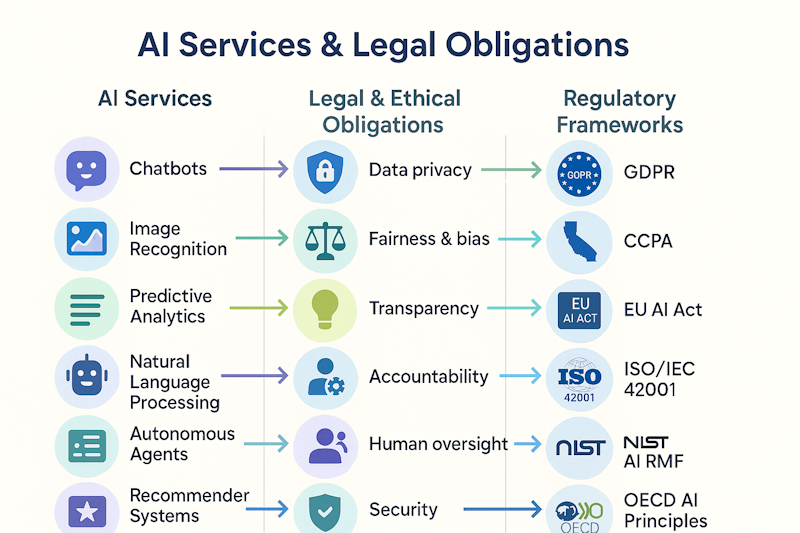
Organizations that develop, deploy, or manage AI security services face a complex web of legal obligations that extend far beyond traditional cybersecurity requirements. These obligations encompass data protection, transparency, accountability, and specific technical safeguards designed to address the unique risks associated with AI systems.
Data privacy and protection represent the foundation of legal compliance for AI security services. Regulatory frameworks such as the California Consumer Privacy Act (CCPA) in the United States govern how personal data is collected, processed, and stored, requiring businesses to obtain explicit consent from users before collecting their data. For AI security services that analyze customer interactions, network traffic, or user behavior to identify potential threats, ensuring that personal identifiers are properly anonymized and that customers are informed about this use of their data is not merely good practice—it's a legal requirement.
The concept of data minimization and purpose limitation has become central to AI security compliance. Legal frameworks emphasize the importance of collecting only the data necessary for a specific purpose and using that data solely for the intended purpose. AI security services must be designed to minimize data collection and implement robust data security measures to protect information from breaches or unauthorized access. Regular audits and updates to security protocols are essential to maintaining compliance and protecting user privacy.
Transparency requirements present particular challenges for AI security services, which often rely on complex algorithms and machine learning models. Organizations must provide clear documentation of how their AI systems make decisions, especially in high-stakes applications such as threat detection or access control. This documentation must be sufficiently detailed to satisfy regulatory requirements while protecting proprietary information and avoiding the creation of security vulnerabilities that could be exploited by malicious actors.
Establishing clear lines of accountability for AI decisions is crucial, particularly in security contexts where incorrect AI decisions could have serious consequences. Legal frameworks often require businesses to assess and mitigate risks associated with AI deployment, conducting thorough impact assessments and implementing safeguards to minimize potential harm. This includes establishing governance structures that clearly define responsibility for AI system outcomes and ensuring human oversight of critical security functions.
For AI security services that operate across jurisdictions, compliance becomes even more complex. Organizations must navigate a patchwork of regulations that may impose different—and sometimes conflicting—requirements. The EU's NIS2 Directive, which takes effect in early 2025, imposes stricter rules for cyber hygiene, incident response, supply chain risk, and executive accountability across more than 160,000 public and private organizations in the EU. Meanwhile, India's Digital Personal Data Protection Act (DPDPA), effective July 2025, establishes a modern privacy regime built around notice, consent, limited retention, and fiduciary responsibilities, with steep penalties for noncompliance and swift breach reporting requirements.
The Technical Dimensions of Legal Compliance
Meeting legal obligations for AI security services requires implementing specific technical measures designed to protect data, ensure system integrity, and maintain operational resilience. These technical requirements are increasingly codified in regulations and industry standards, creating clear expectations for organizations deploying AI security solutions.
The Digital Operational Resilience Act (DORA), which takes effect on January 17, 2025, standardizes digital operational resilience requirements across the EU financial sector. It enforces stringent obligations around ICT risk management, third-party oversight, threat-led penetration testing, and mandatory incident reporting. Financial institutions and their critical third-party ICT service providers must implement robust technical measures to identify and classify sensitive financial and operational data across cloud, SaaS, and on-premises environments, map third-party data flows, and assess exposure risks for vendors and processors.
Securing the AI data supply chain has emerged as a critical legal obligation, as highlighted in guidance released by the Cybersecurity and Infrastructure Security Agency (CISA) in May 2025. This guidance, published in conjunction with the National Security Agency, the Federal Bureau of Investigation, and cyber agencies from Australia, the United Kingdom, and New Zealand, emphasizes the importance of verifying and maintaining data integrity during storage and transport, sourcing reliable data, and tracking data provenance. Organizations must implement technical measures to detect and mitigate specific risks such as "split-view poisoning," "frontrunning poisoning techniques," and the inherent risks associated with web-crawled datasets.
The guidance outlines ten cybersecurity best practices specific to AI systems, building on security practices described in NIST SP 800-53 and other common security frameworks. These include classifying data, leveraging access controls and trusted infrastructure, encrypting data, and storing and deleting data securely. The guidance also references leveraging privacy-preserving techniques, such as data depersonalization or differential privacy, and conducting ongoing data security risk assessments.
Organizations must also implement technical measures to address the risk of maliciously modified data, which can result in inaccurate outcomes, poor decisions, and compromised security. This includes mitigating adversarial machine learning threats, bad data statements, statistical bias, data poisoning from inaccurate information, and data duplications. Recommended technical approaches include sanitizing training data to reduce the impact of outliers and poisoned inputs, and implementing metadata validation to check the completeness and consistency of metadata before it is used for AI training.
Data drift presents another technical challenge with legal implications. As the statistical properties of input data naturally change over time, becoming different from those of the original data used to train the model, organizations must implement continuous monitoring, retrain models with new data, and perform regular data cleansing to maintain system accuracy and reliability. Failure to address data drift could result in AI security systems that gradually become less effective, potentially creating legal liability if security incidents occur as a result.
Breach Notification Requirements and Liability Implications
The legal landscape surrounding AI security breaches is particularly complex, with significant variations in notification requirements, liability frameworks, and potential penalties across jurisdictions. Understanding these requirements is essential for organizations deploying AI security services, as the consequences of non-compliance can be severe.
Breach notification requirements have become more stringent and specific with regard to AI systems. The SEC's cybersecurity disclosure rules, which entered full enforcement in 2025, require public companies to disclose material cybersecurity incidents within four business days. This tight timeline creates significant challenges for organizations experiencing AI security breaches, as determining the scope and impact of such breaches often requires complex forensic analysis. Organizations must develop robust incident response capabilities that enable them to detect, analyze, and report AI security breaches within these compressed timeframes.
The EU AI Act introduces specific breach notification requirements for high-risk AI systems, requiring providers to report serious incidents to relevant authorities within specified timeframes. These requirements are in addition to existing breach notification obligations under the General Data Protection Regulation (GDPR) and the NIS2 Directive, creating a multi-layered compliance challenge for organizations operating in Europe. The penalties for non-compliance are substantial, with fines under the EU AI Act reaching up to €35 million or 7% of global annual turnover, whichever is higher.
In the United States, breach notification requirements vary by state, creating a complex compliance landscape for organizations operating nationally. Montana, Iowa, Delaware, and Indiana implemented new privacy laws on January 1, 2025, with Tennessee following on July 1, 2025. These laws provide residents with rights to access, delete, correct, and opt out of personal data processing—including profiling and targeted advertising. Organizations experiencing AI security breaches that compromise personal data must navigate these varying state requirements, potentially making multiple notifications with different content and timing requirements.
Liability for AI security breaches extends beyond regulatory penalties to include potential civil litigation, reputational damage, and business disruption. The question of who bears liability when an AI security system fails is increasingly complex, particularly when multiple parties are involved in developing, deploying, and operating the system. Organizations must establish clear contractual frameworks that define liability and indemnification obligations among AI developers, service providers, and end users.
The concept of "reasonable security" is evolving rapidly in the context of AI systems. Courts and regulators are increasingly looking to industry standards and best practices to determine whether an organization has implemented appropriate security measures. The ISO/IEC 42001 standard for AI Management Systems, which begins enterprise adoption in 2025, provides a globally recognized management system standard for responsible AI development and deployment, emphasizing documentation, risk assessment, and lifecycle monitoring. Organizations that fail to implement security measures aligned with such standards may face increased liability in the event of a breach.
Practical Strategies for Managing Legal Risk in AI Security
Organizations deploying AI security services must develop comprehensive strategies to manage legal risk while maintaining operational effectiveness. These strategies should address governance, technical controls, documentation, and ongoing monitoring to ensure compliance with evolving regulatory requirements.
Establishing robust AI governance frameworks is essential for managing legal risk. Organizations should create cross-functional AI governance committees that include legal, IT, and business units to oversee AI security initiatives. These committees should develop clear policies and procedures for AI development, deployment, and operation, with specific attention to security requirements and compliance obligations. Regular reviews and updates to these policies ensure ongoing compliance with evolving regulatory landscapes while reducing legal risks.
Implementing comprehensive data governance is equally important. Organizations should establish clear data classification schemes that identify sensitive, regulated, and high-risk data used in AI security systems. Data minimization principles should be applied to limit collection to necessary information, with clear data retention policies and defined timelines. Granular access controls based on legitimate need and robust encryption for data in transit and at rest provide additional protection against breaches and unauthorized access.
Documentation plays a critical role in demonstrating compliance and managing legal risk. Organizations should create clear documentation trails for AI decision-making processes, including model development, training data sources, testing procedures, and validation results. This documentation should be maintained throughout the AI lifecycle and be sufficiently detailed to satisfy regulatory requirements and support defense against potential liability claims. Incident response procedures specific to AI-related issues should be developed and regularly tested to ensure the organization can respond effectively to security breaches.
Continuous monitoring and adaptation are essential in the rapidly evolving AI security landscape. Organizations should stay informed about changes in laws and regulations affecting AI security and be prepared to adapt their policies and practices accordingly. Regular reviews and updates to AI security policies ensure ongoing compliance and reduce legal risks. Implementing systems to detect anomalous behavior or performance degradation in AI security systems can help identify potential issues before they result in security breaches or compliance violations.
Third-party risk management is particularly important for organizations that rely on external vendors for AI security services. Organizations should conduct thorough due diligence on AI security vendors, including assessments of their security practices, compliance programs, and incident response capabilities. Contractual agreements should clearly define security requirements, compliance obligations, liability allocation, and breach notification procedures. Regular audits and assessments of vendor performance help ensure ongoing compliance and security.
The Future of AI Security Regulation
The regulatory landscape for AI security is likely to continue evolving rapidly in the coming years, with significant implications for organizations deploying AI security services. Understanding emerging trends and preparing for future requirements can help organizations stay ahead of regulatory developments and minimize compliance risks.
Increased regulatory convergence is likely as jurisdictions around the world develop more comprehensive AI security frameworks. While there are currently significant variations in regulatory approaches between regions, there is growing recognition of the need for international cooperation and harmonization. Organizations should monitor developments in global standards and best practices, such as the work of the ISO/IEC on AI standards, to anticipate future regulatory requirements and align their compliance programs accordingly.
Sector-specific regulations are likely to proliferate, particularly in high-risk industries such as healthcare, finance, critical infrastructure, and defense. These regulations will impose more stringent requirements on AI security services operating in these sectors, reflecting the potential consequences of security failures. Organizations operating in regulated industries should engage with relevant regulatory bodies and industry associations to stay informed about emerging requirements and contribute to the development of practical and effective regulatory frameworks.
Algorithmic accountability is likely to receive increased regulatory attention, with requirements for explainability, transparency, and human oversight becoming more stringent. Organizations deploying AI security services should invest in technologies and methodologies that enhance the explainability of AI systems, particularly those used for critical security functions. Developing robust processes for human review and oversight of AI security decisions can help address regulatory concerns about algorithmic accountability.
Privacy-enhancing technologies (PETs) are likely to play an increasingly important role in AI security compliance. Techniques such as federated learning, differential privacy, and homomorphic encryption enable organizations to derive insights from data while minimizing privacy risks. Regulatory frameworks are increasingly recognizing the value of these technologies in addressing privacy concerns, and organizations that adopt PETs may benefit from reduced compliance burdens and enhanced ability to use sensitive data for security purposes.
The intersection of AI security and critical infrastructure protection is likely to receive increased regulatory attention. As AI systems become more deeply embedded in critical infrastructure, the security implications of AI failures or compromises become more significant. Organizations operating in critical infrastructure sectors should anticipate more stringent requirements for AI security, including requirements for resilience, redundancy, and fail-safe mechanisms.
Navigating the Complex Intersection of AI, Security, and Law
The legal and privacy implications of AI security services present a complex challenge for organizations across sectors. As AI becomes increasingly integrated into critical security functions, the potential consequences of security failures—and the associated legal liabilities—continue to grow. Organizations must navigate a rapidly evolving regulatory landscape while implementing robust technical and governance measures to manage legal risk.
The key to success in this environment lies in adopting a proactive, risk-based approach to AI security compliance. By understanding legal obligations, implementing appropriate technical controls, establishing clear governance frameworks, and maintaining comprehensive documentation, organizations can minimize legal risk while leveraging the powerful capabilities of AI for security purposes.
As we move forward, collaboration between technology developers, legal experts, and policy makers will be essential to develop regulatory frameworks that effectively address the unique risks of AI security while enabling innovation and operational effectiveness. Organizations that engage constructively in this process, sharing insights and best practices while advocating for practical and effective regulations, can help shape the future of AI security governance.
In this rapidly evolving landscape, staying informed about regulatory developments, investing in compliance capabilities, and maintaining a commitment to responsible AI deployment will be essential for organizations seeking to navigate the complex intersection of AI, security, and law. By doing so, they can not only minimize legal risk but also build trust with customers, partners, and regulators—a critical foundation for sustainable success in the AI-powered future.
