The Digital Battlefield: Are We Losing the Cyber Wars?

The Escalating Cyber Threat Landscape
In the shadowy realm of cyberspace, a silent war rages with increasingly devastating consequences for nations, businesses, and citizens worldwide. As we navigate through 2025, the question looms larger than ever: Are we losing the cyber wars? The evidence suggests a troubling trajectory, with state-sponsored attacks, ransomware campaigns, and sophisticated threat actors demonstrating capabilities that outpace our collective defensive measures.
Recent data from the Center for Strategic and International Studies (CSIS) reveals that Russian cyberattacks on Ukraine surged by nearly 70% in 2024, with over 4,300 incidents targeting critical infrastructure, including government services, energy facilities, and transportation networks. This represents not merely an escalation in volume but a strategic weaponization of cyber capabilities as an extension of geopolitical conflict.
The weaponization of cyber attacks has evolved from theoretical concern to practical reality. Nation-states now deploy cyber weapons with the same strategic consideration previously reserved for conventional military assets. These digital arsenals target the very foundations of modern society – our critical infrastructure, government operations, and public safety systems – creating vulnerabilities that can be exploited for maximum political and economic impact.
Critical Infrastructure Under Siege
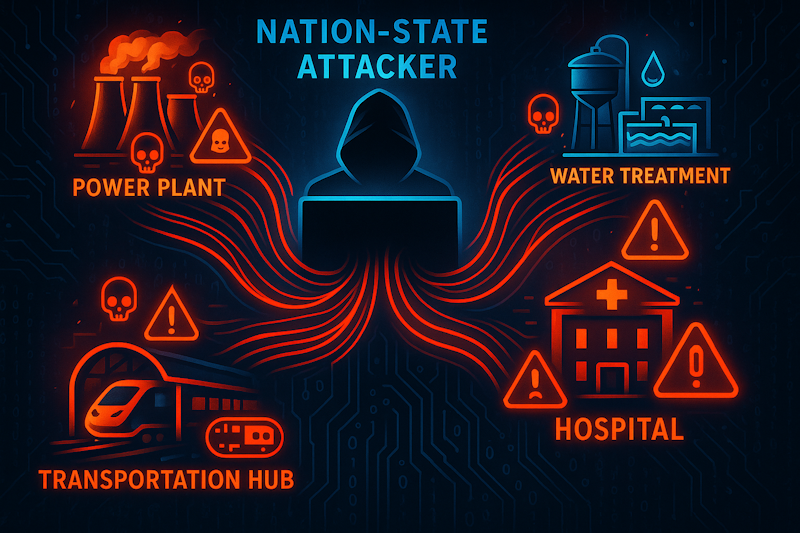
The targeting of critical infrastructure represents perhaps the most alarming trend in the evolving cyber battlefield. In April 2025, Iranian state-linked hackers deployed customized dropper malware against water utilities across the United States, demonstrating both technical sophistication and strategic intent. This follows a troubling pattern established in 2024, when criminal actors conducted coordinated cyber attacks against both large and small water utilities, potentially inspired by similar campaigns against healthcare providers.
The healthcare sector itself remains particularly vulnerable. The February 2024 ransomware attack against Change Healthcare serves as a sobering example, as it impacted virtually every U.S. hospital in some capacity, disrupting patient care, delaying treatments, and compromising sensitive medical data. The attack demonstrated how cyber threats have evolved beyond mere financial motivations to potentially life-threatening consequences.
Energy infrastructure has not been spared either. According to the World Economic Forum's Global Cybersecurity Outlook 2025, the world witnessed the largest IT outage in history during 2024, disrupting airlines, banks, broadcasters, healthcare providers, and retail payment systems simultaneously. The cascading effects of such attacks highlight the interconnected nature of our digital ecosystem and the potential for systemic collapse when critical nodes are compromised.
The financial impact of these attacks continues to grow exponentially. Cybercrime damages, which were projected to exceed $6 trillion annually by 2021, are now estimated to reach $10.5 trillion by the end of 2025, according to Cybersecurity Ventures. This represents the greatest transfer of economic wealth in history and poses risks to innovation, investment, and development across all sectors.
The State-Sponsored Threat Actors
Behind many of the most sophisticated cyber attacks lie nation-states with strategic objectives that extend beyond mere financial gain. The Office of the Director of National Intelligence's 2025 Threat Assessment identifies Russia, China, Iran, and North Korea as the primary state sponsors of cyber operations, collectively responsible for 77% of all suspected operations since 2005.
Russia's cyber capabilities have been prominently displayed in its ongoing conflict with Ukraine, where digital attacks often precede or accompany kinetic military operations. Chinese state-sponsored groups continue to target intellectual property and strategic information across multiple sectors, with a particular focus on defense, technology, and telecommunications. Iran has increasingly directed its cyber operations against critical infrastructure, while North Korea leverages cyber capabilities primarily for financial gain to circumvent international sanctions.
The motivations driving state-sponsored cyber attacks vary widely but often align with broader geopolitical objectives. For Russia, cyber operations serve as asymmetric tools to project power and undermine Western democratic institutions. China employs cyber espionage to accelerate technological development and gain competitive advantages. Iran seeks to demonstrate capabilities and extract revenge for perceived slights, while North Korea focuses on financial gain and regime survival.
Political Objectives and Digital Coercion
The weaponization of cyber capabilities for political objectives represents a fundamental shift in international relations. Nation-states now routinely employ cyber attacks as instruments of national power, alongside diplomatic, informational, military, and economic tools. This "whole-of-government" approach to cyber operations blurs traditional boundaries between war and peace, creating a persistent state of conflict below the threshold of armed confrontation.
According to the Department of Homeland Security's 2025 Homeland Threat Assessment, domestic and foreign violent extremists increasingly call for physical attacks on critical infrastructure to further ideological objectives. This convergence of cyber capabilities with extremist ideologies creates a particularly dangerous threat vector, as non-state actors gain access to increasingly sophisticated tools and techniques.
The political objectives behind cyber attacks often include:
- Undermining public confidence in government institutions
- Influencing electoral processes and outcomes
- Creating economic pressure to force policy concessions
- Demonstrating capabilities as a deterrent against adversaries
- Testing response mechanisms and identifying vulnerabilities for future exploitation
The 2025 assessment from the Center for AI Safety notes that artificial intelligence technologies are increasingly being weaponized to enhance cyber attack capabilities, enabling more sophisticated social engineering, faster vulnerability discovery, and automated attack execution. This technological acceleration widens the gap between offensive and defensive capabilities, potentially tilting the balance further in favor of attackers.
The Technological Arms Race
The cyber battlefield continues to evolve at a pace that challenges traditional security paradigms. Emerging technologies like artificial intelligence, quantum computing, and 5G networks create new attack surfaces and vulnerabilities even as they deliver transformative benefits. This technological arms race favors attackers, who need only find a single vulnerability to succeed, while defenders must protect an ever-expanding digital perimeter.
In 2025, we are witnessing an escalation in state-sponsored cyberattacks aimed at creating widespread disruption and psychological stress. These attacks increasingly leverage AI to identify vulnerabilities, craft convincing phishing campaigns, and automate attack processes. The democratization of these capabilities means that sophisticated attack tools once available only to nation-states are now accessible to criminal organizations and even individual actors.
The proliferation of Internet of Things (IoT) devices further complicates the security landscape. By 2025, an estimated 75 billion connected devices worldwide create an unprecedented attack surface. Many of these devices lack basic security features, creating vulnerable entry points into critical systems and networks. The integration of operational technology (OT) with information technology (IT) in industrial environments similarly expands the potential impact of cyber attacks, as demonstrated by incidents targeting industrial control systems in manufacturing, energy, and water treatment facilities.
A Lost Cause? The War on Drugs Comparison
The parallels between cybersecurity challenges and the "war on drugs" offer a sobering perspective on our current trajectory. Both represent complex, multifaceted problems with deep societal roots that resist purely technical or enforcement-based solutions. Both involve asymmetric conflicts where defenders face inherent disadvantages against adaptable, motivated adversaries. And both have seen massive investments yield disappointing returns.
Mark Thiele, in his analysis "Why Cybersecurity is our Drug War," notes that we've "mostly continued to fight the same war, with more and more expensive resources. With Cyber Security we decry the latest security breaches, we talk about the need for better security, we spend more money, and we continue to get breached." This cycle of reaction rather than prevention mirrors the enforcement-focused approach that has characterized much of the war on drugs.
The war on drugs has been widely criticized for its failure to reduce drug availability or consumption despite decades of effort and trillions in spending. Similarly, despite exponential growth in cybersecurity spending – projected to exceed $300 billion globally by 2025 – the frequency, severity, and impact of cyber attacks continue to increase. This suggests that our current approach may be fundamentally flawed or insufficient.
The comparison extends to market dynamics as well. Just as prohibition creates black markets with enormous profit potential for drug traffickers, the digital economy creates incentives for cybercriminals that far outweigh the risks of detection and prosecution. The low barriers to entry, minimal risk of physical harm, and potential for substantial financial gain make cybercrime an attractive proposition for skilled individuals in regions with limited economic opportunities.
Society's Technological Dependencies
Our increasing dependence on digital technologies creates fundamental vulnerabilities that cannot be eliminated without sacrificing the very benefits these technologies provide. Modern society relies on interconnected digital systems for everything from power generation and water treatment to financial transactions and healthcare delivery. This dependency creates an asymmetric advantage for attackers, who can target these essential services to achieve maximum impact.
The COVID-19 pandemic accelerated digital transformation across all sectors, expanding remote work, telehealth, online education, and e-commerce. While these changes delivered significant benefits, they also expanded attack surfaces and created new vulnerabilities. Organizations that rapidly deployed digital solutions often prioritized functionality over security, creating technical debt that continues to plague their security posture.
The Army War College's analysis "It's Easy to Get Lost: The Temptation of Overreliance on Technology" highlights how dependency on technology can lead to the loss of basic skills, which can prove disastrous when technology fails. This observation applies equally to cybersecurity, where over-reliance on technical solutions often comes at the expense of fundamental security practices and human factors.
Rethinking Our Approach: Beyond the Lost Cause Narrative
While the challenges are daunting, declaring the cyber wars a "lost cause" risks becoming a self-fulfilling prophecy. Instead, we might benefit from reframing our understanding of cybersecurity as a form of risk management rather than a problem to be "solved" once and for all. This perspective acknowledges that perfect security is unattainable but focuses on making attacks more difficult, less profitable, and less impactful.
The Center for Strategic and International Studies (CSIS) report "A Shared Responsibility" emphasizes that many attacks succeed because of failures to observe basic cybersecurity measures, like patching vulnerabilities or implementing multi-factor authentication. This suggests that significant improvements are possible through wider adoption of existing best practices rather than novel technical solutions alone.
The public-private partnership model offers another promising approach. Unlike the war on drugs, which has been primarily government-led, effective cybersecurity requires collaboration between government agencies, private companies, academic institutions, and individual users. The National Cyber Security Strategy increasingly recognizes this distributed responsibility, moving away from placing the burden primarily on end-users toward holding software manufacturers and service providers accountable for secure-by-design principles.
International cooperation represents another critical dimension. Cybersecurity challenges transcend national boundaries, requiring coordinated responses across jurisdictions. Recent efforts to establish international norms for responsible state behavior in cyberspace, while imperfect, represent important steps toward a more stable digital environment.
Adapting to a Persistent Threat
The cyber wars will not be won in any conventional sense. Rather than seeking total victory, we must adapt to a persistent threat environment where success is measured by resilience, rapid recovery, and the ability to maintain essential functions even under attack. This requires a fundamental shift in mindset from prevention alone to a balanced approach that encompasses detection, response, and recovery capabilities.
The comparison to the war on drugs offers valuable lessons about the limitations of purely technical or enforcement-based approaches to complex socio-technical problems. Just as effective drug policy requires addressing root causes and harm reduction alongside enforcement, effective cybersecurity demands attention to human factors, economic incentives, and international cooperation alongside technical defenses.
Are we losing the cyber wars? If victory means eliminating the threat entirely, then yes – that battle was lost before it began. But if success means building resilient systems that can withstand attacks, recover quickly, and adapt to emerging threats, then the outcome remains very much in our hands. The challenge lies not in finding a silver bullet solution, but in developing the collective will, coordination mechanisms, and sustained commitment necessary to manage an enduring risk to our digital society.
As we navigate the increasingly complex digital battlefield of 2025 and beyond, our focus must shift from winning an unwinnable war to building a more secure, resilient digital ecosystem that can deliver on technology's promise while managing its inherent risks. This represents not a retreat but a strategic adaptation to the realities of our interconnected world – one where cyber threats persist but need not prevail.
