
ZTA Integration with OpenID Connect and OAuth 2.0 within Healthcare


In a Zero Trust Architecture (ZTA), the fundamental principle is "never trust, always verify," which means that no entity—whether inside or outside the network perimeter—is trusted by default. This approach is particularly relevant for medical facilities where protecting sensitive patient data is paramount. OpenID Connect (OIDC) and OAuth 2.0 play crucial roles in implementing this architecture by providing robust identity verification and authorization mechanisms.
The Healthcare Security Imperative
Healthcare organizations face unique security challenges that make Zero Trust particularly valuable:
-
High-Value Target: Medical records contain comprehensive personal, financial, and health information, making them extremely valuable on the black market—up to 50 times more valuable than credit card information.
-
Regulatory Compliance: HIPAA and other healthcare regulations mandate strict protection of patient data with severe penalties for breaches. Zero Trust helps achieve and maintain compliance by enforcing continuous verification.
-
Complex Access Patterns: Medical facilities have diverse users (doctors, nurses, administrative staff, patients) accessing systems from various locations and devices, creating complex access management challenges.
-
Legacy Systems: Many healthcare organizations operate legacy systems that weren't designed with modern security principles, making them vulnerable to attacks.
-
Life-Critical Systems: Security failures in healthcare can directly impact patient care and safety, raising the stakes beyond mere data protection.
Continuous Verification: The Core of Zero Trust in Healthcare
The "always verify" principle is implemented through continuous monitoring and validation:
-
Contextual Authentication: Every access request is evaluated based on multiple factors including user identity, device health, network location, resource sensitivity, and behavioral patterns.
-
Just-in-Time and Just-Enough Access: Healthcare professionals receive only the minimum necessary permissions to perform their specific duties, for only the time needed.
-
Session Monitoring: Even after initial authentication, user sessions are continuously monitored for anomalous behavior that might indicate compromise.
-
Automated Response: Suspicious activities trigger immediate responses, from requiring re-authentication to terminating sessions or isolating systems.
OpenID Connect and OAuth 2.0: The Identity Foundation
These protocols provide the identity and authorization framework essential for Zero Trust:
-
OpenID Connect (OIDC): Extends OAuth 2.0 to provide identity verification, allowing healthcare systems to confirm that users are who they claim to be. This is critical when accessing sensitive patient information.
-
OAuth 2.0: Provides the authorization framework that determines what specific resources (patient records, medical devices, administrative systems) a verified user can access.
-
Token-Based Security: Rather than persistent credentials, these protocols use short-lived tokens that limit the damage potential if intercepted.
-
Federated Identity: Allows healthcare organizations to integrate with trusted identity providers while maintaining strict access controls.
Practical Implementation in Medical Environments
In healthcare settings, Zero Trust with OIDC/OAuth 2.0 creates multiple security layers:
-
Device Trust: Ensures that only managed, compliant devices can access medical systems, preventing compromised devices from becoming entry points.
-
Network Segmentation: Isolates critical systems (EHR, PACS, medical devices) from each other, limiting lateral movement if one system is compromised.
-
Micro-Segmentation: Further divides networks into secure zones where access is granted based on verified identity and need.
-
Data-Centric Protection: Encrypts sensitive information and applies access controls at the data level, ensuring protection even if network defenses are breached.
-
Continuous Monitoring: Implements real-time analysis of access patterns to detect potential threats, with particular attention to unusual access to patient records.
Conceptual Integration Model
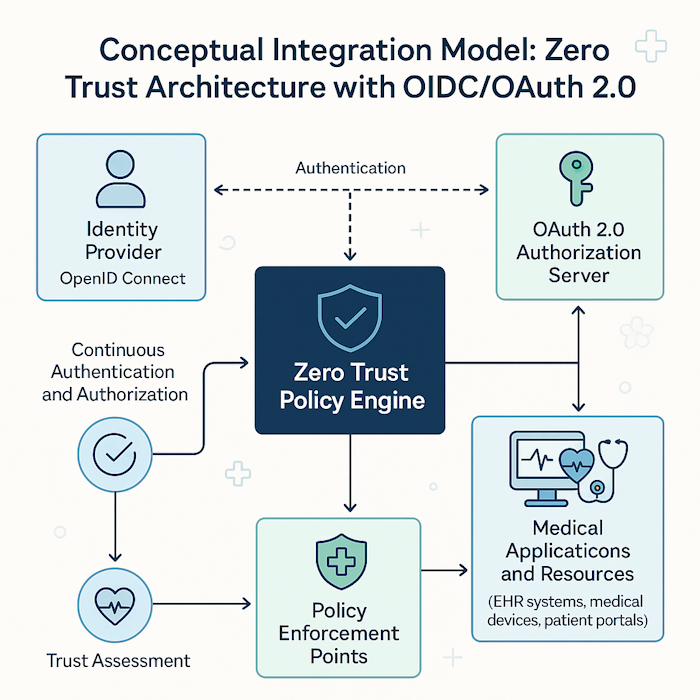
How OpenID Connect and OAuth 2.0 Work in Zero Trust
1. Identity Verification Process (OpenID Connect)
OpenID Connect extends OAuth 2.0 to provide identity verification. In a medical facility ZTA, this process works as follows:
- User Authentication Initiation:
- A healthcare professional attempts to access a clinical application (e.g., EHR system)
- The client application redirects the user to the Identity Provider (IdP)
- Authentication at the Identity Provider:
- The IdP challenges the user with multi-factor authentication (MFA)
- For medical environments, this typically includes:
- Something you know (password)
- Something you have (smart card, mobile device)
- Something you are (biometrics like fingerprint)
- Identity Token Issuance:
- Upon successful authentication, the IdP issues an ID token (JWT format)
- The ID token contains claims about the user's identity:
- Subject identifier (unique user ID)
- Name, email, department, role (e.g., physician, nurse)
- Authentication time and method
- Session information
- Device information
- Identity Context Enrichment:
- The authentication service enriches the identity with additional context:
- Device health and compliance status
- Location information
- Network information
- Behavioral patterns
- Previous access history
2. Authorization Process (OAuth 2.0)
OAuth 2.0 handles the authorization aspect, determining what resources the authenticated user can access:
- Access Token Request:
- After authentication, the client application requests an access token
- The request includes:
- The ID token (proving authentication)
- The requested scope (what access is needed)
- Client credentials (identifying the application)
- Policy Evaluation:
- The Zero Trust Policy Engine evaluates the request against security policies
- Factors considered include:
- User identity and attributes (role, department)
- Device security posture
- Location and network
- Time of access
- Requested resource sensitivity
- Behavioral analytics
- Risk score calculation
- Access Token Issuance:
- If the policy evaluation passes, an access token is issued
- The token contains:
- Scopes (permissions granted)
- Resource server identifiers
- Expiration time (typically short-lived in ZTA)
- Audience (intended recipient)
- Token Presentation and Validation:
- The client presents the access token to the resource server
- The resource server validates:
- Token signature
- Expiration time
- Audience claim
- Required scopes
- Additional custom claims
- Continuous Verification:
- In Zero Trust, verification is continuous, not just at login
- Access tokens have short lifetimes (minutes, not hours)
- Refresh tokens require re-verification of security context
- Session monitoring for anomalies triggers re-authentication
Detailed Flow in a Medical Facility Context
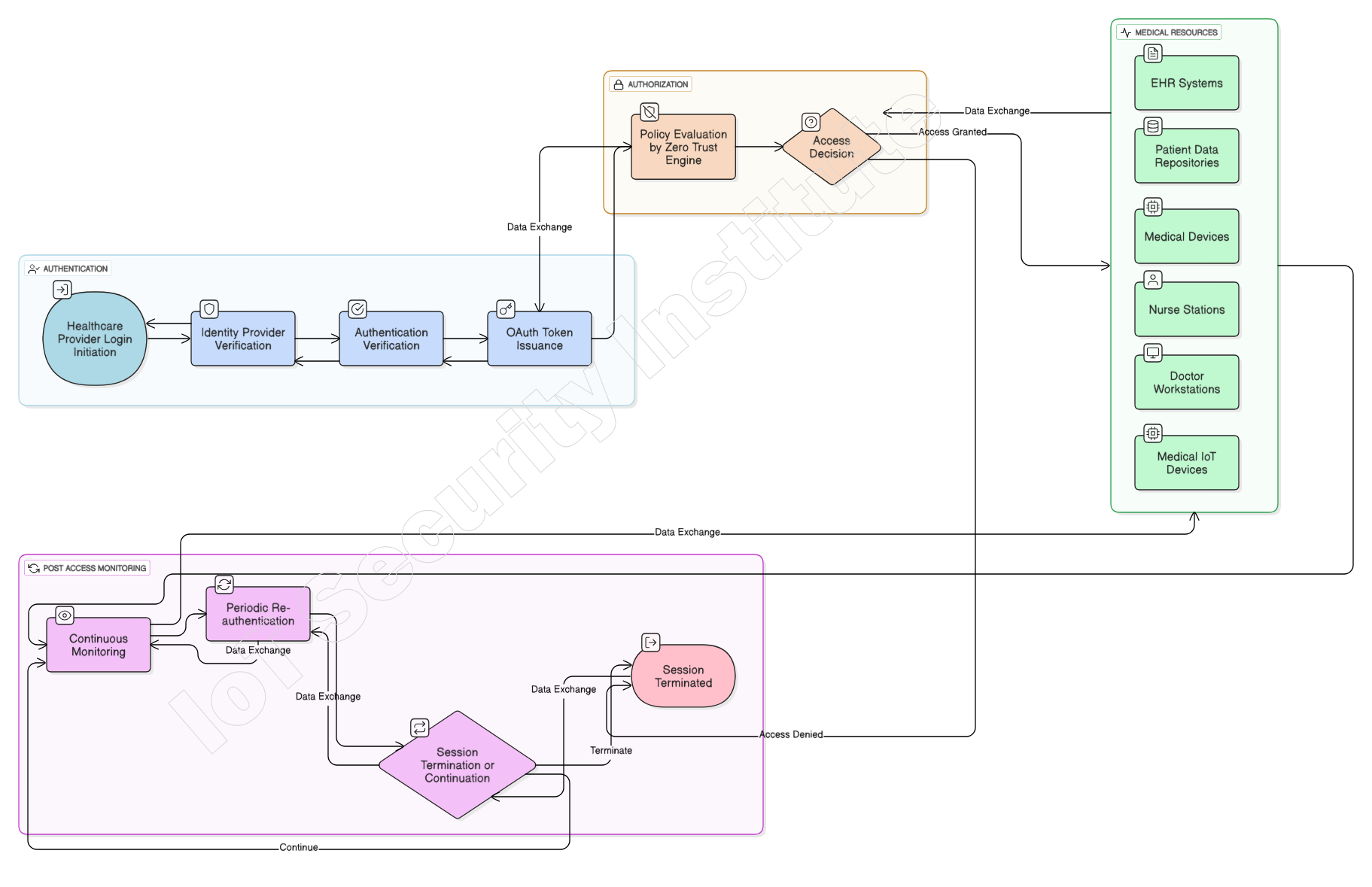
Practical Example: Physician Accessing EHR
Let's walk through a practical example of how a physician would access an Electronic Health Record (EHR) system in a Zero Trust Architecture using OpenID Connect and OAuth 2.0:
- Initial Access Request:
- Dr. Smith attempts to access the EHR system from a hospital workstation
- The EHR application redirects to the hospital's Identity Provider
- Strong Authentication (OpenID Connect):
- Dr. Smith authenticates using:
- Hospital-issued smart card (inserted into workstation)
- PIN code (something known only to Dr. Smith)
- Optional biometric verification for high-risk actions
- Device and Context Verification:
- The Identity Provider verifies:
- Workstation is hospital-managed and compliant with security policies
- Device has up-to-date antivirus and patches
- Connection is from a recognized hospital network
- Access is during Dr. Smith's scheduled shift
- ID Token Issuance:
- The Identity Provider issues an ID token containing:
- Dr. Smith's unique identifier
- Attributes: "Physician", "Cardiology Department"
- Authentication time and method used
- Device identifier and health status
- Authorization Request (OAuth 2.0):
- The EHR application requests an access token from the Authorization Server
- Request includes:
- ID token (proving Dr. Smith's identity)
- Requested scope: "patient.read" (for viewing patient records)
- Client ID (identifying the EHR application)
- Zero Trust Policy Evaluation:
- The Authorization Server evaluates:
- Is Dr. Smith authorized to access patient records?
- Is Dr. Smith currently assigned to the patients being accessed?
- Is the access request consistent with normal patterns?
- What is the current risk score for this session?
- Access Token Issuance:
- Authorization Server issues an access token with:
- Limited scope: "patient.read" (but not "patient.write")
- Short expiration time (15 minutes)
- Resource restrictions (only patients under Dr. Smith's care)
- Context conditions (valid only from hospital network)
- Resource Access:
- EHR application presents the access token to the patient records API
- API validates the token and enforces fine-grained access control
- Dr. Smith can view only authorized patient information
- Continuous Monitoring and Re-verification:
- Throughout the session:
- Behavioral analytics monitor for unusual access patterns
- Token refresh requires re-verification of security context
- Significant context changes (e.g., network change) trigger re-authentication
- Suspicious activities immediately revoke active tokens
Technical Implementation Details
1. Token Structure and Claims
In a medical facility ZTA, the tokens contain specialized claims:
ID Token Example (JWT format):
|
{ "iss": "https://idp.hospital.org", "sub": "1234567890", "aud": "ehr-system-client-id", "exp": 1616174144, "iat": 1616170544, "auth_time": 1616170544, "nonce": "n-0S6_WzA2Mj", "name": "Dr. Jane Smith", "given_name": "Jane", "family_name": "Smith", "email": "This email address is being protected from spambots. You need JavaScript enabled to view it.", "hospital_id": "STAFF123456", "department": "Cardiology", "role": "Physician", "amr": ["mfa", "smartcard", "pin"], "device_id": "HOSP-WS-12345", "device_compliance": "compliant", "network_zone": "clinical" } |
Access Token Example (JWT format):
|
{ "iss": "https://authz.hospital.org", "sub": "1234567890", "aud": "https://api.ehr.hospital.org", "exp": 1616171544, "iat": 1616170544, "client_id": "ehr-web-application", "scope": "patient.read patient.search", "department": "Cardiology", "role": "Physician", "context": { "device_compliance": "compliant", "network_zone": "clinical", "risk_score": "low", "session_id": "SES12345678" }, "resource_restrictions": { "patient_access": "assigned_only", "department_access": "cardiology primary_care" }
|
2. Policy Decision Points
The Zero Trust Policy Engine evaluates multiple factors when making authorization decisions:
- User Attributes:
- Role-based access (physician vs. nurse vs. administrator)
- Department-based restrictions
- Care relationship (is the user assigned to this patient?)
- Certification and training status
- Device Security:
- Managed vs. unmanaged device
- Encryption status
- Patch level
- Endpoint protection status
- Device recognition and history
- Contextual Factors:
- Location (on-premises, remote, geographic location)
- Network (hospital network, VPN, public internet)
- Time of day (normal working hours vs. off-hours)
- Behavioral patterns (typical access patterns vs. anomalies)
- Resource Sensitivity:
- PHI classification level
- Record type (psychiatric, substance abuse, HIV status)
- Emergency access requirements
- Research vs. clinical data
3. Continuous Authentication and Authorization
Zero Trust requires continuous verification, not just at login:
- Token Lifetime Management:
- Access tokens have short lifetimes (10-15 minutes)
- Refresh tokens require re-verification of security context
- Critical actions require step-up authentication
- Session Monitoring:
- Real-time monitoring of user behavior
- Anomaly detection triggers re-authentication
- Continuous device health attestation
- Adaptive Authentication:
- Risk-based authentication challenges
- Increased verification for unusual patterns
- Context-aware MFA requirements
Integration with Medical Facility Security Architecture
In the context of the medical facility security architecture, OpenID Connect and OAuth 2.0 integrate with other security components:
- Integration with Clinical Systems:
- EHR systems implement OAuth 2.0 resource server capabilities
- FHIR APIs use OAuth 2.0 for authorization
- Medical devices use device authentication flows
- Integration with Security Monitoring:
- Authentication and authorization events feed into SIEM
- Failed authentication attempts trigger alerts
- Token usage patterns are analyzed for anomalies
- Integration with Compliance Requirements:
- HIPAA audit logging of all access decisions
- Detailed attribution of all PHI access
- Evidence collection for compliance reporting
Implementation Best Practices for Medical Facilities
When implementing OpenID Connect and OAuth 2.0 in a healthcare Zero Trust Architecture:
- Use Healthcare-Specific Scopes:
- Define granular scopes aligned with clinical workflows
- Example scopes: patient read : patent demographics: patient medications: patient billing
- Implement purpose-based access control (why is the data being accessed?)
- Implement Break-Glass Procedures:
- Emergency access protocols that bypass normal restrictions
- Heavily audited and time-limited
- Requires post-access justification
- Secure Token Handling:
- Store tokens securely (no local storage in browsers)
- Implement proper PKCE for public clients
- Use secure token binding where possible
- Robust Identity Proofing:
- Strong initial identity verification for healthcare staff
- Integration with medical credentialing systems
- Regular re-verification of credentials
- Federated Healthcare Identities:
- Support for healthcare-specific federation standards
- Integration with regional health information exchanges
- Cross-organizational authentication for referrals and consultations
OpenID Connect and OAuth 2.0 provide the foundation for implementing Zero Trust Architecture in medical facilities by enabling:
- Strong Identity Verification: Ensuring users are who they claim to be through multi-factor authentication and contextual verification.
- Fine-Grained Authorization: Controlling access to sensitive patient data based on need-to-know principles and clinical relationships.
- Continuous Verification: Moving beyond perimeter-based security to continuous evaluation of trust throughout each session.
- Adaptive Security Posture: Adjusting security requirements based on risk assessment and contextual factors.
By properly implementing these protocols within a Zero Trust framework, medical facilities can significantly enhance their security posture while maintaining the efficiency of clinical workflows and ensuring patient data remains protected.
