Emerging AI Agent Protocols: Security Challenges and Threat Vectors

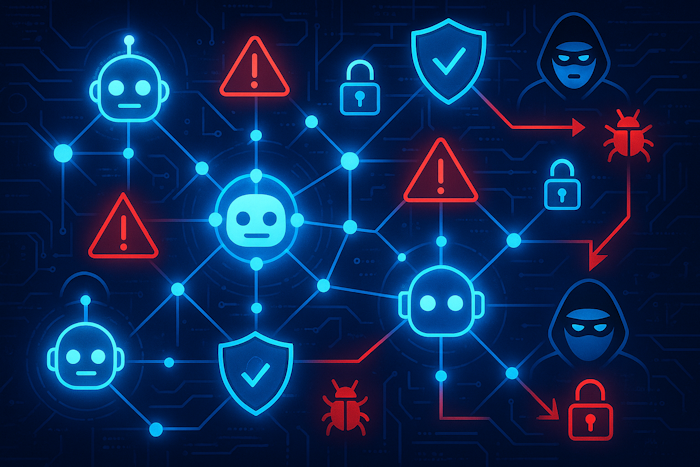
The rapid evolution of artificial intelligence has ushered in a new era of autonomous AI agents capable of performing complex tasks with minimal human intervention. As these agents become more sophisticated, the need for standardized communication protocols has emerged as a critical requirement for interoperability and scalability. Three protocols in particular—Model Context Protocol (MCP), Agent-to-Agent Protocol (A2A), and Agent Communication Protocol (ACP)—have gained significant traction in the industry. However, with these advancements come new security challenges and threat vectors that organizations must understand and address.
This article explores these emerging protocols, their applications, security vulnerabilities, and the cybersecurity measures necessary to protect AI agent ecosystems in enterprise environments.
Understanding the Emerging AI Agent Protocol Landscape
Before diving into security considerations, it's essential to understand what these protocols are and how they differ from one another.
Model Context Protocol (MCP)
Introduced by Anthropic in late 2024, the Model Context Protocol (MCP) is an open standard designed to create standardized connections between AI models and external tools, data sources, and resources. MCP focuses on enriching a single model's context, enabling it to access and utilize various tools to complete tasks more effectively.
MCP operates on a client-server architecture where:
- MCP clients are AI applications seeking to connect with external knowledge and capabilities without specifying in advance what specific tools they'll need.
- MCP servers are modules that interact with data sources, perform analysis, and implement specific APIs without knowing specifically how their capabilities will be used.
The protocol defines how servers advertise their capabilities through a discovery process and how clients can request and utilize these services. MCP has been described as "a universal adapter for AI applications, similar to what USB-C is for physical devices."
Agent-to-Agent Protocol (A2A)
Launched by Google with support from over 50 technology partners, the Agent-to-Agent Protocol (A2A) enables AI agents to communicate with each other, exchange information, and coordinate actions across platforms. Unlike MCP, which focuses on connecting a model to tools, A2A is designed for peer-to-peer agent communication.
A2A facilitates communication through:
- Capability discovery: Agents advertise their capabilities using "Agent Cards" in JSON format
- Task management: Agents collaborate toward task completion for end-users
- Collaboration: Agents exchange messages to communicate context, replies, and user instructions
- User experience negotiation: Agents negotiate the format needed for content delivery
A2A is built on existing standards like HTTP, SSE, and JSON-RPC, making it compatible with enterprise IT stacks while supporting enterprise-grade authentication and authorization.
Agent Communication Protocol (ACP)
Developed by IBM's BeeAI, the Agent Communication Protocol (ACP) completes the picture by focusing on local-first agent coordination with minimal network overhead. ACP is particularly valuable for edge computing applications, robotics, IoT deployments, and scenarios requiring operation without internet connectivity.
Key features of ACP include:
- REST-based communication: Uses standard HTTP conventions for easier integration into production environments
- No SDK required: Doesn't require specialized libraries, allowing interaction with tools like cURL or Postman
- Offline discovery: Agents can embed metadata directly into distribution packages, enabling discovery even when inactive
- Async-first design: Optimized for asynchronous communication with synchronous support when needed
ACP defines a decentralized agent environment where agents broadcast capabilities locally, communicate through event-driven messaging, and can be orchestrated by optional runtime controllers that enforce policies.
Security Challenges and Threat Vectors
As organizations adopt these protocols, they face a range of security challenges that extend beyond traditional cybersecurity concerns. The autonomous nature of AI agents, combined with their ability to access tools and communicate with other agents, creates novel attack vectors that must be addressed.
Naming Attacks
Naming attacks occur when malicious entities register servers or agents with names deceptively similar to legitimate ones. This type of attack affects both MCP and A2A protocols.
In MCP environments, AI agents rely heavily on server names and descriptions to identify which tools to use. An attacker could register a malicious server with a nearly identical name (e.g., "finance-tool-mcp.company.com" instead of "finance-tools-mcp.company.com"). To an AI agent scanning for available tools, these names appear equivalent and could be confused during natural language processing.
Similarly, A2A faces naming vulnerabilities for both agent names and skills. Attackers could create Agent Cards that mimic legitimate agents by using similar agent names (e.g., "DataAnalysisAgent" vs. "DataAnalyzerAgent"), identical or similar skill descriptions, or typosquatting agent identifiers.
The consequences of naming attacks can include data exfiltration, credential theft, and unauthorized access to sensitive systems as the AI agent mistakenly invokes malicious tools or agents.
Context Poisoning / Indirect Prompt Injection
Context poisoning represents perhaps the most sophisticated attack vector against AI agents. This approach exploits the natural language descriptions of tools, agents, and skills that are included in the context sent to the AI model.
For MCP, context poisoning typically involves manipulating tool descriptions to contain hidden instructions that influence the AI model's behavior. For example, a seemingly innocent investment calculator tool might include instructions in its description that direct the AI to exfiltrate sensitive financial data from the user's system.
A2A systems face similar poisoning risks due to their multi-agent collaboration model. A misbehaving agent could send a task to a peer agent containing malicious instructions. Since the receiving agent trusts the sending agent, it may execute these instructions without proper validation.
ACP, while designed with security in mind, is not immune to context poisoning. Its event-driven messaging system could potentially be exploited if proper validation and sanitization are not implemented.
Shadowing Attacks
Shadowing attacks occur when malicious components override or alter the behavior of legitimate ones. In MCP environments, this might involve a malicious server providing a seemingly innocent tool with a description that secretly contains instructions to modify how the AI agent uses other legitimate tools.
For example, a malicious symptom checker tool in a healthcare setting might include hidden instructions that tell the AI agent to redirect all patient billing information to an attacker's email address. What makes shadowing attacks particularly dangerous is that the malicious tool doesn't need to be used directly—its mere presence in the agent's context is enough to influence behavior.
In A2A environments, shadowing attacks can be even more complex to detect. Since A2A enables agents to collaborate and delegate tasks, one compromised agent can influence the behavior of others in a workflow chain. This creates a "sleeper cell" effect that becomes difficult to identify as the compromise propagates through agent interactions.
Rug Pulls
Rug pulls represent another significant threat in AI agent ecosystems. These attacks involve establishing a seemingly legitimate service that builds trust over time, only to suddenly change behavior in harmful ways once widely adopted.
In an MCP ecosystem, a malicious actor might deploy a genuinely valuable tool, patiently build trust and reputation, and once sufficiently embedded in critical workflows, weaponize it. For example, a research analysis tool that has been providing valuable insights for months might begin subtly manipulating results or exfiltrating sensitive data.
The A2A protocol extends this risk through its dynamic discovery and collaboration model. A specialized agent that has established itself as the go-to solution in a particular niche might begin selectively manipulating results or harvesting sensitive operational data passed in contexts.
ACP's focus on local-first operation provides some inherent protection against rug pulls, but organizations must still implement proper vetting and monitoring of agents to mitigate this risk.
Protocol-Specific Security Considerations
MCP Security Challenges
MCP's design introduces several specific security concerns:
- Tool access control: MCP lacks robust built-in mechanisms for controlling which tools an agent can access, potentially allowing unauthorized access to sensitive capabilities.
- Authorization framework limitations: MCP's authorization framework has been criticized as insufficient for enterprise environments, requiring additional security layers.
- Prompt injection vulnerabilities: The natural language descriptions used in MCP create opportunities for prompt injection attacks that can manipulate agent behavior.
A2A Security Challenges
A2A introduces its own set of security considerations:
- Cross-agent trust boundaries: A2A requires careful management of trust between agents from different vendors or organizations.
- Task delegation security: The ability for agents to delegate tasks creates potential for privilege escalation if not properly controlled.
- State transition attacks: A2A's state-based communication model can be exploited through malicious state transition requests, such as fake "input-required" states that request sensitive information.
ACP Security Challenges
While ACP was designed with security as a priority, it still faces challenges:
- Edge security: ACP's focus on edge computing requires robust security measures at the edge, which may have limited resources.
- Offline operation risks: The ability to operate offline, while beneficial for availability, can complicate security monitoring and updates.
- Identity federation: ACP's roadmap includes identity federation, but current implementations may have limitations in cross-organizational identity verification.
Mitigation Strategies and Best Practices
Organizations implementing AI agent protocols must adopt comprehensive security strategies to mitigate these novel threats. Here are key approaches to consider:
Centralized Gateway Architecture
Implementing a centralized AI gateway provides a control point for all agent communications, enabling consistent policy enforcement, monitoring, and security controls. This approach can:
- Validate and sanitize all tool and agent descriptions before they reach AI models
- Enforce access controls based on agent identity and permissions
- Monitor for suspicious patterns in agent communications
- Provide audit trails for all agent activities
By channeling all agent traffic through a secure gateway, organizations can apply security measures consistently across their AI ecosystem.
Agent Identity and Access Management
Robust identity and access management is essential for secure agent communications:
- Implement strong authentication for all agents and tools
- Use fine-grained authorization to control which agents can access specific capabilities
- Consider adopting SPIFFE (Secure Production Identity Framework for Everyone) for workload identity
- Implement least privilege principles for all agent operations
Organizations should treat AI agents as privileged entities with carefully controlled access to resources and capabilities.
Content Validation and Sanitization
To prevent context poisoning and prompt injection attacks:
- Implement strict validation of all tool and agent descriptions
- Sanitize inputs to remove potential malicious instructions
- Use pattern matching to detect and block known attack patterns
- Consider using AI-based security tools to detect subtle manipulation attempts
Content validation should be applied at multiple layers, including at the gateway, within the agent framework, and at the model level.
Continuous Monitoring and Anomaly Detection
Detecting malicious agent behavior requires comprehensive monitoring:
- Implement logging of all agent activities and communications
- Deploy anomaly detection to identify unusual patterns in agent behavior
- Monitor for unexpected changes in agent outputs or performance
- Establish baselines for normal agent behavior and alert on deviations
Organizations should integrate agent monitoring into their broader security operations center (SOC) to ensure coordinated response to potential threats.
Secure Development Practices
Building security into agent development from the start is critical:
- Implement secure coding practices for all agent components
- Conduct regular security assessments of agent code and configurations
- Apply the principle of defense in depth with multiple security controls
- Establish a secure agent development lifecycle with security gates
Organizations should treat AI agent development with the same rigor as other critical software development, with appropriate security reviews and testing.
Regulatory and Compliance Considerations
As AI agents become more prevalent in enterprise environments, regulatory and compliance considerations are increasingly important:
- Data privacy regulations: AI agents must comply with regulations like GDPR, CCPA, and industry-specific requirements
- Audit and accountability: Organizations must maintain comprehensive audit trails of agent activities for compliance purposes
- Explainability requirements: Some regulations require AI systems to provide explanations for their decisions
- Industry-specific compliance: Sectors like healthcare, finance, and critical infrastructure have additional regulatory requirements
Organizations should work closely with legal and compliance teams to ensure their AI agent implementations meet all applicable regulatory requirements.
Future Directions and Emerging Standards
The landscape of AI agent protocols continues to evolve rapidly:
- Protocol convergence: We may see convergence between protocols or the emergence of middleware that abstracts protocol differences
- Enhanced security standards: Industry groups are working on security standards specifically for AI agent communications
- Zero-trust architectures: Zero-trust principles are being adapted for AI agent ecosystems
- Regulatory frameworks: New regulations specifically addressing AI agent security are likely to emerge
Organizations should stay informed about these developments and be prepared to adapt their security strategies accordingly.
Securing the Future of AI Agent Communications
The emergence of standardized protocols for AI agent communication represents a significant advancement in the field of artificial intelligence. MCP, A2A, and ACP each address different aspects of the agent communication challenge, enabling more powerful and flexible AI systems.
However, these protocols also introduce novel security challenges that organizations must address. By understanding the threat landscape and implementing comprehensive security measures, organizations can harness the power of AI agents while managing the associated risks.
As we move toward a future where AI agents play increasingly important roles in enterprise operations, security must remain a top priority. By building security into AI agent ecosystems from the ground up, organizations can ensure that these powerful technologies enhance their operations without introducing unacceptable risks.
The IoT Security Institute continues to monitor developments in this space and provide guidance on securing AI systems across the enterprise. As these protocols mature and adoption increases, we will update our recommendations to help organizations navigate this evolving landscape securely.
