Integrating Large Language Models in Enterprise IT Environments: Implementation, Architecture, and Security Challenges

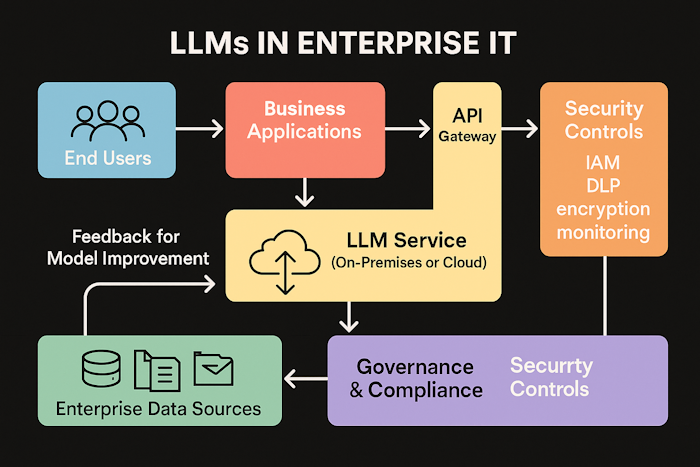
The Enterprise LLM Revolution
The integration of Large Language Models (LLMs) into enterprise IT environments represents one of the most significant technological shifts of the decade. Organizations across sectors are leveraging these sophisticated AI systems to transform operations, enhance decision-making processes, and create new value streams. LLMs have matured from experimental implementations to mission-critical deployments that drive business outcomes. This evolution brings both tremendous opportunities and complex challenges, particularly in the realms of implementation architecture, access methodologies, and security governance.
The rapid advancement of LLM capabilities has created a technological inflection point for IT departments worldwide. No longer just research curiosities, these models now form the backbone of numerous enterprise applications—from intelligent knowledge management systems and advanced customer service platforms to sophisticated data analysis tools and automated content generation solutions. Understanding how these systems are built, deployed, accessed, and secured has become essential knowledge for IT leaders navigating this new landscape.
The Architecture and Construction of Enterprise LLMs
Foundational Architecture
At their core, Large Language Models are built upon transformer architecture—a neural network design that revolutionized natural language processing through its attention mechanisms. These mechanisms allow the model to weigh the importance of different words in relation to each other, enabling a deeper understanding of context and meaning. Enterprise LLMs typically consist of billions of parameters organized in multiple layers that process and generate text through complex mathematical operations.
The scale of these models varies significantly based on their intended application. While general-purpose models like GPT-4 or Claude 3 contain hundreds of billions of parameters, specialized enterprise implementations may utilize smaller, more focused models with parameters in the range of 1-20 billion. These specialized models trade some versatility for increased efficiency, reduced computational requirements, and domain-specific expertise.
Training Methodologies
The development of enterprise-grade LLMs follows a multi-stage process that begins with pre-training on vast corpora of text data. This initial phase establishes the model's foundational understanding of language patterns, semantic relationships, and general knowledge. For enterprise deployments, this pre-training is increasingly supplemented with domain-specific data that aligns with the organization's particular industry, terminology, and use cases.
Following pre-training, models undergo fine-tuning—a process that adapts the general capabilities of the model to specific tasks or domains. Enterprise implementations typically employ several fine-tuning approaches:
Supervised Fine-Tuning (SFT) uses labeled examples to teach the model specific response patterns and domain knowledge. This approach is particularly valuable for aligning the model with enterprise terminology, policies, and procedures.
Reinforcement Learning from Human Feedback (RLHF) incorporates human evaluations to refine model outputs, making them more helpful, accurate, and aligned with organizational values and objectives.
Parameter-Efficient Fine-Tuning (PEFT) techniques like LoRA (Low-Rank Adaptation) allow organizations to customize models with minimal computational resources by adjusting only a small subset of parameters rather than the entire model.
Deployment Architectures
Enterprise LLM deployments typically follow one of several architectural patterns, each with distinct characteristics suited to different organizational needs:
Retrieval-Augmented Generation (RAG) has emerged as the dominant architecture for enterprise implementations. This approach combines the generative capabilities of LLMs with information retrieval systems that access enterprise knowledge bases, documentation, and databases. By grounding LLM responses in verified organizational data, RAG systems significantly reduce hallucinations (fabricated information) while ensuring outputs reflect current and accurate enterprise knowledge. The RAG architecture typically includes components for document processing, chunking, embedding generation, vector storage, and retrieval orchestration.
Fine-tuned Models represent another common approach where pre-trained models undergo additional training on enterprise-specific datasets. This creates specialized models that inherently understand organizational context without needing to retrieve it at runtime. While more computationally intensive to develop, these models can deliver more consistent performance for specific use cases.
Hybrid Architectures combine multiple approaches, often implementing a chain of specialized models that handle different aspects of processing. For example, a system might use one model for understanding user intent, another for retrieving relevant information, and a third for generating the final response. This modular approach allows organizations to optimize each component independently.
Integration Methods and Access Patterns
Deployment Models
Enterprises have several options for deploying LLMs, each with distinct implications for control, cost, and compliance:
Cloud-based API Services represent the most straightforward deployment method, where organizations access models hosted by providers like OpenAI, Anthropic, or cloud platforms such as AWS, Google Cloud, or Azure. This approach minimizes infrastructure requirements and maintenance overhead but introduces dependencies on external providers and potential data privacy concerns.
Self-hosted Deployments involve running LLM infrastructure within the organization's own environment, either on-premises or in private cloud instances. This approach provides maximum control over data and model behavior but requires significant technical expertise and computational resources. Organizations pursuing this path typically leverage open-source models like Llama 3, Mistral, or Falcon, which can be deployed on specialized hardware or containerized environments.
Hybrid Deployments combine both approaches, using cloud APIs for general capabilities while maintaining self-hosted models for sensitive or specialized functions. This balanced approach allows organizations to leverage the strengths of both models while mitigating their respective limitations.
Integration Patterns
Integrating LLMs into existing enterprise systems follows several established patterns:
API Integration represents the most common approach, where applications communicate with LLM services through standardized REST or GraphQL interfaces. This pattern enables straightforward incorporation into existing systems with minimal architectural changes. Organizations typically implement middleware layers that handle authentication, rate limiting, prompt construction, and response processing.
Containerized Deployments package LLMs and their dependencies into standardized containers that can be deployed across various environments. This approach provides consistency across development, testing, and production while enabling horizontal scaling to meet demand fluctuations.
Serverless Functions allow organizations to deploy LLM capabilities without managing underlying infrastructure. This event-driven approach is particularly effective for intermittent workloads, automatically scaling resources based on demand and reducing costs during periods of inactivity.
Embedded Models represent an emerging pattern where smaller, specialized LLMs are integrated directly into applications. While limited in capabilities compared to their larger counterparts, these models enable offline operation and reduced latency for specific functions.
Access Methods
Enterprise users interact with LLM systems through various interfaces tailored to different use cases:
Conversational Interfaces provide natural language interaction through chatbots, virtual assistants, or dedicated applications. These interfaces are particularly effective for knowledge workers seeking information or assistance with complex tasks.
Application Plugins embed LLM capabilities directly into existing productivity tools like Microsoft Office, Slack, or enterprise CRM systems. This integration pattern minimizes workflow disruption by bringing AI capabilities to environments where users already work.
Programmatic Access enables developers to incorporate LLM capabilities into custom applications through SDKs, libraries, or direct API calls. This approach supports the creation of specialized tools tailored to specific business processes or requirements.
Orchestration Platforms provide centralized management of LLM resources, enabling administrators to control access, monitor usage, and enforce governance policies across the organization. These platforms typically include features for prompt management, model selection, and output filtering.
Security Challenges and Threat Landscape
Emerging Threat Vectors
The integration of LLMs into enterprise environments introduces novel security challenges that extend beyond traditional cybersecurity concerns:
Prompt Injection attacks represent one of the most significant threats to LLM deployments. These attacks involve crafting inputs that manipulate the model into ignoring established guardrails or performing unauthorized actions. Direct prompt injections attempt to override system instructions with conflicting commands, while indirect injections hide malicious instructions within seemingly innocuous content. The sophistication of these attacks continues to evolve, with adversaries developing techniques to bypass common defenses.
Data Extraction vulnerabilities arise from the model's access to sensitive information during training or operation. Adversaries may craft queries designed to extract confidential data, proprietary information, or personal details from the model's parameters or knowledge base. This risk is particularly acute in RAG implementations where models have access to enterprise document repositories.
Model Poisoning occurs when adversaries manipulate training data or fine-tuning processes to introduce backdoors or biases into the model. These compromised models may function normally in most scenarios but exhibit malicious behavior under specific conditions or when processing particular triggers.
Supply Chain Risks emerge from dependencies on external model providers, training data sources, or component libraries. Organizations must consider the security implications of these dependencies, particularly when models or data originate from regions with different regulatory or geopolitical considerations.
Privacy and Compliance Implications
LLM deployments introduce complex privacy and compliance challenges that organizations must address:
Data Privacy concerns arise from the model's potential access to personal or sensitive information. Organizations must implement robust controls to prevent unauthorized processing or disclosure of protected data, particularly in jurisdictions with stringent privacy regulations like GDPR, CCPA, or industry-specific frameworks.
Intellectual Property Protection becomes critical when models process proprietary information or generate content based on confidential data. Organizations must establish clear boundaries regarding ownership of model-generated outputs and implement controls to prevent unauthorized use of protected materials.
Regulatory Compliance requirements vary significantly across industries and regions, with financial services, healthcare, and government sectors facing particularly stringent oversight. Organizations must navigate complex regulatory landscapes that may include requirements for explainability, bias mitigation, and audit trails.
Cross-border Data Transfers introduce additional complexity, particularly for multinational organizations operating across jurisdictions with different data sovereignty requirements. LLM deployments must account for restrictions on where data can be processed and stored, potentially necessitating region-specific model deployments.
Security Best Practices
Addressing the unique security challenges of enterprise LLM deployments requires a comprehensive approach:
Defense-in-Depth Strategies implement multiple layers of protection rather than relying on any single security control. This approach combines input validation, output filtering, access controls, and monitoring to create a robust security posture.
Prompt Engineering Guidelines establish standards for constructing system prompts that resist injection attacks. These guidelines typically include techniques for clear instruction boundaries, explicit authorization models, and input sanitization.
Content Filtering Systems analyze both inputs and outputs to identify and block potentially harmful content. These systems typically employ specialized models trained to recognize sensitive information, malicious instructions, or inappropriate content.
Least Privilege Access ensures that LLM systems have access only to the information and systems necessary for their intended function. This principle applies both to the model's access to enterprise data and to users' access to LLM capabilities.
Continuous Monitoring and Auditing provide visibility into LLM usage patterns and potential security events. Organizations should implement logging for all interactions, with particular attention to unusual query patterns, rejected requests, and access to sensitive information.
Implementation Strategies for Enterprise Adoption
Governance Frameworks
Successful enterprise LLM implementations require robust governance structures that address both technical and organizational considerations:
Cross-functional Oversight brings together stakeholders from IT, security, legal, compliance, and business units to establish policies and procedures for LLM deployments. This collaborative approach ensures that implementations address the full spectrum of organizational requirements and constraints.
Risk Assessment Methodologies provide structured approaches for evaluating the potential impacts of LLM deployments on security, privacy, and compliance postures. These assessments should consider both the inherent risks of the technology and the specific context of each implementation.
Model Lifecycle Management establishes processes for the selection, deployment, monitoring, and retirement of LLM systems. This framework should include procedures for evaluating model performance, addressing security vulnerabilities, and managing the transition between model versions.
Operational Considerations
Beyond technical implementation, organizations must address operational aspects of LLM deployments:
Cost Management becomes critical as LLM usage scales across the enterprise. Organizations should implement monitoring and controls to track usage patterns, optimize prompt efficiency, and allocate costs to appropriate business units.
Performance Optimization balances response quality against computational requirements and latency. Techniques such as model quantization, caching, and request batching can significantly improve efficiency without compromising effectiveness.
Scalability Planning ensures that LLM infrastructure can accommodate growing demand and evolving use cases. This planning should consider both vertical scaling (more powerful resources) and horizontal scaling (distributed processing) approaches.
Future-Proofing Implementations
The rapidly evolving nature of LLM technology requires organizations to design implementations with adaptability in mind:
Model-Agnostic Architectures decouple applications from specific LLM implementations, enabling organizations to switch between models or providers as capabilities and requirements evolve. This approach typically involves abstraction layers that standardize interactions across different model types.
Continuous Evaluation Frameworks assess model performance against established benchmarks, identifying opportunities for improvement or replacement. These frameworks should consider both technical metrics like accuracy and latency as well as business outcomes and user satisfaction.
Emerging Standards Alignment ensures that implementations remain compatible with evolving industry standards for LLM interoperability, security, and governance. Organizations should monitor developments in standards bodies and adjust implementations accordingly.
Navigating the Enterprise LLM Landscape
The integration of Large Language Models into enterprise IT environments represents both a significant opportunity and a complex challenge. Organizations that successfully navigate this landscape can unlock unprecedented capabilities for knowledge management, process automation, and decision support. However, realizing these benefits requires thoughtful consideration of architectural choices, integration patterns, and security implications.
As the technology continues to evolve, organizations must develop flexible, secure, and governance-driven approaches to LLM deployment. By establishing robust frameworks for implementation, access, and security, enterprises can harness the transformative potential of these models while mitigating their inherent risks. The most successful implementations will balance innovation with responsibility, leveraging these powerful tools to create value while maintaining alignment with organizational values and compliance requirements.
The journey toward enterprise LLM adoption is not merely a technical challenge but a strategic imperative that touches every aspect of the organization. By approaching this journey with clear-eyed recognition of both opportunities and challenges, organizations can position themselves at the forefront of this technological revolution while ensuring that their implementations remain secure, compliant, and aligned with business objectives.
Key Points
-
Enterprise LLM deployments require thoughtful architectural decisions, with Retrieval-Augmented Generation (RAG) emerging as the dominant pattern for ensuring accurate, contextually relevant responses.
-
Organizations can choose between cloud-based API services, self-hosted deployments, or hybrid approaches based on their specific requirements for control, cost, and compliance.
-
The security landscape for LLMs includes novel threats like prompt injection, data extraction, and model poisoning that require specialized defenses beyond traditional cybersecurity measures.
-
Successful implementations require robust governance frameworks that address technical, operational, and compliance considerations across the entire model lifecycle.
-
Future-proof deployments should maintain flexibility through model-agnostic architectures and continuous evaluation frameworks that adapt to evolving capabilities and requirements.
