Smart Grids: Technical Analysis of Advanced Cyber Attack Vectors

The Vulnerable Backbone of Modern Energy Infrastructure
The evolution of traditional power grids into smart grids represents one of the most significant technological transformations in critical infrastructure. While smart grids offer unprecedented efficiency, flexibility, and integration capabilities for renewable energy sources, they simultaneously introduce complex cybersecurity challenges that threaten the very foundation of our energy security. This technical analysis explores the sophisticated attack vectors targeting smart grid infrastructure, examining real-world incidents, technical methodologies, and the strategic objectives behind such attacks.
Smart grids integrate advanced digital communications, automated control systems, and distributed intelligence to create a more resilient and efficient power delivery system. However, this increased connectivity and digitalization creates an expanded attack surface that malicious actors—from nation-states to criminal organizations—actively exploit. Understanding these vulnerabilities is crucial for developing robust defense mechanisms to protect our increasingly interconnected energy infrastructure.
Smart Grid Architecture: Understanding the Attack Surface
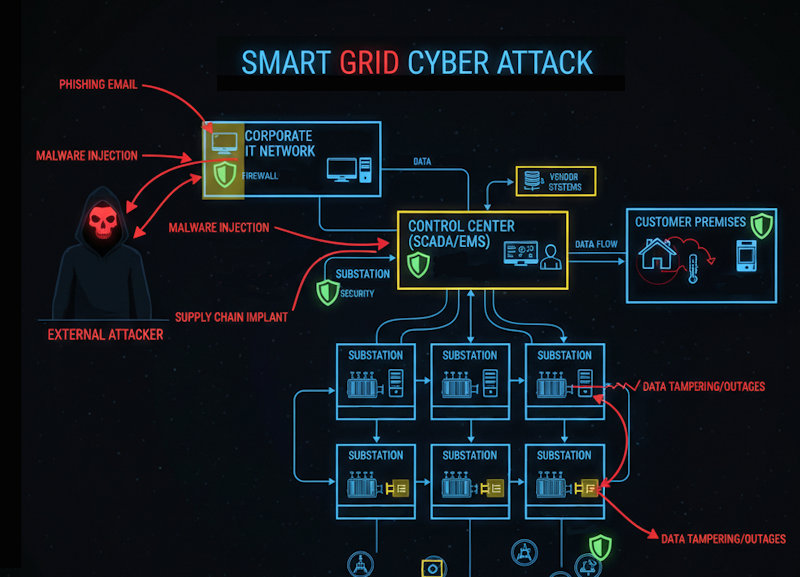
To comprehend the technical aspects of smart grid attacks, we must first understand the layered architecture that presents multiple entry points for malicious actors. Smart grid infrastructure typically consists of several interconnected layers:
Generation Layer
The generation layer encompasses power plants, renewable energy sources, and distributed generation systems. Attack vectors at this layer include compromising control systems to manipulate power output, targeting SCADA systems to disrupt operations, and exploiting vulnerabilities in Industrial Control Systems (ICS). Attackers targeting this layer aim to cause immediate disruption to power generation capabilities, potentially triggering cascading failures throughout the grid.
Transmission Layer
The high-voltage transmission network that transports electricity over long distances relies heavily on automated systems for load balancing and fault detection. Vulnerabilities in this layer include Remote Terminal Units (RTUs), Phasor Measurement Units (PMUs), and substation automation systems. Sophisticated attackers can manipulate transmission parameters to cause physical damage to expensive, difficult-to-replace equipment such as Large Power Transformers (LPTs).
Distribution Layer
The distribution layer delivers electricity to end consumers and incorporates numerous digital components including smart meters, distribution automation systems, and Advanced Metering Infrastructure (AMI). This layer presents a particularly attractive target due to its extensive connectivity and proximity to end users. Compromising this layer allows attackers to manipulate billing data, disrupt service to specific areas, or use compromised devices as entry points to more critical systems.
Communication and Control Layer
The nervous system of the smart grid, this layer encompasses the networks, protocols, and control systems that enable real-time monitoring and management. It includes Energy Management Systems (EMS), Distribution Management Systems (DMS), and various communication protocols (DNP3, Modbus, IEC 61850). This layer represents a prime target for sophisticated attackers seeking to gain persistent access and control over grid operations.
Technical Analysis of Smart Grid Attack Methodologies
Smart grid attacks employ diverse technical approaches, each targeting specific vulnerabilities within the infrastructure. The following analysis examines the most sophisticated attack methodologies observed in both real-world incidents and security research.
False Data Injection Attacks (FDIA)
False Data Injection Attacks represent one of the most technically sophisticated threats to smart grid infrastructure. These attacks manipulate the state estimation process by introducing falsified measurement data that appears legitimate to detection systems.
Technical Implementation:
-
Reconnaissance Phase: Attackers first gather detailed information about the grid topology, measurement points, and state estimation algorithms through passive monitoring or compromised access.
-
Mathematical Modeling: Using knowledge of the grid's physical model and state estimation algorithms, attackers construct mathematically sound false measurements that will bypass bad data detection mechanisms.
-
Injection Vectors: Carefully crafted data is injected into the system through compromised sensors, communication channels, or control systems. The injected data is designed to remain within expected parameters while subtly altering the perceived state of the grid.
-
Impact Amplification: By targeting multiple measurement points simultaneously with coordinated false data, attackers can create a significantly distorted view of grid conditions while remaining undetected.
The technical sophistication of FDIAs makes them particularly dangerous, as they can manipulate grid operators into taking harmful actions based on falsified information. For example, operators might unnecessarily shed load in response to a falsely indicated overload condition, or fail to respond to actual emergencies masked by manipulated data.
Man-in-the-Middle (MITM) Attacks
MITM attacks intercept and potentially alter communications between grid components, enabling attackers to manipulate control commands, measurement values, and pricing signals without detection.
Technical Implementation:
-
Network Infiltration: Attackers gain access to communication networks through compromised network equipment, exploiting unpatched vulnerabilities, or physical access to communication infrastructure.
-
Traffic Interception: Using techniques such as ARP spoofing, DNS poisoning, or SSL stripping, attackers position themselves between communicating entities to intercept traffic.
-
Protocol Exploitation: Many legacy grid protocols (Modbus, DNP3) lack built-in authentication and encryption, making them particularly vulnerable to interception and manipulation.
-
Command Modification: Once positioned, attackers can selectively modify control commands (e.g., changing a "close breaker" command to "open breaker") or alter measurement data to trigger undesired automated responses.
MITM attacks are particularly effective against smart grid components that rely on wireless communications or insecure protocols. For instance, attackers can intercept communications between smart meters and collection points to manipulate consumption data or billing information.
Firmware and Supply Chain Attacks
These sophisticated attacks target the fundamental software that controls smart grid devices, potentially creating persistent backdoors and compromising equipment functionality at scale.
Technical Implementation:
-
Firmware Analysis: Attackers reverse-engineer device firmware to identify vulnerabilities, authentication mechanisms, and update procedures.
-
Malicious Modifications: Custom malware is developed to target specific firmware components, often incorporating sophisticated techniques to evade detection.
-
Deployment Vectors: Modified firmware is deployed through compromised update servers, physical access during manufacturing or maintenance, or by exploiting remote update mechanisms.
-
Persistence Mechanisms: Advanced firmware implants establish persistent access that survives reboots and standard security measures, often hiding in rarely examined portions of device memory.
The 2015 Ukrainian power grid attack demonstrated the effectiveness of firmware attacks when attackers deployed custom malware to overwrite firmware on serial-to-Ethernet converters, rendering them permanently inoperable and complicating recovery efforts.
Distributed Denial of Service (DDoS) Attacks
DDoS attacks target the availability of critical smart grid systems by overwhelming them with traffic or connection requests, preventing legitimate communications and potentially disrupting grid operations.
Technical Implementation:
-
Botnet Deployment: Attackers assemble networks of compromised devices (often IoT devices with poor security) to generate massive traffic volumes.
-
Amplification Techniques: Using protocols like NTP, DNS, or SNMP that can be exploited to multiply traffic volume, attackers generate overwhelming traffic with relatively limited resources.
-
Protocol Exploitation: Smart grid protocols often have limited bandwidth and processing capabilities, making them particularly vulnerable to even moderate-scale DDoS attacks.
-
Strategic Timing: DDoS attacks are frequently launched as diversionary tactics during critical periods or in conjunction with other attack vectors to maximize impact and complicate response.
During the Ukrainian power grid attack, attackers launched a telephone DDoS attack against the utility's call center, preventing customers from reporting outages and complicating the utility's situational awareness during the incident.
Case Study: The Ukrainian Power Grid Attack
The December 2015 attack on Ukrainian power distribution companies represents one of the most sophisticated and well-documented attacks on energy infrastructure. This incident provides invaluable insights into the technical methods employed in advanced smart grid attacks.
Attack Timeline and Technical Details
The attack unfolded in three distinct phases over approximately eight months:
Phase 1: Initial Compromise (Spring 2015)
The attack began with a spear-phishing campaign targeting employees of Ukrainian power distribution companies. The emails contained Microsoft Office attachments with malicious macros that, when executed, installed the BlackEnergy3 malware. This initial compromise provided attackers with a foothold in the corporate IT networks.
Phase 2: Reconnaissance and Lateral Movement (Summer-Fall 2015)
Over several months, attackers conducted extensive reconnaissance of the compromised networks, identifying critical systems and mapping pathways to operational technology (OT) networks. They established persistent access through custom backdoors and harvested credentials that would later enable direct access to SCADA systems. The attackers demonstrated sophisticated knowledge of industrial control systems, specifically targeting workstations running HMI software used to control circuit breakers.
Phase 3: Coordinated Attack Execution (December 23, 2015)
The final phase demonstrated remarkable coordination and technical sophistication:
-
Remote Control of HMI Systems: Attackers used legitimate remote access tools to connect to operator workstations and manually opened circuit breakers at more than 30 substations, directly cutting power to consumers.
-
Credential Theft and Modification: System passwords were changed to prevent operators from regaining control of compromised systems.
-
Firmware Attacks: Custom malware was deployed to overwrite firmware on serial-to-Ethernet converters, rendering them permanently inoperable and significantly complicating recovery efforts.
-
Wiper Malware Deployment: KillDisk malware was executed on targeted systems to erase master boot records and destroy forensic evidence.
-
Telephone Denial of Service: A coordinated DDoS attack targeted the utilities' call centers, preventing customers from reporting outages and complicating the utilities' situational awareness.
-
UPS Sabotage: Uninterruptible power supplies at control centers were remotely disabled, ensuring that control systems would lose power during the outage.
The attack affected approximately 230,000 customers for up to 6 hours. Recovery was only possible because operators were able to manually operate circuit breakers at affected substations—a capability that may not exist in more automated grid environments.
Technical Lessons from the Ukrainian Attack
Analysis of the Ukrainian incident reveals several critical insights:
-
Attack Sophistication: The attackers demonstrated deep knowledge of industrial control systems, grid operations, and cybersecurity principles, suggesting nation-state capabilities.
-
Multi-Vector Approach: The attack combined multiple techniques (phishing, credential theft, firmware attacks, DDoS) to maximize effectiveness and complicate response.
-
Long-Term Planning: The extended reconnaissance phase (approximately 6 months) allowed attackers to develop a comprehensive understanding of target systems before executing the attack.
-
Human-in-the-Loop Execution: Rather than fully automated malware, attackers manually executed key attack components, demonstrating the importance of human expertise in sophisticated operations.
-
Recovery Obstruction: Specific techniques (firmware destruction, credential changes) were employed specifically to complicate recovery efforts, extending the attack's impact.
Strategic Objectives of Smart Grid Attacks
Understanding the strategic objectives behind smart grid attacks provides context for the technical methodologies employed. These objectives typically fall into several categories:
Immediate Disruption and Damage
Some attacks aim to cause immediate, visible disruption to power delivery. These attacks typically target control systems to force outages, potentially causing cascading failures across interconnected grid segments. The Ukrainian power grid attack exemplifies this objective, with attackers directly manipulating breaker controls to cut power to consumers.
Long-Term Persistent Access
More sophisticated attackers may prioritize establishing persistent, undetected access to grid systems over immediate disruption. This approach enables ongoing intelligence gathering, positions attackers for future operations, and potentially provides leverage during geopolitical conflicts. Advanced Persistent Threats (APTs) like Dragonfly/Energetic Bear have focused on establishing long-term access to energy sector networks.
Economic and Market Manipulation
By manipulating grid data or operations, attackers can potentially influence energy markets for financial gain. For example, false data injection attacks could manipulate perceived grid conditions to affect spot market prices or trigger unnecessary emergency responses that benefit specific market participants.
Physical Infrastructure Damage
The most sophisticated attacks aim to cause physical damage to critical grid components that are expensive and time-consuming to replace. The Stuxnet attack on Iranian nuclear facilities demonstrated how cyber attacks can cause physical damage to industrial equipment. In grid contexts, similar approaches could target critical transformers or generators by manipulating protection systems or operating parameters.
Technical Countermeasures and Defense Strategies
Defending smart grid infrastructure requires a multi-layered approach that addresses the diverse attack vectors and methodologies employed by sophisticated adversaries.
Advanced Anomaly Detection
Modern defense systems employ machine learning and artificial intelligence to identify subtle anomalies in grid operations that may indicate an attack in progress. These systems analyze multiple data streams—network traffic, control commands, sensor readings—to detect deviations from normal patterns that might evade traditional rule-based detection.
Secure-by-Design Architecture
Implementing security at the architectural level significantly reduces the attack surface. Key principles include:
-
Network Segmentation: Strictly controlling communication between IT and OT networks, and between different operational zones within the grid.
-
Defense-in-Depth: Deploying multiple, overlapping security controls so that the failure of any single measure doesn't compromise the entire system.
-
Least Privilege Access: Limiting system access to the minimum required for each user or component to perform its function.
-
Secure Authentication: Implementing multi-factor authentication for all access to critical systems, particularly for remote connections.
Cryptographic Protection
Cryptographic measures protect both data at rest and in transit:
-
Secure Communications: Implementing end-to-end encryption for all grid communications, particularly for critical control commands.
-
Digital Signatures: Using cryptographic signatures to verify the authenticity and integrity of firmware updates, configuration changes, and control commands.
-
Secure Key Management: Implementing robust key management systems to protect cryptographic keys throughout their lifecycle.
Resilient System Design
Beyond preventing attacks, modern smart grids must be designed to maintain essential functions even when compromised:
-
Fail-Safe Mechanisms: Designing systems to default to safe states when anomalies are detected or communications are lost.
-
Manual Overrides: Maintaining capabilities for manual operation of critical components when automated systems are compromised.
-
Rapid Recovery Capabilities: Implementing secure backup systems and recovery procedures to minimize outage duration following successful attacks.
The Evolving Threat Landscape
The technical sophistication of attacks targeting smart grid infrastructure continues to evolve, driven by geopolitical tensions, criminal profit motives, and the increasing digitalization of energy systems. The Ukrainian power grid attack demonstrated that sophisticated adversaries possess both the capability and intent to disrupt critical energy infrastructure through cyber means.
As smart grids become more interconnected and automated, the potential impact of successful attacks grows correspondingly. The integration of distributed energy resources, electric vehicles, and demand response systems creates new attack surfaces and potential cascading failure modes that must be addressed through comprehensive security strategies.
Defending against these evolving threats requires continuous innovation in security technologies, close collaboration between public and private stakeholders, and a commitment to security as a fundamental design principle rather than an afterthought. By understanding the technical methodologies employed in smart grid attacks, security professionals can develop more effective countermeasures and build more resilient energy infrastructure for the future.
The security of our smart grid infrastructure is not merely a technical challenge but a critical national security imperative. As we continue to modernize our energy systems, we must ensure that cybersecurity evolves in parallel with operational capabilities to protect this essential foundation of modern society.
