CNAPP: Transforming Cloud-Native Security for the Connected Enterprise

The Evolving Security Landscape
In today's hyperconnected digital ecosystem, organizations are rapidly embracing cloud-native architectures to drive innovation, scalability, and operational efficiency. This transformation has fundamentally altered the security landscape, creating complex challenges that traditional security approaches struggle to address effectively. As enterprises deploy increasingly sophisticated applications across distributed environments—spanning public clouds, private infrastructure, edge computing, and IoT devices—security teams face unprecedented complexity in protecting these dynamic, interconnected systems.
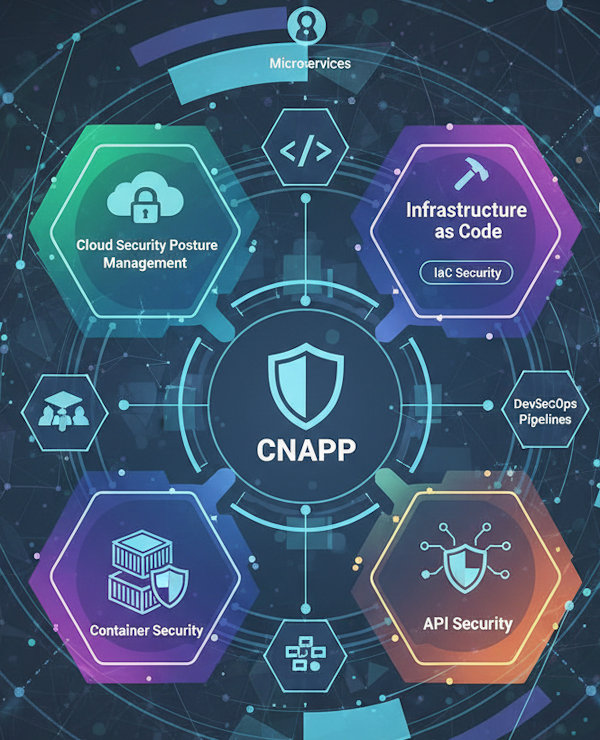
Cloud-Native Application Protection Platforms (CNAPPs) have emerged as a revolutionary approach to securing modern applications throughout their entire lifecycle. Unlike conventional security tools that focus on specific aspects of protection, CNAPPs provide a unified, integrated framework that consolidates multiple security functions into a cohesive platform. This comprehensive approach is particularly critical as organizations navigate the complexities of securing not just cloud workloads, but also the expanding universe of connected devices and operational technology that form the backbone of today's digital enterprises.
As we progress through 2025, CNAPP technology has established itself as an essential component of forward-thinking security strategies, offering integrated protection that spans from development to deployment and runtime environments. This article explores the fundamental capabilities, implementation considerations, and strategic value of CNAPPs in securing the modern enterprise, with particular attention to their role in protecting IoT and industrial environments.
Understanding CNAPP: Core Capabilities and Components
A Cloud-Native Application Protection Platform represents the convergence of previously siloed security tools into a unified solution designed to protect applications throughout their lifecycle. First coined by Gartner in 2021, the term CNAPP encompasses a comprehensive set of capabilities that address the unique security challenges of cloud-native environments.
Foundational Components of CNAPP Solutions
Modern CNAPP solutions integrate several critical security functions:
Cloud Security Posture Management (CSPM) forms the foundation of CNAPP capabilities, providing continuous monitoring of cloud infrastructure configurations against security best practices and compliance frameworks. This component automatically identifies misconfigurations, compliance gaps, and potential vulnerabilities across multi-cloud environments, enabling organizations to maintain a strong security posture even as their cloud footprint evolves. Advanced CSPM capabilities include automated remediation workflows that can correct misconfigurations before they lead to security incidents.
Cloud Workload Protection (CWP) extends security to the workload level, safeguarding containers, virtual machines, and serverless functions throughout their operational lifecycle. This component provides runtime protection through behavioral monitoring, vulnerability management, and threat detection capabilities specifically designed for cloud-native workloads. By implementing micro-segmentation and just-in-time access controls, CWP limits lateral movement in case of a breach, containing potential damage and preventing attackers from escalating privileges.
Cloud Infrastructure Entitlement Management (CIEM) addresses the complex challenge of managing identities and permissions across distributed cloud environments. This capability discovers and visualizes identity relationships, detects excessive permissions, and enforces least privilege principles to minimize the risk of privilege escalation and unauthorized access. By continuously monitoring identity-related activities and automatically remediating risky permissions, CIEM helps organizations maintain a strong security posture even as their cloud environments grow in complexity.
Data Security Posture Management (DSPM) focuses on protecting sensitive data across cloud environments through discovery, classification, and monitoring of data access patterns. This component enforces data protection policies and ensures compliance with privacy regulations such as GDPR, CCPA, and industry-specific requirements. By providing visibility into where sensitive data resides and how it's being accessed, DSPM helps organizations prevent data breaches and maintain regulatory compliance.
Advanced CNAPP Capabilities
Beyond these foundational components, modern CNAPP solutions offer advanced capabilities that address emerging security challenges:
DevSecOps Integration enables security to shift left in the development process, embedding security controls directly into CI/CD pipelines. This integration allows for automated security testing during development, providing developers with immediate feedback on potential vulnerabilities and compliance issues. By implementing policy-as-code approaches, organizations can ensure consistent security enforcement across environments while maintaining development velocity.
API Security has become increasingly critical as applications rely more heavily on APIs for communication between services. CNAPP solutions provide API discovery, monitoring, and protection capabilities that identify vulnerable or misconfigured APIs, detect abnormal access patterns, and prevent API-based attacks. This protection extends across internal, partner, and public-facing APIs, ensuring comprehensive coverage of this expanding attack surface.
Container Security addresses the unique challenges of securing containerized applications by providing image scanning, runtime protection, and compliance enforcement specifically designed for container environments. This capability ensures that container images are free from vulnerabilities and malware, while also monitoring container behavior during runtime to detect and respond to potential threats.
Serverless Security protects increasingly popular serverless functions by analyzing function configurations, monitoring runtime behavior, and enforcing security policies specifically designed for this architecture. This component addresses the unique challenges of securing ephemeral compute resources that may only exist for seconds or minutes at a time.
CNAPP Implementation: Strategic Considerations and Best Practices
Implementing a CNAPP solution requires careful planning and consideration of organizational needs, existing security infrastructure, and strategic objectives. The following framework provides guidance for organizations embarking on their CNAPP journey.
Assessing Organizational Readiness
Before implementing a CNAPP solution, organizations should conduct a comprehensive assessment of their current security posture and cloud environment. This assessment should include:
Cloud Asset Inventory: Develop a detailed inventory of all cloud environments, workloads, applications, and connected devices. This inventory should capture not only traditional cloud resources but also edge computing nodes, IoT devices, and operational technology that interfaces with cloud systems. Understanding the full scope of your digital footprint is essential for effective CNAPP implementation.
Security Requirements Mapping: Identify specific security requirements based on compliance obligations, risk tolerance, and business objectives. This mapping should consider industry-specific regulations, contractual obligations, and internal security policies that govern how data and applications must be protected across environments.
Current Security Tool Evaluation: Assess existing security tools and identify gaps that a CNAPP solution could address. This evaluation should consider not only the capabilities of current tools but also their integration points, operational overhead, and effectiveness in addressing cloud-native security challenges. Understanding these gaps will help prioritize CNAPP capabilities during implementation.
Success Metrics Definition: Establish clear metrics for measuring the success of CNAPP implementation, including both technical metrics (e.g., reduction in misconfigurations, time to remediate vulnerabilities) and business outcomes (e.g., improved compliance posture, reduced security incidents). These metrics should align with organizational objectives and provide a framework for evaluating the return on investment from CNAPP implementation.
Implementation Approaches and Considerations
Organizations typically follow one of several implementation approaches when deploying CNAPP solutions:
Phased Implementation involves deploying CNAPP capabilities incrementally, starting with foundational components like CSPM before progressing to more advanced capabilities. This approach allows organizations to build expertise gradually, demonstrate value early, and refine their implementation strategy based on initial results. A typical phased approach might begin with cloud posture management, then add workload protection, followed by identity management and DevSecOps integration.
Use Case-Driven Implementation focuses on addressing specific security challenges or use cases, such as securing containerized applications, protecting sensitive data, or implementing Zero Trust access controls. This approach aligns CNAPP implementation with immediate business needs and can deliver targeted value quickly. Organizations often prioritize use cases based on risk assessment, compliance requirements, or strategic initiatives.
Environment-Based Implementation deploys CNAPP capabilities across different environments sequentially, starting with non-production environments before moving to production. This approach minimizes disruption to critical systems and allows security teams to refine policies and processes before applying them to sensitive production workloads. It also provides an opportunity to train development and operations teams on new security tools and processes in lower-risk environments.
Integration with Existing Security Infrastructure
Effective CNAPP implementation requires thoughtful integration with existing security infrastructure and processes:
Security Information and Event Management (SIEM) Integration enables centralized visibility and correlation of security events across environments. By feeding CNAPP telemetry into SIEM platforms, organizations can correlate cloud security events with other security data, enabling more comprehensive threat detection and investigation. This integration also supports compliance reporting and security analytics across the enterprise.
Security Orchestration, Automation, and Response (SOAR) Integration enhances incident response capabilities by automating remediation workflows and orchestrating response actions across security tools. This integration enables security teams to respond more quickly to threats and reduce the manual effort required to maintain security posture. By automating routine tasks, security teams can focus on more complex security challenges that require human expertise.
Identity and Access Management (IAM) Integration ensures consistent identity governance across environments and enables unified access controls based on Zero Trust principles. This integration is particularly important for implementing least privilege access and just-in-time privilege elevation across cloud environments. By centralizing identity management, organizations can reduce the risk of credential compromise and unauthorized access.
DevOps Toolchain Integration embeds security into development workflows, enabling automated security testing, policy enforcement, and vulnerability management throughout the development lifecycle. This integration supports the shift-left approach to security, catching and remediating security issues earlier in the development process when they are less costly to address. It also promotes collaboration between security and development teams, fostering a shared responsibility for application security.
CNAPP for IoT and Industrial Environments: Extending Cloud-Native Security
As organizations deploy increasingly connected systems that span from cloud to edge, CNAPP solutions are evolving to address the unique security challenges of IoT and industrial environments. This extension of cloud-native security principles to operational technology represents a significant advancement in protecting critical infrastructure and connected devices.
Securing the IoT-Cloud Continuum
Modern enterprises operate across a continuum that spans from cloud infrastructure to edge computing nodes and IoT devices. CNAPP solutions are expanding to provide unified security across this continuum through several key capabilities:
Edge Workload Protection extends cloud-native security principles to edge computing environments, providing runtime protection, vulnerability management, and compliance enforcement for workloads running at the edge. This capability is particularly important for applications that process sensitive data at the edge to reduce latency or bandwidth requirements. By implementing consistent security controls across cloud and edge environments, organizations can maintain a strong security posture even as their applications span multiple deployment models.
IoT Device Security Integration enables CNAPP solutions to discover, monitor, and protect IoT devices that connect to cloud services. This integration provides visibility into device behavior, enforces security policies for device-to-cloud communication, and detects potential compromises of connected devices. By extending security visibility to include IoT devices, organizations can identify and mitigate risks that might otherwise remain hidden from traditional cloud security tools.
API-Centric Security for IoT addresses the critical role that APIs play in connecting IoT devices to cloud services. CNAPP solutions provide API discovery, monitoring, and protection capabilities specifically designed for IoT scenarios, ensuring that device-to-cloud communication remains secure even as the number and variety of connected devices increase. This protection includes authentication enforcement, rate limiting, and anomaly detection for API traffic from IoT devices.
Industrial Control System (ICS) and Operational Technology (OT) Protection
For organizations operating critical infrastructure or industrial systems, CNAPP solutions are increasingly incorporating capabilities specifically designed for OT environments:
OT Asset Discovery and Visibility provides comprehensive inventory of operational technology assets and their connections to IT systems and cloud services. This visibility is essential for understanding the potential attack surface and implementing appropriate security controls. By maintaining an accurate inventory of OT assets, organizations can identify unauthorized connections and potential security gaps that might expose critical systems to cyber threats.
OT Protocol Support enables CNAPP solutions to understand and monitor industrial protocols such as Modbus, DNP3, and OPC UA, providing visibility into communications between industrial systems and cloud services. This capability allows security teams to detect potential attacks or anomalies in OT-to-cloud communication, even when those communications use specialized industrial protocols rather than standard IT protocols.
OT-Specific Threat Detection incorporates knowledge of industrial systems and their normal behavior patterns to identify potential security incidents. This detection capability considers the unique characteristics of OT environments, such as predictable communication patterns and stable configurations, to identify anomalies that might indicate a security breach. By understanding the context of industrial operations, CNAPP solutions can provide more accurate threat detection with fewer false positives.
Segmentation and Zero Trust for OT/IT Convergence implements strict access controls and micro-segmentation to protect industrial systems from potential threats originating in IT or cloud environments. This capability is particularly important as organizations increasingly connect previously isolated OT systems to cloud services for data analytics, remote monitoring, and operational optimization. By implementing Zero Trust principles at the boundary between IT and OT, organizations can enable these valuable connections while minimizing the associated security risks.
Real-World Implementation Scenario: Smart Manufacturing
To illustrate the practical application of CNAPP in IoT and industrial environments, consider the following implementation scenario for a smart manufacturing organization:
A global manufacturing company is implementing a digital transformation initiative that includes connecting factory equipment to cloud services for predictive maintenance, quality control analytics, and supply chain optimization. This initiative introduces new security challenges as previously isolated operational technology becomes connected to cloud environments.
The organization implements a comprehensive CNAPP solution with the following components:
Cloud Infrastructure Security: The CNAPP solution monitors cloud infrastructure configurations across multiple cloud providers, ensuring that services used for manufacturing analytics and supply chain management maintain a strong security posture. Automated compliance checks verify that cloud resources meet both industry standards and internal security requirements.
Edge Computing Protection: Security controls extend to edge computing nodes deployed in manufacturing facilities, providing runtime protection and vulnerability management for workloads that process sensor data before sending aggregated information to the cloud. This edge protection minimizes the exposure of raw manufacturing data while enabling advanced analytics in the cloud.
IoT Device Security: The CNAPP solution integrates with the organization's IoT device management platform, providing visibility into the security posture of connected sensors and equipment. Security policies enforce strong authentication for device-to-cloud communication and monitor for anomalous behavior that might indicate compromised devices.
OT/IT Segmentation: Micro-segmentation and strict access controls govern the flow of data between operational technology and cloud environments, ensuring that cloud services can access the data they need while preventing unauthorized access to critical industrial systems. This segmentation implements Zero Trust principles, verifying every access request based on identity, context, and risk.
DevSecOps for Industrial Applications: Security is embedded into the development process for applications that interface with manufacturing equipment, ensuring that these applications are secure by design. Automated security testing identifies potential vulnerabilities before applications are deployed to production environments.
Through this implementation, the manufacturing organization achieves comprehensive security across its connected manufacturing environment while enabling the business benefits of cloud-based analytics and optimization. The CNAPP solution provides unified visibility and consistent security controls across cloud, edge, and OT environments, protecting the entire digital manufacturing ecosystem.
Future Trends: The Evolution of CNAPP
As cloud-native architectures continue to evolve and organizations embrace increasingly distributed computing models, CNAPP solutions are adapting to address emerging security challenges and opportunities. Several key trends are shaping the future of CNAPP technology:
AI and Machine Learning Integration
Artificial intelligence and machine learning are transforming CNAPP capabilities in several important ways:
Behavioral Analytics leverages machine learning to establish baseline behavior patterns for applications, users, and devices, enabling more accurate detection of anomalies that might indicate security incidents. This capability is particularly valuable in complex, dynamic environments where traditional rule-based detection approaches struggle to keep pace with legitimate changes in behavior.
Predictive Security uses AI to anticipate potential vulnerabilities and attack vectors before they can be exploited. By analyzing patterns across vast amounts of security telemetry, predictive security capabilities can identify emerging risks and prioritize preventive measures. This proactive approach helps organizations stay ahead of evolving threats rather than merely reacting to known vulnerabilities.
Automated Remediation employs machine learning to determine the most appropriate response to security incidents based on context and potential impact. This capability enables more efficient incident response by automating routine remediation actions while escalating complex issues that require human judgment. As these systems learn from past incidents, they become increasingly effective at resolving security issues with minimal human intervention.
Extended Detection and Response (XDR) Convergence
CNAPP is increasingly converging with Extended Detection and Response (XDR) capabilities to provide unified security across all environments:
Unified Threat Detection spans cloud, on-premises, edge, and IoT environments, providing comprehensive visibility into potential security incidents regardless of where they originate. This unified approach eliminates blind spots that can occur when security monitoring is fragmented across different tools and teams.
Cross-Domain Correlation analyzes security telemetry across endpoints, networks, cloud workloads, and applications to identify sophisticated attacks that might not be apparent when looking at individual security domains in isolation. By connecting seemingly unrelated events across different systems, cross-domain correlation can reveal attack patterns that would otherwise remain hidden.
Coordinated Response orchestrates security actions across multiple security domains, ensuring a consistent and effective response to threats regardless of where they are detected. This coordination is particularly important for addressing attacks that span multiple environments, such as advanced persistent threats that might begin with endpoint compromise before moving to cloud resources.
Zero Trust Architecture Integration
Zero Trust principles are becoming deeply integrated into CNAPP solutions, reflecting the recognition that traditional perimeter-based security is insufficient for protecting modern distributed applications:
Continuous Verification implements the core Zero Trust principle that trust should never be assumed based on network location or initial authentication. Instead, every access request is verified based on identity, device health, behavior patterns, and other contextual factors. This continuous verification ensures that compromised credentials or insider threats are detected even after initial authentication.
Least Privilege Enforcement automatically identifies and removes excessive permissions across cloud environments, implementing the principle of least privilege at scale. This capability is particularly important in cloud environments where permission models are complex and traditional approaches to access management often result in excessive privileges that increase security risk.
Adaptive Access Controls adjust security requirements based on risk assessment, implementing stronger controls for high-risk scenarios while maintaining usability for lower-risk interactions. This risk-based approach balances security and user experience, applying appropriate protections without unnecessarily impeding legitimate business activities.
Supply Chain Security Enhancement
As software supply chain attacks increase in frequency and sophistication, CNAPP solutions are expanding to address this critical attack vector:
Software Composition Analysis identifies vulnerabilities and security risks in third-party dependencies, ensuring that applications don't inherit security flaws from their components. This capability is particularly important as organizations increasingly assemble applications from open-source components and third-party services rather than building everything from scratch.
Container Image Verification ensures that container images used in production environments are from trusted sources and haven't been tampered with. This verification includes checking digital signatures, validating image integrity, and scanning for vulnerabilities before containers are deployed. By verifying container images throughout their lifecycle, organizations can prevent the deployment of compromised containers that might introduce security risks.
Infrastructure-as-Code Security analyzes infrastructure definitions for security issues before they're deployed, shifting security left in the infrastructure lifecycle. This capability ensures that security best practices are enforced consistently across all infrastructure deployments, preventing misconfigurations that could create security vulnerabilities.
Building a Resilient Security Posture with CNAPP
As organizations continue to embrace cloud-native architectures and extend their digital footprint to include edge computing and IoT devices, the need for integrated, automated, and intelligent security solutions becomes increasingly critical. Cloud-Native Application Protection Platforms represent a significant evolution in security technology, offering a unified approach that addresses the unique challenges of securing modern distributed applications.
By implementing a CNAPP solution, organizations can achieve comprehensive visibility, consistent security controls, and automated remediation across their entire digital ecosystem—from cloud infrastructure to edge computing nodes and connected devices. This integrated approach not only improves security posture but also enables the business to innovate faster and more securely, leveraging the full potential of cloud-native technologies without compromising on security.
The journey to implementing CNAPP may be challenging, requiring careful planning, stakeholder engagement, and a phased approach tailored to organizational needs. However, the benefits of a unified, automated, and intelligent security platform make this journey worthwhile. Organizations that embrace CNAPP as a cornerstone of their security strategy will be well-positioned to navigate the complex and ever-changing security landscape, protecting their digital assets while enabling the innovation that drives business success.
As we look to the future, CNAPP solutions will continue to evolve, incorporating advanced AI capabilities, deeper integration with development workflows, and expanded protection for emerging technologies. By staying informed about these trends and continuously adapting their security approach, organizations can maintain a resilient security posture in an increasingly complex digital world.
Summing Up
CNAPP solutions provide integrated protection across the entire application lifecycle, from development to deployment and runtime.
Core CNAPP capabilities include cloud security posture management, workload protection, identity management, and data security, with advanced features for DevSecOps integration and API security.
Implementing CNAPP requires careful assessment of organizational readiness, thoughtful integration with existing security infrastructure, and a phased approach tailored to specific needs.
CNAPP solutions are evolving to address the unique security challenges of IoT and industrial environments, providing unified protection across the cloud-to-edge continuum.
The future of CNAPP includes AI-driven capabilities, XDR convergence, Zero Trust integration, and enhanced supply chain security, enabling organizations to stay ahead of emerging threats.
Is your organization ready to transform its security approach with CNAPP? The journey may be challenging, but the benefits of a unified, automated, and intelligent security platform make it well worth the effort in today's increasingly complex and distributed digital landscape.
