
Kubernetes Exploitation: Understanding Attack Vectors and Hardening Your Clusters

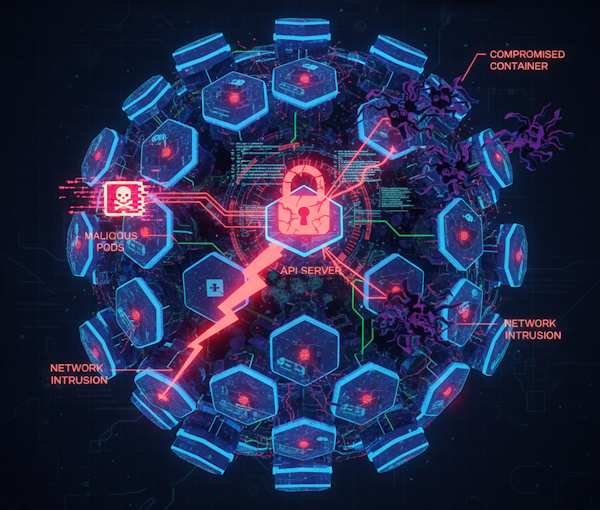
In today's cloud-native landscape, Kubernetes has emerged as the de facto standard for container orchestration, powering mission-critical applications across industries. However, this widespread adoption has made Kubernetes clusters prime targets for sophisticated threat actors. As organizations increasingly migrate their workloads to containerized environments, understanding the attack surface and potential exploitation paths becomes essential for security teams.
This technical deep dive explores the complex attack vectors targeting Kubernetes environments, the methodologies employed by adversaries, and the comprehensive security measures required to protect your infrastructure. Whether you're a security professional, DevOps engineer, or cloud architect, this guide will equip you with the knowledge to identify vulnerabilities and implement robust defenses for your Kubernetes deployments.
Understanding the Kubernetes Attack Surface
Kubernetes presents a multi-layered attack surface that spans from the underlying infrastructure to the application layer. Each component introduces potential vulnerabilities that attackers can exploit to gain unauthorized access, escalate privileges, or compromise the entire cluster.
Control Plane Components
The Kubernetes control plane represents a high-value target for attackers due to its centralized role in managing the cluster. Key components include:
API Server: As the front-end interface for the Kubernetes control plane, the API server processes all REST operations and validates them. Unauthenticated or improperly secured API servers can allow attackers to execute unauthorized commands against the cluster. According to recent research, exposed Kubernetes API servers remain one of the most common entry points for attackers, with thousands of instances discoverable on the public internet.
etcd: This distributed key-value store serves as Kubernetes' backing database for all cluster data, including secrets. Unauthorized access to etcd is equivalent to gaining root access to the entire cluster, as it contains sensitive information such as service account tokens and TLS certificates. Write access to etcd allows attackers to bypass validation mechanisms and potentially create privileged pods.
Scheduler and Controller Manager: While less commonly targeted directly, compromising these components can allow attackers to influence pod placement decisions or manipulate controller behaviors, potentially leading to resource exhaustion or denial of service conditions.
Node Components
Worker nodes execute the containerized workloads and present several attack vectors:
Kubelet: The agent running on each node is responsible for pod lifecycle management. Exposed kubelet endpoints without proper authentication can allow attackers to execute commands within containers, retrieve pod information, or even run arbitrary containers. The kubelet's read-only port (10255) and secure port (10250) are frequently targeted in reconnaissance activities.
Container Runtime: Whether Docker, containerd, or CRI-O, the container runtime represents a critical security boundary. Vulnerabilities in the runtime can lead to container escapes, allowing attackers to break out of container isolation and access the host system.
Node Operating System: The underlying host OS presents traditional attack vectors. Unpatched vulnerabilities, misconfigured services, or weak SSH credentials can provide initial access to the node, which attackers can leverage to pivot to the containers or the broader cluster.
Workload Components
The applications running within Kubernetes introduce their own attack surface:
Container Images: Vulnerable or outdated dependencies within container images are a primary attack vector. According to Microsoft's 2025 threat research, over 60% of container images in production environments contain at least one high-severity vulnerability. Supply chain attacks targeting container registries have also increased, with attackers injecting malicious code into widely used base images.
Application Code: Traditional application vulnerabilities like SQL injection, cross-site scripting, and command injection remain relevant in containerized environments. These can serve as the initial foothold for more sophisticated attacks against the cluster.
Service Accounts: Kubernetes service accounts provide identities for processes running in pods. Overly permissive service account configurations can allow attackers to escalate privileges within the cluster after compromising a single pod.
Common Attack Vectors and Methodologies
Understanding how attackers target Kubernetes environments is crucial for developing effective defenses. The following section outlines prevalent attack vectors observed in real-world incidents.
1. Exposed Kubernetes API Server
The Kubernetes API server is a primary target for attackers seeking to gain control over a cluster. When exposed to the internet without proper authentication and authorization controls, it becomes a significant vulnerability.
Attack Methodology:
- Discovery: Attackers use scanning tools to identify exposed Kubernetes API servers on ports 443, 6443, or 8443.
- Authentication Bypass: They attempt to exploit misconfigured authentication, such as anonymous access or insecure service account tokens.
- Privilege Escalation: Once authenticated, attackers create privileged pods or exploit RBAC misconfigurations to gain cluster-admin privileges.
- Persistence: They establish persistence by creating backdoored deployments or modifying existing ones to maintain access.
In a notable 2025 incident documented by Microsoft, threat actor Storm-1977 (also known as AzureChecker) used password spray attacks against cloud tenants to gain initial access, then leveraged compromised credentials to create over 200 containers for cryptomining operations.
2. Vulnerable Admission Controllers
Admission controllers in Kubernetes validate and potentially modify requests to the API server before they are processed. The recent "IngressNightmare" vulnerability (CVE-2025-1974) highlighted how these components can become attack vectors.
Attack Methodology:
- Targeting Admission Webhooks: Attackers identify clusters using vulnerable admission controllers, particularly those exposed without authentication.
- Configuration Injection: They craft malicious admission review requests that inject arbitrary NGINX configurations into the Ingress NGINX Controller.
- Remote Code Execution: The injected configuration is executed during validation, allowing attackers to run arbitrary code with the controller's privileges.
- Secret Access: With the controller's elevated permissions, attackers can access all secrets across all namespaces, potentially leading to complete cluster takeover.
According to Wiz Research, approximately 43% of cloud environments were vulnerable to the IngressNightmare attack chain, with over 6,500 clusters, including those of Fortune 500 companies, exposing vulnerable admission controllers to the public internet.
3. Container Escape Techniques
Container escape vulnerabilities allow attackers to break out of container isolation and access the underlying host system, representing a severe threat to cluster security.
Attack Methodology:
- Privileged Container Abuse: Attackers target pods running with the privileged flag, which grants extensive capabilities including host device access.
- Kernel Vulnerability Exploitation: They exploit vulnerabilities in the Linux kernel to escape container boundaries.
- Volume Mount Abuse: Sensitive host paths mounted into containers (like /proc, /sys, or /var/run/docker.sock) are leveraged to access host resources.
- Capability Abuse: Containers with excessive Linux capabilities (e.g., CAP_SYS_ADMIN) are exploited to perform privileged operations.
A common technique observed in 2025 involves attackers targeting containers with the Docker socket mounted, allowing them to create new privileged containers on the host and effectively escape the original container's restrictions.
4. Supply Chain Attacks
The container supply chain has become an increasingly attractive target for sophisticated threat actors seeking to compromise multiple organizations through a single vector.
Attack Methodology:
- Compromising Base Images: Attackers inject malicious code into popular base images hosted in public registries.
- Dependency Poisoning: They target package managers and libraries commonly used in container builds.
- Build System Compromise: CI/CD pipelines are compromised to inject malicious code during the build process.
- Typosquatting: Similar-looking package names are registered to trick developers into pulling malicious dependencies.
In 2025, several high-profile supply chain attacks targeted container ecosystems, including a sophisticated campaign that compromised a popular Node.js base image, affecting thousands of downstream applications.
5. Credential and Secret Theft
Kubernetes environments often contain valuable credentials and secrets that attackers actively target to expand their access.
Attack Methodology:
- Service Account Token Theft: Attackers extract service account tokens automatically mounted in pods.
- Secret Enumeration: They exploit RBAC misconfigurations to list and access secrets across namespaces.
- etcd Direct Access: Unencrypted etcd instances are targeted to extract all cluster secrets.
- Environment Variable Scanning: Containers with secrets passed as environment variables are compromised to extract sensitive data.
Microsoft's threat intelligence indicates that 51% of workload identities were inactive in the past year, representing a significant attack surface for credential theft and abuse.
6. Network-Based Attacks
Kubernetes network policies and configurations present various attack opportunities for lateral movement and data interception.
Attack Methodology:
- Default Allow Policies: Attackers exploit the default allow-all network posture to move laterally between pods.
- Service Mesh Vulnerabilities: Misconfigurations in service mesh implementations like Istio are leveraged to bypass network controls.
- DNS Poisoning: They manipulate Kubernetes DNS to redirect traffic to malicious endpoints.
- Man-in-the-Middle: In clusters without mutual TLS, attackers intercept unencrypted pod-to-pod communication.
The absence of network policies remains one of the most common security gaps in Kubernetes deployments, with research indicating that over 70% of clusters lack properly configured network segmentation.
7. Misconfigured Pod Security
Pod security misconfigurations provide attackers with opportunities to escalate privileges and compromise the cluster.
Attack Methodology:
- Privileged Container Deployment: Attackers create pods with the privileged flag enabled.
- HostPath Volume Mounts: They configure pods to mount sensitive host directories.
- Capability Abuse: Excessive Linux capabilities granted to containers are exploited.
- RunAsUser Exploitation: Pods configured to run as root or with specific user IDs are leveraged for privilege escalation.
According to Cpluz research, misconfigured Pod Security Standards remain one of the top seven Kubernetes security threats in 2025, providing attackers with clear paths to gain escalated privileges.
Comprehensive Kubernetes Security Best Practices
Securing Kubernetes requires a defense-in-depth approach that addresses vulnerabilities across the entire stack. The following best practices provide a framework for hardening your Kubernetes environments against sophisticated attacks.
Securing the Control Plane
API Server Security:
- Implement strong authentication using OpenID Connect (OIDC) or cloud provider IAM integration rather than relying on certificate-based or token-based authentication.
- Enable audit logging with a focus on authorization failures, which may indicate attempted privilege escalation.
- Use network policies or cloud provider firewalls to restrict API server access to trusted networks only.
- Implement Just-In-Time (JIT) access for administrative operations using conditional access policies.
etcd Security:
- Enable encryption at rest for etcd to protect sensitive data stored in the cluster.
- Implement mutual TLS authentication between the API server and etcd.
- Isolate etcd behind a firewall that only allows access from API server instances.
- Regularly back up etcd data and secure the backups with encryption.
Control Plane Component Hardening:
- Run control plane components with the minimum required privileges.
- Implement network segmentation to isolate control plane components from worker nodes and external networks.
- Regularly update Kubernetes to the latest stable version to address known vulnerabilities.
- Use separate service accounts with minimal permissions for each control plane component.
Securing Worker Nodes
Node Hardening:
- Implement a minimal OS installation with only required components to reduce the attack surface.
- Apply security patches promptly to address kernel and container runtime vulnerabilities.
- Disable unnecessary kernel modules using modprobe blacklisting, particularly for modules like DCCP and SCTP that have had security vulnerabilities.
- Implement host-based intrusion detection and file integrity monitoring.
Kubelet Security:
- Enable authentication and authorization for the Kubelet API.
- Disable the read-only port (10255) which allows unauthenticated access.
- Configure the Kubelet to verify that pods are coming from the API server using the --enforce-node-allocatable flag.
- Implement the NodeRestriction admission controller to limit kubelet permissions.
Container Runtime Security:
- Configure the container runtime with secure defaults, such as user namespace mapping and seccomp profiles.
- Implement runtime security monitoring to detect anomalous container behavior.
- Consider using container sandboxing technologies like gVisor, Kata Containers, or Firecracker for high-security environments.
- Regularly audit container runtime configurations for security best practices.
Workload Security
Image Security:
- Implement vulnerability scanning in your CI/CD pipeline to detect and remediate vulnerabilities before deployment.
- Use minimal base images like distroless or scratch to reduce the attack surface.
- Implement image signing and verification to ensure image integrity.
- Maintain a private registry with access controls and scan images regularly for newly discovered vulnerabilities.
Pod Security Standards:
- Enforce the Restricted Pod Security Standard for production workloads, which implements pod hardening best practices.
- Disable privileged containers and limit capabilities to only those required.
- Prevent containers from running as root using the runAsNonRoot security context setting.
- Configure read-only root filesystems to prevent runtime modifications.
Secret Management:
- Use external secret management solutions like HashiCorp Vault or cloud provider secret managers instead of Kubernetes Secrets for sensitive data.
- If using Kubernetes Secrets, ensure they are encrypted at rest.
- Mount secrets as volumes rather than exposing them as environment variables.
- Implement secret rotation policies and audit secret access regularly.
Network Security
Network Policies:
- Implement a default deny policy for all namespaces and explicitly allow required communication.
- Segment network traffic between application tiers and enforce the principle of least privilege.
- Use namespace isolation to prevent cross-namespace communication where not required.
- Regularly audit and test network policies to ensure they are functioning as expected.
Service Mesh Security:
- Implement mutual TLS (mTLS) between services to encrypt pod-to-pod communication.
- Use service mesh authorization policies to control service-to-service communication at a granular level.
- Implement traffic monitoring and anomaly detection within the service mesh.
- Regularly update the service mesh components to address security vulnerabilities.
Ingress and Egress Controls:
- Secure ingress controllers with proper TLS configuration and authentication.
- Implement web application firewalls (WAFs) for ingress traffic to protect against application-layer attacks.
- Control egress traffic to prevent data exfiltration and command-and-control communication.
- Regularly audit exposed services and limit internet-facing endpoints to only those necessary.
Authentication and Authorization
Role-Based Access Control (RBAC):
- Implement the principle of least privilege for all service accounts and users.
- Use namespace-scoped roles and role bindings instead of cluster-wide permissions where possible.
- Avoid wildcard permissions and explicitly define allowed resources and verbs.
- Regularly audit RBAC configurations to identify and remediate excessive permissions.
User Authentication:
- Integrate with enterprise identity providers using OIDC for centralized authentication and authorization.
- Implement multi-factor authentication for all user access to the Kubernetes API.
- Avoid static credentials and implement short-lived tokens with automatic rotation.
- Audit authentication events and alert on suspicious access patterns.
Service Account Management:
- Create dedicated service accounts for each application with minimal required permissions.
- Disable automatic token mounting where not required using automountServiceAccountToken: false.
- Implement token audience restrictions to prevent token reuse across services.
- Regularly rotate service account credentials and audit their usage.
Monitoring and Detection
Audit Logging:
- Enable comprehensive audit logging for the Kubernetes API server.
- Collect logs from all cluster components, including control plane, nodes, and applications.
- Implement a centralized logging solution with retention policies that meet compliance requirements.
- Develop alerts for suspicious activities such as privilege escalation, unauthorized access, and unusual API calls.
Runtime Security Monitoring:
- Implement container runtime security tools to detect anomalous behavior, such as unexpected process execution or file system modifications.
- Monitor network traffic between pods to identify lateral movement attempts.
- Deploy host-based intrusion detection on worker nodes to detect container escape attempts.
- Implement behavioral analytics to identify deviations from normal operation patterns.
Threat Intelligence Integration:
- Incorporate threat intelligence feeds specific to container and Kubernetes vulnerabilities.
- Implement automated scanning for known indicators of compromise (IoCs) in your environment.
- Participate in security communities to stay informed about emerging threats and attack techniques.
- Regularly conduct threat hunting exercises to proactively identify potential compromises.
Incident Response and Recovery
Incident Response Planning:
- Develop Kubernetes-specific incident response playbooks that address common attack scenarios.
- Implement automated containment procedures, such as scaling suspicious pods to zero or isolating affected nodes.
- Establish clear roles and responsibilities for responding to Kubernetes security incidents.
- Regularly test incident response procedures through tabletop exercises and simulations.
Backup and Recovery:
- Implement regular backups of etcd data and critical application state.
- Test restoration procedures to ensure they function as expected.
- Maintain golden images for rapid redeployment of clean environments.
- Document dependencies between components to facilitate coordinated recovery.
Post-Incident Analysis:
- Conduct thorough post-incident analysis to identify root causes and improvement opportunities.
- Update security controls based on lessons learned from incidents.
- Share sanitized incident information with the broader security community when appropriate.
- Regularly review and update incident response procedures based on emerging threats.
Emerging Threats and Future Considerations
As Kubernetes continues to evolve, new security challenges and attack vectors will emerge. Security teams should stay informed about the following trends:
AI-Powered Attacks: Machine learning algorithms are increasingly being used to identify vulnerabilities and automate attacks against Kubernetes clusters. Defenders must similarly leverage AI for detection and response.
Quantum Computing Threats: As quantum computing advances, current cryptographic protections may become vulnerable. Organizations should begin planning for post-quantum cryptography in their Kubernetes environments.
Edge Computing Challenges: The expansion of Kubernetes to edge environments introduces new security considerations, including physical security risks and limited resources for security controls.
Supply Chain Security: The software supply chain will continue to be a primary target for sophisticated attackers. Organizations must implement comprehensive software bill of materials (SBOM) and verification throughout the container lifecycle.
Kubernetes security requires a comprehensive approach that addresses vulnerabilities across the entire stack, from infrastructure to application code. By understanding the attack surface, implementing defense-in-depth strategies, and staying informed about emerging threats, organizations can significantly reduce the risk of successful attacks against their Kubernetes environments.
The security landscape for Kubernetes is constantly evolving, with new vulnerabilities and attack techniques emerging regularly. Security teams must maintain vigilance, continuously update their defenses, and foster collaboration between security, development, and operations teams to effectively protect containerized workloads.
By implementing the best practices outlined in this article and adapting them to your specific environment, you can build a robust security posture that enables the safe adoption of Kubernetes while mitigating the risks associated with this powerful but complex technology.
Remember that security is a journey, not a destination. Regular assessment, continuous improvement, and a commitment to security as a shared responsibility are essential for maintaining the integrity and confidentiality of your Kubernetes deployments in an increasingly hostile threat landscape.
