
Managed Control Plane (MCP) for AI Agents: The Architectural Backbone of Enterprise Agentic AI

The Evolution of AI Infrastructure
As artificial intelligence transitions from passive tools to autonomous agents capable of reasoning, planning, and executing complex tasks, organizations face a critical architectural challenge: how can these AI agents securely and reliably interact with enterprise data, tools, and systems? The traditional approach of building one-off, custom-coded integrations for each AI application and data source has proven unsustainable, creating technical debt and security vulnerabilities while limiting scalability.
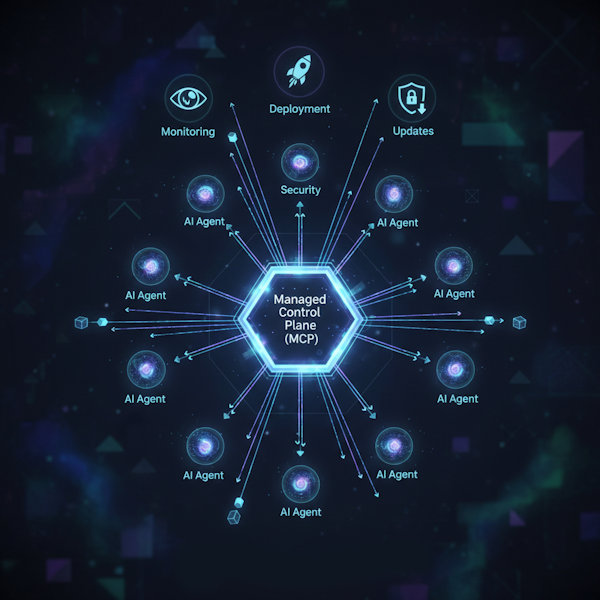
Enter the Managed Control Plane (MCP) for AI agents—a transformative architectural layer that standardizes, governs, and orchestrates how AI agents connect to and interact with the world around them. Drawing inspiration from cloud-native concepts like Kubernetes, which revolutionized container orchestration, MCP provides the foundational infrastructure for building secure, scalable, and interoperable agentic AI systems.
This article explores the technical architecture, implementation considerations, and strategic advantages of adopting a Managed Control Plane for AI agents in enterprise environments.
Understanding the Model Context Protocol (MCP)
At the core of the Managed Control Plane concept is the Model Context Protocol (MCP), an open protocol developed by Anthropic that standardizes how AI models and agents interact with external tools, data sources, and other agents. Often described as "Kubernetes for language models" or the "USB-C port for AI applications," MCP provides a common language that decouples AI agents from the specific implementation details of the tools they need to use.
The MCP architecture follows a client-server model that cleanly separates the concerns of the AI application from the tool provider:
Core Components of MCP Architecture
-
MCP Client: Resides within the AI application (the "agent host"). This could be a development environment like VSCode with GitHub Copilot, a conversational interface like Claude Desktop, or a custom-built agentic framework. The client translates an agent's intent to use a tool into a structured request and sends it to the appropriate MCP server.
-
MCP Server: Acts as an intermediary between the MCP client and the actual tool, database, or API. It functions as an "adapter," receiving standardized requests from any client and translating them into the specific commands or API calls required by the underlying system. For example, an MCP server for a SQL database would translate a natural language request into a valid SQL query, execute it, and return the results in the standardized MCP format.
-
Communication Protocol: MCP primarily uses JSON-RPC 2.0 for request-response cycles. For scenarios requiring real-time updates, such as streaming long responses or notifying the client of a change in tool availability, MCP can leverage Server-Sent Events (SSE).
This standardized architecture enables a modular, plug-and-play approach to AI system development. New models, tools, or data sources can be added into the agent ecosystem via the control plane, rather than building one-off pipelines for each integration.
Key Capabilities of a Managed Control Plane
A robust Managed Control Plane for AI agents extends beyond basic protocol implementation to provide comprehensive orchestration, governance, and operational capabilities:
Intelligent Routing and Orchestration
The MCP directs incoming queries or tasks to the appropriate AI model, agent, or tool pipeline. It can load-balance across model instances and chain together multiple steps as needed. This dynamic routing is based on semantics and context rather than just URLs, allowing the system to handle complex multi-step agent workflows in real time.
For example, a query might first be routed to an MCP server for a retrieval model to gather relevant documents, with the output then being passed to a different agent or tool for summarization or analysis. This orchestration capability enables sophisticated workflows that would be difficult to implement with traditional integration approaches.
Tool and Data Integration
Modern AI agents need to interact with external tools, APIs, and data sources to be truly useful. The MCP serves as a bridge between AI and these external resources, providing a unified interface for tool discovery and invocation.
Rather than hard-coding integrations for every service, the control plane provides a standardized way for AI to request an action (e.g., "schedule a meeting") and translates that into the appropriate API calls behind the scenes. This lets AI agents go beyond text responses to actually execute tasks, without the model itself needing to know the details of each API.
A powerful pattern emerging in the MCP ecosystem is dynamic tool discovery and loading. An agent can start with a minimal set of core tools and, based on the task at hand, discover and enable new, specialized toolsets on the fly. This keeps the operational context clean and efficient while providing access to a wide range of capabilities.
Fine-Grained Permissions and Governance
With great power comes the need for control. An MCP enforces policies, access controls, and permissions on what each AI agent or model can do. This governance layer is critical for enterprise adoption, as it ensures that AI agents operate within defined boundaries and comply with organizational policies.
The MCP can restrict certain tools or data to particular agents, apply role-based access control for enterprise data, or set usage policies like rate limits or allowed hours of operation. Mature MCP architectures include policy engines to decide who or what is authorized to use a model or tool, integrating with identity systems (RBAC/ABAC) and maintaining audit logs of all requests.
Because the MCP server acts as a centralized gateway for tool use, it provides a natural chokepoint for logging and auditing. All agent actions, tool invocations, and data exchanges can be logged, creating a comprehensive audit trail that is critical for security forensics, regulatory compliance, and understanding agent behavior.
Stateful Execution and Memory Management
Real-world agentic systems are often long-running or multi-turn—they carry context from one interaction to the next. An MCP helps manage this state and memory so that AI agents can maintain context over time.
This might involve storing conversation history, intermediate results, or long-term knowledge in a database or cache accessible to the agents. For instance, an agent may query a knowledge base, get some data, then use that data in a follow-up reasoning step; the control plane can hold that intermediate state and supply it when needed.
By providing a common memory substrate, the MCP enables agents to be stateful and context-aware across their workflow, rather than treating each request in isolation. This is essential for building coherent, personalized AI experiences that maintain continuity across interactions.
Observability and Monitoring
In a complex agent system, robust observability is essential to understand and trust what's happening. An MCP provides centralized logging, tracing, and monitoring of all interactions between users, agents, models, and tools.
This means capturing each step of a multi-agent conversation, the inputs and outputs of each model call, any tool invocations, and performance metrics like latency or token usage. Such end-to-end observability lets developers and operators trace how a query flowed through various agents and backends.
A good control plane will offer dashboards for usage (How often is each model being called? How many tickets did the AI assistant close this week?), alerting on anomalies, and logs for debugging errors or misbehaviors. This unified view is essential for reliable operations and continuous improvement of AI agents.
Versioning and Lifecycle Management
As AI models and prompts evolve, the MCP handles model version control, rollout strategies, and experimentation. Just as a DevOps team uses a control plane to deploy new microservice versions gradually, an AI team uses the MCP to deploy new model versions or agent configurations safely.
The control plane might support A/B testing a new model, shadow testing it behind the scenes, or canary releasing an updated agent to a small percentage of users. It also keeps a model registry of all available models/agents, their versions, and metadata (ownership, training data, etc.), ensuring that when an agent requests a certain capability, the right model version is used.
Security Considerations for MCP Implementation
The adoption of MCP introduces unique security challenges that require careful consideration. Unlike conventional applications with defined boundaries, MCP builds dynamic pathways between AI systems and enterprise resources. A single compromised MCP server doesn't just breach one system but potentially the entire IT infrastructure.
Authentication and Authorization
While OAuth 2.0 and OpenID Connect lay the foundations for identity verification, MCP authentication policies themselves become high-value targets since they're written as code. This means they require version control, audit trails, and signature verification to prevent tampering.
The MCP should integrate with enterprise identity systems to enforce role-based access control (RBAC) and attribute-based access control (ABAC). Every action should be authorized based on the user's identity, the specific operation being attempted, and relevant organizational policies.
Transport Security
Transport security is crucial and demands mutual TLS (mTLS) communications. This bidirectional verification ensures that compromised clients can't masquerade as legitimate services. Best practices dictate that when MCP servers become unavailable, systems need predetermined fail-safe behaviors—typically "fail closed" rather than "fail open" to prevent security breaches.
Supply Chain Security
Given MCP's decentralized nature, supply chain security can be especially complex. Without a central authority enforcing security standards, organizations may encounter varying code quality and inconsistent patching across implementations.
The solution is to implement internal trust registries that treat unvetted MCP servers like unknown software from the internet. Organizations should establish a process for vetting and approving MCP servers before they're deployed in production environments.
Real-Time Policy Enforcement
One of the most powerful security capabilities of MCP is real-time policy enforcement. Instead of relying on post-incident forensics, organizations can implement policies that evaluate every request based on identity, environment context, and the specific action being attempted.
For example, when an AI agent requests access to customer data, the MCP can check not only whether the agent has the necessary permissions but also whether the request is consistent with the agent's normal behavior pattern. If the agent has attempted several suspicious operations in the past hour, the MCP might block the request or require additional authorization.
Enterprise Use Cases for MCP
The adoption of MCP enables a wide range of enterprise use cases that would be difficult or impossible to implement with traditional integration approaches:
Multi-Agent Systems
As AI solutions grow in complexity, it often becomes impractical or inefficient for a single, monolithic agent to handle them. This has led to the rise of Multi-Agent Systems (MAS), where tasks are decomposed and distributed among a team of specialized micro-agents.
MCP provides the architectural backbone for these multi-agent systems, enabling:
-
Specialization: Each agent can be an "expert" in a specific domain or task, such as a "researcher agent" skilled at data gathering, an "analyst agent" proficient in data processing, or a "writer agent" that excels at synthesizing information into coherent reports.
-
Parallelism: Multiple agents can work on different sub-tasks simultaneously, dramatically reducing the time required to complete a complex goal.
-
Resilience and Accuracy: Smaller agents tend to perform better and make fewer mistakes. In a well-designed multi-agent system, the failure of a single agent does not necessarily cause the entire system to crash; other agents can adapt, or the task can be rerouted.
Enterprise Knowledge Access
One of the most significant challenges in deploying LLMs in the enterprise is their propensity to "hallucinate"—to generate plausible but factually incorrect information. MCP enables Retrieval-Augmented Generation (RAG) as a service, allowing any MCP-compatible agent to perform powerful semantic search and receive summarized, factually-grounded answers based on a specific, curated corpus of data.
For example, an MCP server for a vector database like Vectara can expose tools that allow agents to:
- Perform semantic search over enterprise knowledge bases
- Generate concise, summarized responses to user queries based on retrieved documents
- Provide source attribution for generated content
This enables developers to build agents that can confidently answer questions about product documentation, internal knowledge bases, or financial reports without inventing facts.
Workflow Automation
MCP enables AI agents to automate complex workflows that span multiple systems and applications. By providing a standardized interface for tool invocation, MCP allows agents to:
- Create and update tickets in issue tracking systems
- Schedule meetings and send calendar invitations
- Generate reports and distribute them to stakeholders
- Process and approve requests based on organizational policies
These automation capabilities can significantly improve operational efficiency and reduce the burden of routine tasks on human employees.
Implementation Best Practices
Organizations looking to implement a Managed Control Plane for AI agents should consider the following best practices:
Start Small and Pilot
Begin with pilot projects in low-risk areas where agent-to-agent communication can demonstrably reduce latency or manual effort. For example, integrating MCP to provide real-time CRM context to support agents.
Embrace Open Standards
Prioritize open-standard MCP implementations to avoid vendor lock-in and ensure future flexibility. This allows for easier integration of new models, APIs, and microservices as they become available.
Implement a Context Layer
Develop a context repository to maintain evolving state information, enabling agents to coordinate actions with continuity and relevance. This context layer should understand temporal signals, task relevance, and user intent.
Define Clear Governance Policies
Establish clear policies for what actions agents can perform, what data they can access, and under what conditions. These policies should be implemented as code and version-controlled like any other critical system component.
Implement Comprehensive Monitoring
Deploy robust monitoring and observability tools to track agent behavior, performance, and compliance with policies. This monitoring should include both technical metrics (latency, token usage) and business metrics (task completion rates, user satisfaction).
Plan for Failure Modes
Define how the system should behave when components fail or become unavailable. This includes establishing fallback mechanisms, graceful degradation strategies, and clear error handling procedures.
Establish Human Oversight
Implement mechanisms for human oversight and intervention when needed. This might include approval workflows for high-risk actions, escalation paths for complex decisions, and feedback loops for continuous improvement.
The Future of MCP: Agent-to-Agent Communication
While MCP is foundational for agent-tool interaction, the ecosystem is already evolving to address a more complex challenge: agent-to-agent collaboration. This has led to the emergence of the Agent-to-Agent (A2A) protocol as a complementary standard to MCP.
While MCP standardizes how a reasoning agent interacts with its tools, A2A standardizes how a smart agent interacts with another smart agent. The communication is collaborative and involves more complex primitives like discovering another agent's capabilities, delegating high-level tasks, negotiating responsibilities, and sharing context.
This forward-looking vision points to a new architectural paradigm for the enterprise: the "Agentic AI Mesh"—where AI applications are a composable, distributed, and governed framework that integrates a diverse ecosystem of both custom-built and third-party agents.
This layered, protocol-driven architecture is the key to building enterprise AI systems that are scalable, resilient, and most importantly, easy to evolve and improve. It allows components to be swapped out and upgraded independently, preventing vendor lock-in and future-proofing the organization's AI investments.
Strategic Implications of MCP Adoption
The adoption of a Managed Control Plane for AI agents is not merely a tactical technical upgrade. It is a strategic architectural decision that lays the groundwork for a new generation of software—one that is not monolithic and human-driven, but distributed, collaborative, and intelligently autonomous.
For enterprise leaders and architects planning for the future, embracing this open standard offers several strategic advantages:
-
Interoperability: MCP enables seamless integration of different AI models and tools without extensive custom coding, reducing vendor lock-in and allowing organizations to leverage best-of-breed components.
-
Security and Governance: MCP provides fine-grained control over agent access to tools, tasks, and data, ensuring predictable and explainable AI behavior while maintaining compliance with regulatory requirements.
-
Scalability: The modular architecture of MCP allows organizations to scale their AI initiatives without a linear increase in management overhead, making it possible to deploy and manage fleets of specialized agents across the enterprise.
-
Adaptability: MCP enables organizations to easily upgrade and replace AI components (e.g., new LLMs) without disrupting the overall architecture, ensuring that AI systems can evolve with changing business needs and technological advancements.
-
Operational Efficiency: By standardizing the integration pattern, MCP reduces the time and effort required to connect AI agents to enterprise systems, accelerating the deployment of new AI capabilities and reducing operational costs.
As AI continues to transform business operations, the organizations that establish a robust architectural foundation for agentic AI will be best positioned to leverage its full potential. The Managed Control Plane, with MCP at its core, provides that foundation—enabling the secure, scalable, and governed deployment of AI agents across the enterprise.
